Why choose yoga therapy practice for wellness?
The earlier article on yoga therapy highlighted the importance of equilibrium or homeostasis for health and the role yoga therapy practice can play, to keep you healthy! The great thing about yoga therapy practice is that it is an easy-to-use tool for a healthy life, because:
- It is easy to do, you can practice it even when you grow old or are recovering from illness.
- Yoga therapy integrates seamlessly into your life, so the lifestyle changes required are minimum.
- You don’t need to spend big money on equipment. All you need is a mat! Therefore, yoga therapy practice is universal in capability.
- Yoga therapy is an open system. Once you learn the basics, you can develop it in any direction you wish.
- Yoga is a value system, means it will only add value to your life, and its benefits are dependent only on your efforts.
So, yoga therapy is a “small investment, large return” tool which the ancient masters of Bharat presented free to mankind.
Yoga therapy practice – Key contributions by Yogacharya Sundaram:
With yoga becoming popular around the world, many yoga centers have mushroomed around the world. So, the good news is that learning yoga is no longer a difficult process.
Since information and teachers are universally available, all you need to do is practice exercises (asana) that strengthen every part of the body. Therefore, once you learn the correct set of asanas, all you need to do is ensure that you practice them correctly and regularly.
Many schools recommend various sets and routines of asana. Also, various ancient texts recommend different routines. This can easily confuse the aspiring practitioners.
In around 1921, Yogacharya Sundaram developed a set of asana routines, which, when coupled with diet and meditation, support rejuvenation from illness and post-illness recovery. This was the first attempt by any person to systematise yoga therapy, and the principles have not changed.
Additionally, Sundaram detailed his views on Yoga Therapy, first in his Tamil book “Yoga Sigicchai” in 1952. Subsequently, this book was translated into English in 2004 as Sundaram’s Yogic Therapy.
Sundaram’s work was the result of over 20 years of research into the application of asana for freedom from disease, in an era when doctors were hard to find and the modern diagnostics were not available.
Asana as a tool for yoga therapy practice:
The classical definition from Patanjali’s yoga-sutra (2.46) of asana is स्थिरसुखमासनम् ॥४६॥ or sthira-sukham-asanam.
The rough translation of this Sanskrit text is, sthira (static or stable) + sukham (comfortable or pleasant) + asanam (posture). Asana therefore needs to comply with the following rules;
- It should be static, not vigorous or dynamic.
- It should be easy to perform, and not stressful.
- Is should be at one place, with minimal movement.
- Yogacharya Sundaram introduced a breathing routine. This increases quality of air intake and awareness (prajna).
Therefore, asana is a static exercise where the body movement is minimal and the focus is on holding the pose, to maximise impact and movement of prana in a specific area of the body. This requirement will result in the yoga therapy practitioner remaining close to the state of homeostasis, which is a condition of the body remaining in balance and equilibrium. This is what makes yoga therapy practice a universal tool for maintaining and reclaiming health at any age or condition.
Asana is supported by kriya and bandha
Kriya (dynamic exercises): Exercises which increase flexibility of the body. Suryanamaskara and nauli fall into this classification.
Bandha (holding position): This exercise is far more complex than the above two types, and focuses on smooth flow of prana in and around that area of focus. Uddiyana falls into this classification.
School of Yoga’s note to the readers on yoga therapy practice:
Use of Sanskrit words – there is always a desire to make approximations to make the subject more appealing and less forbidding. However, that has been avoided in this site. The reason is that translations are at best approximations which may not present the truth to the reader. However, availability of both, the classical Sanskrit word and its translation will allow the reader to come to an informed judgement. This might make the page slightly heavy for reading, but one could skip the Sanskrit word and move to the translation.
Many teachers get started with warm up asana and beginner asanas. Yogacharya Sundaram never really did that. In fact, he got people started on the below mentioned asana sequence as soon as he could get them to flex. This is the right approach because, by definition asanas are static position, and the warm up aspect is already embedded in them.
The most appropriate set of asanas and their correct sequence has been detailed below.
School of Yoga’s asana recommendations for yoga therapy practice:
- The asana sequence given below covers every aspect of human physiology, therefore is a remedy for most common ailments.
- The asana sequence can be mixed and matched to cover specific requirements of any ailment.
- For normal, healthy people, it is recommended to perform as many of these asanas as possible for a healthy life.
- Asana should be coupled with pranayama and meditation or dhyana for maximum benefit.
- The detailed instructions are given in the links to the asana.
The recommended asana sequence for yoga therapy practice is:
|
Sl. No. | Asana (click on the asana for detailed process) |
Meaning / Translation |
| 1 | Padmasana | Lotus Pose |
Reverse bending asana (click on the asana for detailed process) | ||
| 2 | Bhujangasana | Cobra Pose |
| 3 | Shalabhasana | Locust Pose |
| 4 | Dhanurasana | Bow Pose |
Forward bending asana for upper and lower abdomen (click on the asana for detailed process) | ||
| 5 | Pavanamuktasana | Air relieving pose |
| 6 | Paschimottanasana | Torso stretch pose |
| 7 | Halasana | Plough pose |
| 8 | Mayurasana | Peacock pose |
Upper region asana – focus on neck, shoulders, lungs and head (click on the asana for detailed process) | ||
| 9 | Sarvangasana | Pan-body pose |
| 10 | Matsyasana | Fish pose |
| 11 | Shirshasana | Head stand |
| 12 | Sundara-viparitakarani | Inverted triangle pose |
Abdominal asana (click on the asana for detailed process) | ||
| 13 | Ardha-matsyendrasana | Half fish middle pose |
| 14 | Yoga-mudra | Yoga seal |
| 15 | Uddiyana-bandha | Abdominal suction |
Standing asanas (click on the asana for detailed process) | ||
| 16 | Padahastasana | Hand to toe pose |
| 17 | Trikonasana | Triangle pose |
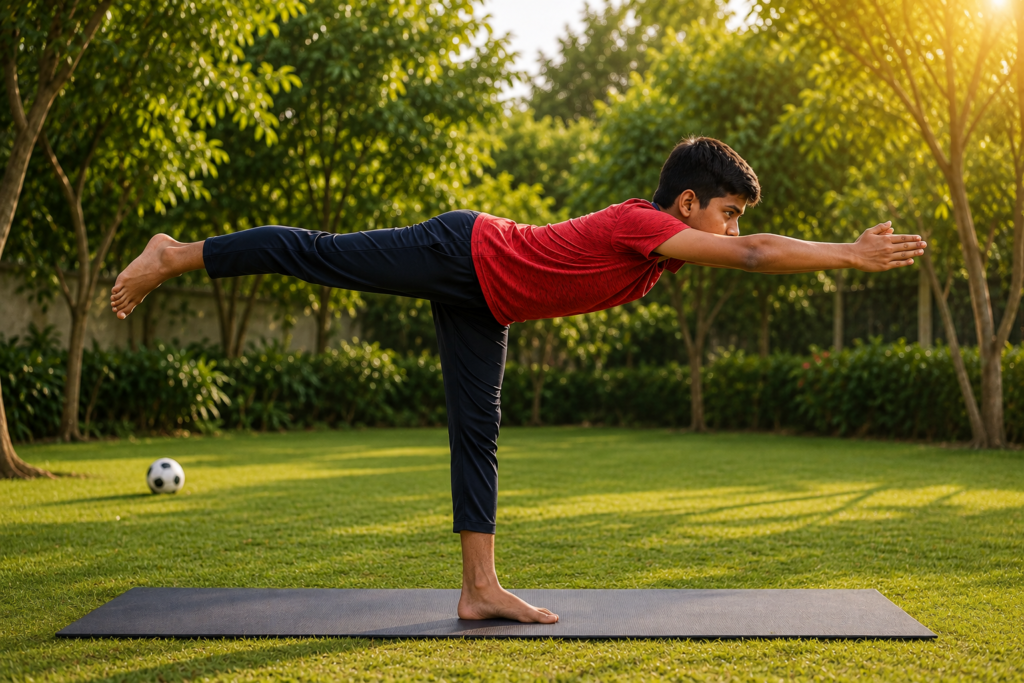
| 18 | Virabhadrasana | Gracious warrior pose |
Body reset asana (click on the asana for detailed process) | ||
| 19 | Shavasana | Corpse pose |
This should be followed by suryanamaskara-kriya (click on the kriya for detailed process).
Pranayama as a tool for yoga therapy practice:
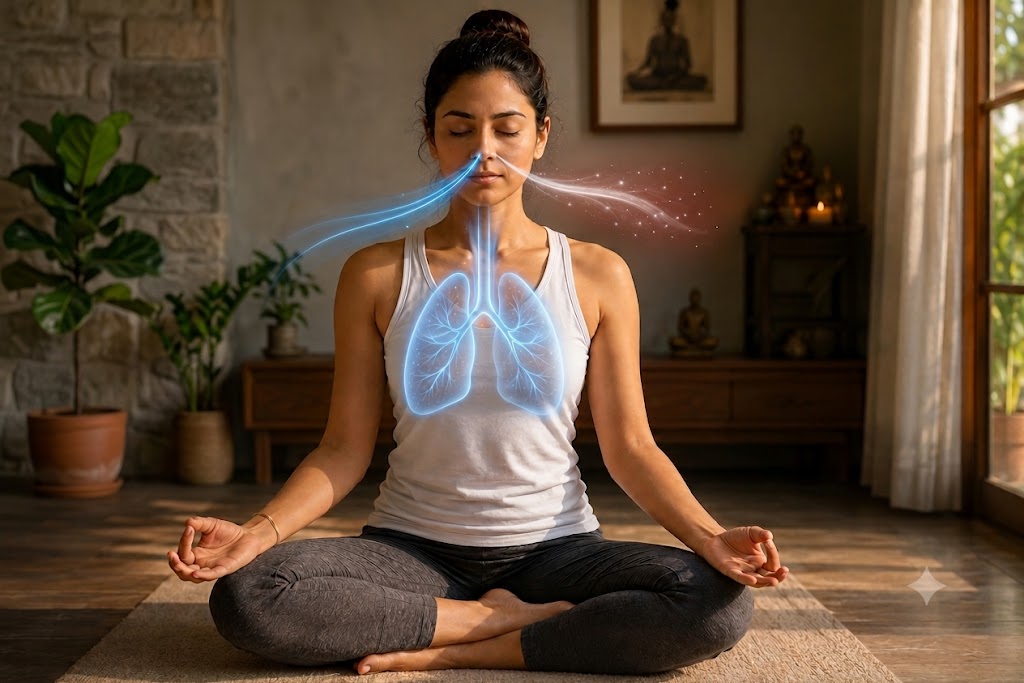
Pranayama breathing is an important tool for yoga therapy practice.
There are many pranayama techniques, such as sama-vritti (even breathing), visama-vritti (uneven breathing), sitali (tongue curled between the lips), sitkarin (tongue curled between the teeth), udgita (pranayama with chanting), etc.
However, a pranayama cycle comprising the following schedule is adequate and recommended to meet daily practice requirements.
Pranayama | Cycles |
Benefits |
| Nadi shuddhi with kumbhaka | 5-20 | Overall lung functioning, balancing of left/ right brain, balancing of ida & pingala nadis |
| Bhastrika | 5-10 | Increases lung capacity, transfer capacity, activates dead alveoli, increases lung elasticity and strengthens diaphragm. |
| Kapalabhati | 20-50 | Increases volumetric efficiency of the lungs, strengthens the trachea and all pulmonary vessels. Strengthens the abdominal walls. |
| Ujjayi | 5-20 | Improves the autonomous nervous system, the heart, clears ears and sinuses. |
| Bhramari | 5-10 | Opens the nasal passages, clears all the sinuses, removes mucous. |
| Nadi shuddhi | 5 | Close with nadi shuddhi to reset the system. |
Additionally, it is important to practice pranayama on an empty stomach and in a clean room with the windows open. Pranayama done after asana is more effective, as the entire body has already been energised and optimized.
Lastly, don’t forget to keep your weight in the correct range and get adequate sleep.

Meditation or dhyana as a tool for yoga therapy practice:
Meditation or dhyana is an integral tool for yoga therapy practice and overall wellness.
There are many techniques of meditation, but the simplest of all requires the following steps to be followed;
- Sit comfortably.
- Let your body relax from head to toe.
- Become aware of your breathing.
- Observe your breath at any one place along the entire path of the breath.
- Be still. Stop resisting.
- Seek the silence which occurs between breathing in & out.
- Stay in the silence.
- Allow the consciousness (citta) to drift and keep bringing it back to the silence slowly. This will take effort.
Concluding note on yoga therapy practice:
To summarise, staying healthy is easy. All it requires is altering some aspects of one’s lifestyle. Though the steps sound easy, bringing habits under control will require effort. Over time, one will achieve success.