What is yoga therapy?
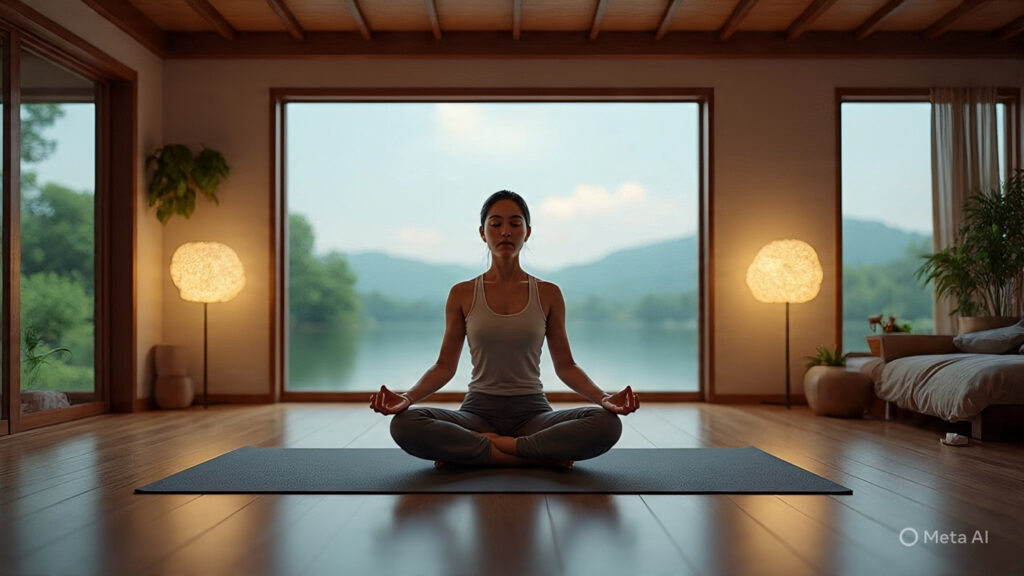
Yoga Therapy is the technique of using principles of yoga for better physical, psychological, and spiritual health.
What are the elements of yoga therapy?
Yoga therapy is the natural process of healing for improving health. It primarily consists of 5 elements – asana (postures), pranayama (breathing), dhyana (meditation), mitahara (diet control), and sleep (nidra).
Anyone can do it! It’s easy and simple and only requires common sense as well as a willingness to try.
Is yoga therapy safe?
We know our bodies best. So, the best solutions for health are resident within us. However, we are also exposed to stress and anxiety. Consequently, we are prone to making mistakes. So, to make yoga therapy completely safe and to derive complete benefits from the practice, it is important that we work closely with our doctors and yoga specialists.
Once we get the hang of what works for our bodies, we can push the envelope and get the best out of yoga therapy. The catch phrase that best explains yoga therapy is, ‘with caution, be bold’.
Concluding, if you are in good health, then yoga therapy will help to build a strong foundation for a healthy life. If you are ill, then yoga therapy can help you recover.
What are the risks of yoga therapy?
Yoga therapy is reasonably safe because it uses everyday tools and is centered around your body and lifestyle. The only thing that a practitioner must keep in mind is to take one step at a time, get a modicum of experience as well as expertise, and then move forward. Also, it is important that the yoga therapy practice is done under supervision, so that mistakes are caught in time.
What are the benefits of yoga therapy?
Yoga therapy works with nature and provides a solution within the operating capabilities of the body. This makes it a great tool for people recovering from illness and in post- operative care.
Since these principles are valid for modern lifestyles and accommodate various cross-cultural biases, the application is universal.
Yoga Therapy helps to retain the body’s psychosomatic balance:

When a person is in physical and psychological equilibrium, there is a feeling of peace and well-being. This is also called a state of “homeostasis”.
Therefore, homeostasis is that condition when the body performs within the parameters it is supposed to.
For example: A car engine is supposed to run at a particular temperature or oil pressure range. Similarly, the body should operate in a physical state which keeps its operating parameters within an optimum range. For example, body temperature should be between 36.1 to 37.2 degree centigrade or blood pressure should be around 120/ 80 etc. There are many such parameters. Generally, any disturbance in one or more parameters is an indication that the body is moving out of the state of homeostasis or equilibrium.
Factors which affect homeostasis
When homeostasis is disturbed, illness occurs. This could be physical – cold, flu, or something more serious; or psychological – like stress, which also affects the body.
If you know the factors, you can control them better and live a healthier life it is as simple as that!
What affects homeostasis at a personal level?
- Age – The ageing process is natural and irreversible, driven by multiple factors. One may not be able to stop illnesses from occurring, but one can do a lot to ensure that the quality of life is balanced and illness is minimised.
- Illness – Poor health disturbs homeostasis because the body’s defense mechanism is activated to protect it. This results in a disturbance within the body which consequently upsets the balance (homeostasis), as the body fights back the disease.
- Lifestyle – Habits of youth seldom leave easily; after all, they occurred when times were good. Therefore, the ability to change any of these habits diminishes with age. Even if one were to be able to kick the habit, for equilibrium to be re-established, the residue needs to be purged from the body.
- Expectation – Change results in stress. Stress is directly related to our ability to cope with stimulus. But, coping action is driven by our expectations and ability to manage outcome. In the pre-internet and entertainment era, sources of stimuli were few and predictable. This allowed us to accept change and cope with the effects of stimuli with greater ease. Also, communities were smaller and more intimate, allowing people to assist each other in coping with the fallout of stress situations, which were mostly related to life events, such as death and disease. Today, these factors have become more complicated, as stimulus has become unpredictable, which requires greater capability for coping.
What affects homeostasis at a societal level?
- Often, we find it easy to control ourselves, but find that society is difficult to handle.
- Our ability to work effectively in society is important as it determines our performance, health, and feeling valued.
What are the important stressors that affect our psychosomatic balance (homeostasis)?
- Upbringing – People often move from familiar and childhood areas to other places where they have no friends or relatives. Also, the social and cultural settings in these new areas could be very different from what people are used to. The result? Stress, imbalances and loss of homeostasis.
- Employment – Lifetime employment is no longer assured. Hence, people form very few deep engagements which last the test of time. They prefer transactional relationships and temporary solutions. This results in an inability to commit to relationships, which damages long-term mental and emotional health.
- Life partners – The traditional institution of marriage has metamorphosed. Relationships often have to sustain high pressures of conflicting expectations with low levels of elasticity as well as willingness to give. Separation is worse because living in intimacy, even for brief periods, brings about transmigration of character between partners, which makes coping after separation severely stressful.
- Social Media – Long distance and impersonal relationships generated by social media may sound great in theory, but result in a surreal feeling of intimacy. This results in people giving inappropriate coping advice to others on various familial, societal, or cultural issues, which might actually harm, and not benefit. Another major factor is the way social media affects conditioning (dharma). The various serials and movies bring different cultures to individuals, and often people begin to identify themselves with these cultures rather than their own. This causes enormous dissonance and stress in people.
- Religion – Religion at home is a personal anchor, but when brought out into society, it has the potential to create conflict. This stress has been a part of humanity for many centuries, but today, its impact is even more significant.
There are others, such as financial strength, climate change, etc., but the above are the most important.
How to get the best out of yoga therapy?
- We must remember that we are our own and only best friend.
- When we are self-reliant, our ability to perform in any type of situation and be successful increases enormously.
- Yoga therapy is an easy tool that can be adapted to the individual’s personality successfully.
Yoga therapy hinges around building capability for anchoring the person around him or herself. Expecting a person to remain in equilibrium all the time is unrealistic, considering the variety of stimuli and the person’s own expectations from a situation. However, it is possible to build capability, which allows the person to cope and revert to a state of homeostasis or equilibrium quickly in any situation. This will build capability and performance in the person, ensuring success.
Yoga Therapy quick-wins:

So, let’s say that you want to start but don’t have time or are not totally convinced in the principle. Try these basic solutions, which only require basic discipline and common sense for quick wins to health.
Weight – keep within the recommended weight range. This ensures that-
- The metabolic system is not stressed, thereby reducing incidence of illness. It helps build natural resistance to disease.
- To keep within weight range, one has to pay attention to diet, this forces a person to eat sensibly and on time, reducing the stress on the digestive organs, and resulting in homeostasis.
Sleep – The circadian rhythm is there for a reason
- When we are awake, we use energy to move around. This is done by expending nutrients, which is called catabolic reactions. Here, we break large molecules for daily use in the wakeful state.
- When we sleep, we enter an anabolic state where we rebuild tissues and our reservoirs of energy for use when we awaken again.
In the past 50 years, the availability of electricity and communication tools has resulted in disturbance of our sleep pattern, resulting in illness and stress, but here Yoga can make a big difference –
- Asana ensures dissipation of excess stress hormones such as adrenaline, cortisol, etc. , thereby bringing a physical equilibrium into the body.
- Pranayama reduces the number of free radicals and induces oxidation, thereby reducing the level of toxins in the body.
- Meditation or dhyana increases alpha waves in the occipital region of the brain and impacts the quality of sleep.
The very act of trying to bring sleep back into control requires lifestyle changes and better time management, which impact health positively.
Why should you try Yoga Therapy?
- It’s easy. All one needs to do is integrate yoga into one’s lifestyle. All one needs to do is sleep on time, sleep well, control weight, practice simple asana (exercises), pranayama (breathing routines), and dhyana (meditation).
- Initially, there will be some resistance to change. However, with patience, dedication, and the willingness to calibrate expectations with realistic outcomes, things will change.
As a result, one will be able to experience better health and overall well-being.
Points to ponder:
- Do you follow any routine for maintaining a healthy lifestyle?
- What are the activities you engage in, which add value to you?
- What do you need to change?
- Have you tried yoga? Do any of your friends or relatives practice yoga?
- What are your control points with regard to diet and sleep?
- Do you meditate?