How does Shri Krishna explain Karma Yoga (yoga of action) in Srimad Bhagavad Gita, Chapter 3?
Introduction to Karma Yoga.
In chapter 2, Arjuna says that he does not want to fight, but Shri Krishna says he must.
To understand Karma Yoga, some principles and concepts which underpin the philosophy as stated by Shri Krishna need to be understood.
The key concepts that will be addressed in chapter 3 are karma, relationship between karma and purusha/ prakriti, karma and debt (rinn) and karma yoga, which means integration of karma with the Self (atman).
Since these concepts are interrelated, there will be overlap in the terminologies and concepts, which could lead to some confusion.
But we will try to keep it simple.
- In chapter 2, we learned that Brahman is a permanent, unchanging, immutable, cognitive state of peace, which is the source and motility of everything.
- Everything that emerges from Brahman is called maya (illusion/ materiality).
- Maya is driven by attributes or guna, consisting of the states of delusion (tamas), passion (rajas) and harmony (sattva).
- Dharma is the natural state of any entity, one that conditions all entities to behave in a particular manner.
How does Shri Krishna compare knowledge and action in karma yoga?
Shri Krishna explains karma-yoga (verse 1-9).
Arjuna asked – If you are saying that the yoga of knowledge (sankhya-yoga) is superior to yoga of action (karma-yoga), why are you asking me to indulge in this terrible action? You are confusing me with your perplexing speech, so please explain to me that ONE way by which I may attain the correct goal.
Shri Krishna replied – In this world, for yogis or those seeking to integrate their awareness with Brahman, there are two paths – the path of knowledge (sankhya-yoga) or the path of action (karma-yoga) (verse 3-9).
- A person does not reach the state of no action by not acting; neither does he reach the highest levels of wisdom by renunciation. This is because action occurs continuously in voluntary and involuntary form, for this is the nature of creation (prakriti) (verse 5).
- Action is superior to inaction, indeed, for even the body cannot be maintained by inaction (verse 8).
- Perfection cannot be attained by renunciation of action (karma). In fact, only the perfect can achieve liberation (samadhi) through renunciation (verse 4).
- He who restrains action without restraining the senses is delusional, but he who restrains the senses and cognition when acting excels (verse 7).
- Common people experience anxiety when acting (karma), but the wise people act in a state of peace (verse 18).
- When performing action, the intent of sacrifice is superior to the intent of result. For example, food cooked for oneself but not shared is action intended for the senses, but one shared with others is a sacrifice. Thus, sacrifice is the source of all well-being (verse 11).
- A person who is anchored in the Self finds connection in all activity. Such a person does not consider himself to cause action, or inaction and is not dependent on others (verse 17-18).
- The ignorant act with attachment to action, the wise act with an attitude of no attachment. The best way to act is for the welfare of the world and to perform all actions with an attitude of balance (verse 25-26).
- So, perform action without attachment, only then do you set a standard and become a role model for people to emulate (verse 20).
What is the relationship between karma and purusha/ prakriti in karma yoga?
- The attributes (guna) that comprise delusion (tamas), passion (rajas) and harmony (sattva) have a passive (purusha) and an active (prakriti).
- The passive component purusha, is the experiencer or Identity of the entity while the active component prakriti is the manifestation of purusha, emerging in the form of attributes (guna).
For example, people recognise us by our behaviour (prakriti), our behaviour is an expression of our Identity (purusha). So, without our Identity (purusha), we would not be able to express ourselves (prakriti).
- Also, our behaviour (prakriti) changes along with our experiences and this is on account of the changes experienced by our Identity (purusha).
- Clearly, purusha cannot exist without prakriti and vice-versa, they are continuously weaving with each other. This weave is called tantra (weave) and the act of weaving is karma (action).
- It’s important not to forget that the source and motility of all the above factors is the Brahman.
So, what is the relationship between action karma, guna, purusha and prakriti? Any stimulus-response transaction results in action (karma) because there is an outcome. This is also the material weave of purusha and prakriti. Since prakriti drives attributes (guna), the weave of purusha and prakriti results in action karma that is driven by attributes (guna).
But, the concept of action (karma) does not stop here,
What is karma in karma-yoga?
Find out how karma yoga imacts our consciousness
How do raga and dvesha result in karma?
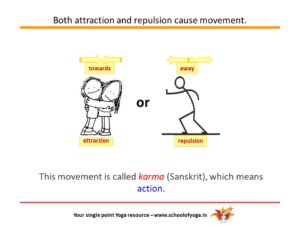
When we like something, we bring it close to ourselves. This is called raga (attraction). When we dislike something, we push it away. This is called dvesha (repulsion) and the action of bringing something close or pushing it away is action (karma).
Since this covers all transactions, karma can be considered as the governing principle of the existence of all sentient, non-sentient, animate and inanimate entities.
What is the relationship between karma and bandhana in karma yoga?
Introduction: karma creates bonds (bandhana) in every transaction because whenever two entities relate to each other, they form a bond even if the transaction is temporary.
Two types of bonds can be created in any transaction; one of equal give-take (sama-bandhana – sama = equal + bandhana = bond) or and unequal bond of give-take which creates by debt is called rnanu-bandhana (rinn = debt + bandhana = bond).
Any transaction where the give and take are equal is called samabandhana (equal bond). Mostly, this is between married couples where give and take is not measured. This is why, in-laws in India are called sambandhi or samdi (those of equal bond).
Importantly, this give and take need not be material alone; it could be ideas, feelings, opinions etc. or a mix of these, anything where there is an imbalance or debt (rinn) created.
What are the types of debt (rinn) in karma-yoga?
The different types of debt in karma yoga are,
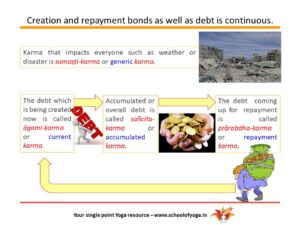
We know that most transactions are rarely equal, one of the parties will give or get more. Hence, this creates a debtor and a creditor, and a debt (rinn) that needs to be repaid in this life or in another, and this is the basis of the concept of rebirth or samsara.
Also, creation and repayment of debt can take many forms, depending on the type of debt.
- All debt accrued to or by one in an ongoing situation is called agami-karma (current debt).
- The overall aggregation of all debit or credit is called sanchita-karma (overall debt).
- Next, the debt which comes for repayment is called prarabdha-karma (repayment debt).
- Finally, any overarching karma which controls environments and communities is called samasti-karma. Example of samasti-karma – Covid-19, all earthquakes, tsunamis, weather etc., where the individual’s karma is subsumed by a macro event.
In karma yoga, where does the debt (rinn) reside?
Debt (rinn) only exists when it can be assigned to an entity. Hence, all debt (rinn) is accumulated by the Self/ Soul (atman) and goes with it at each rebirth until all the debt has been discharged.
How can a person avoid rebirth? Karma is attached to the Self (atman) only when it identifies itself with the action, so the simple way to avoid debt or rinn is to act without attaching the Self (atman) to the outcome.
Act with all senses and cognition (manas) under control, with a spirit of sacrifice (yajna), without desire for results (karma-phala) and without any attitude of being the doer (ahankara).
Unfortunately, this is easier said than done and requires great dedication, patience, persistence and practice (shraddha). This effort to transcend the Self (jiva) during action (karma) is called karma yoga.
The transliteration and translation of Srimad-bhagavad-gita, chapter 3 (Karma yoga) follows.
The Saṃskṛtaṃ words are in red italics.
Arjuna said (1-2) If according to you, wisdom (matā buddhi) is superior to karma, then why are you asking me to engage in this terrible deed? (jyāyasī cetkarmaṇaste matā buddhirjanārdana । tatkiṃ karmaṇi ghore māṃ niyojayasi keśava ॥ 3-1॥). I am perplexed with your speech and my understanding is confused, so tell me for certain, by which path I can succeed (vyāmiśreṇeva vākyena buddhiṃ mohayasīva me । tadekaṃ vada niścitya yena śreyo’hamāpnuyām ॥ 3-2॥).
Śrī Kṛṣṇa said (3-5) As I said, since long ago, in this world, there are two paths; merger by enquiry into the Self for the philosophers and merger by activity for those who prefer action (loke’smin dvividhā niṣṭhā purā proktā mayānagha । jñānayogena sāṅkhyānāṃ karmayogena yoginām ॥ 3-3॥). Man does not attain state of no action by abstaining from action and only the perfect can attain samādhi through renunciation (na karmaṇāmanārambhānnaiṣkarmyaṃ puruṣo’śnute । na ca saṃnyasanādeva siddhiṃ samadhigacchati ॥ 3-4॥). Not for a moment even is anyone free from action at all, for everyone is helplessly driven into action by guṇas which are born out of prakṛti (na hi kaścitkṣaṇamapi jātu tiṣṭhatyakarmakṛt । kāryate hyavaśaḥ karma sarvaḥ prakṛtijairguṇaiḥ ॥ 3-5॥).
(6-8) That deluded soul who restrains organs of action but constantly sits with his cognition remembering sense objects is called a hypocrite (karmendriyāṇi saṃyamya ya āste manasā smaran । indriyārthānvimūḍhātmā mithyācāraḥ sa ucyate ॥ 3-6॥). But that person who controls the senses by control of cognition, commences to act in an unattached manner and excels in harmony of action (yastvindriyāṇi manasā niyamyārabhate’rjuna । karmendriyaiḥ karmayogamasaktaḥ sa viśiṣyate ॥ 3-7॥). Surely, you must perform action, for it is superior to inaction, for even maintenance of your body would not be possible by inaction (niyataṃ kuru karma tvaṃ karma jyāyo hyakarmaṇaḥ । śarīrayātrāpi ca te na prasiddhyedakarmaṇaḥ ॥ 3-8॥).
(9-10) Everyone in this world is bound by actions, for that sake perform action without attachment (yajñārthātkarmaṇo’nyatra loko’yaṃ karmabandhanaḥ । tadarthaṃ karma kaunteya muktasaṅgaḥ samācara ॥ 3-9॥). Having created mankind in the beginning by their sacrifice, Prajāpati said, propagate this as your milch cow of desires (sahayajñāḥ prajāḥ sṛṣṭvā purovāca prajāpatiḥ । anena prasaviṣyadhvameṣa vo’stviṣṭakāmadhuk ॥ 3-10॥).
(11-13) The deities nourish the sinless, those deities will nourish you, then mutually nourishing each other, you shall attain the highest level of trustworthiness (devānbhāvayatānena te devā bhāvayantu vaḥ । parasparaṃ bhāvayantaḥ śreyaḥ paramavāpsyatha ॥ 3-11॥). So, deities will give to you desired objects through their fruits of sacrifice, anyone who enjoys without offering to them is truly like a thief. (iṣṭānbhogānhi vo devā dāsyante yajñabhāvitāḥ । tairdattānapradāyaibhyo yo bhuṅkte stena eva saḥ ॥ 3-12॥). The saintly who harvest the outcome of a sacrifice are freed from faults (yajñaśiṣṭāśinaḥ santo mucyante sarvakilbiṣaiḥ ।), indeed, those evil people who are selfish are those that eat fruits of wretchedness (bhuñjate te tvaghaṃ pāpā ye pacantyātmakāraṇāt ॥ 3-13॥).
(14-16) From food comes beings, from rain comes production of food, from sacrifice comes rain, sacrifice is source of karma (annādbhavanti bhūtāni parjanyādannasambhavaḥ । yajñādbhavati parjanyo yajñaḥ karmasamudbhavaḥ ॥ 3-14॥). Know that action has risen from brahma who has risen from the Imperishable, therefore one can establish that omnipresent Brahman is constantly present in sacrifice (karma brahmodbhavaṃ viddhi brahmākṣarasamudbhavam । tasmātsarvagataṃ brahma nityaṃ yajñe pratiṣṭhitam ॥ 3-15॥). Therefore, he who is malicious and in lives enjoying the delusional world of senses sets in motion this wheel that only moves forward (evaṃ pravartitaṃ cakraṃ nānuvartayatīha yaḥ । aghāyurindriyārāmo moghaṃ pārtha sa jīvati ॥ 3-16॥).
(17-18) Only the person who rejoices in the Self is likely to find satisfaction in the Self and only the human who stays in the Self stays contented in any activity (yastvātmaratireva syādātmatṛptaśca mānavaḥ । ātmanyeva ca santuṣṭastasya kāryaṃ na vidyate ॥ 3-17॥). He does not consider himself to cause action or inaction here and nor does he depend on any other beings (naiva tasya kṛtenārtho nākṛteneha kaścana । na cāsya sarvabhūteṣu kaścidarthavyapāśrayaḥ ॥ 3-18॥).
(19-21) Therefore, always perform mandatory activities without attachment because man attains the Supreme by performing such action (tasmādasaktaḥ satataṃ kāryaṃ karma samācara । asakto hyācarankarma paramāpnoti pūruṣaḥ ॥ 3-19॥). Truly, only by action perfection is reached, Janaka and others performed action only for the welfare of the people, so should you (karmaṇaiva hi saṃsiddhimāsthitā janakādayaḥ । lokasaṅgrahamevāpi sampaśyankartumarhasi ॥ 3-20॥). Whenever undertaken activity is performed splendidly, that becomes the measure by which people of the world judge how a person should perform (yadyadācarati śreṣṭhastattadevetaro janaḥ । sa yatpramāṇaṃ kurute lokastadanuvartate ॥ 3-21॥).
For more on sthithaprajna Chapter 2 – click here
The complete text is available in my book, A Seeker’s Śrīmad-Bhagavadgītā. Buy your copy today – Notion Press home / Flipkart / Amazon / Amazon India / Amazon UK / Amazon US / Amazon Australia
Acknowledgement.
School of Yoga is profoundly grateful to Saṃskṛta scholars and academics Pijus Kanti Pal (pal.pijuskanti@gmail.com) and Dolon Chanpa Mondal for their support in Saṃskṛta transliteration and quality control.