What is Sacrifice in Karma yoga?
How does Shri Krishna explain sacrifice in Srimad Bhagavad Gita, Chapter 3?
Why is sacrifice important?

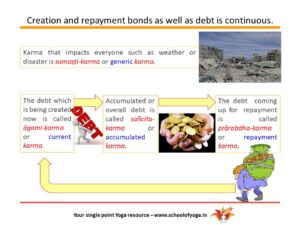
What is Karma? What is bandhana or bond? What is rinn or debt? How are these terms related? Let’s find out…
Action can be selfish or selfless, action which is a sacrifice adds value. How?
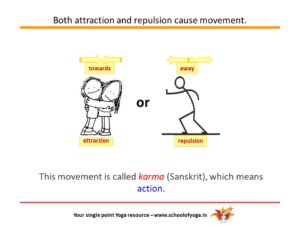
Whenever we meet someone, we either like or dislike them, depending on the congruence of their sense of Identity with our own. When we like the other entity, we try and bring the entity closer to ourselves, and this is called raga or attraction. Whenever we dislike the other entity, we push the entity away from ourselves, this is called dvesha or repulsion.
The movement created by pulling or pushing is called action or karma and the bond created by the transaction is called bandhana.
Importantly, within a bond, there will always be transactions and this will result in a take and give, which will never be equal, and this will mean that we will either be in debit or credit with the other entity. And this imbalance of debit and credit needs to be paid off, if not in this life, then in another life. This is the basis of samsara.
The debt or rinn that we create now is called agami karma, and this debt and credit goes into a general ledger called sanchita karma. The debt that we bring into this life for reconciliation is called prarabdha karma.
However, no matter how good our prarabdha karma, our experiences are always governed by a hierarchy of karmas, of entities that govern us, like the government’s karma, where we live on Earth, and the karma of the Earth. For example, if we were to live in Ukraine or Gaza, we will suffer along with the rest. Another example is Covid. Everybody got affected.
So, we can see that many of the relationships that govern us in this life are driven, either by our debit or credit balances, and this bond is called rnanunubandhana or bond of debt.
However, there is one place where the bond of debt does not apply, and this bond is called samabandhana or equal bond. And it applies in marriages where couples give without calculating. This is why, in Bhārat, marriages are called sambhandham or sambandhi, and the in-laws are called samdhi or sambandhi.
What are the key principles underpinning sacrifice or yajna?
1- All aspects of life are based on natural principles of creation (dharma). Understanding of these principles is the basis of knowledge (sankhya).
For example, the Sun sacrifices itself, so that its rays nourish earth. Likewise, the earth rotates clockwise, plants grow from the earth when they are nourished by rain, gravity acts on all matter etc., these are natural rules (dharma) of creation that cannot be changed. Each sacrifices something for creation of value.
2- Dharma (natural state, order or conditioning) comes from karma, which comes from the weave of purusha and prakriti, which is a continuous unending process.
For example – we need food which must be grown out of the earth. To achieve efficiency, one type of food must be grown on a plot of land. Sacrifice occurs when we align the natural principle of creation with our own ability to grow food, and sacrifice other options.
As a result, there is peace/ order or harmony, which is dharma. But, when food is grown by use of pesticides and other toxic chemicals, this balance is lost and there is chaos (adharma) because the action is selfish and there is no sacrifice. This chaos may not manifest immediately, but over time it manifests as climate change.
3- Action is continuous. Even to maintain the body we need to act. In fact, action occurs when we are asleep, just as acquiring wisdom requires effort or action. Importantly, not acting is also action (akarma).
4- There is no one else! Everything that we do or is done to us is a result of our karma and the debt (rinn) we create is karma that has to be reconciled. So, to avoid debt (rinn) one must act as if he does not consider himself to cause action or inaction, nor with dependence on any other beings.
What are the three defining aspects of sacrifice?
- First, we are born alone and anything we do will affect us only. Our effect on others is not controlled by us unless we force the issue.
- Second is a derivation of the first. While the outcome may not be as per our expectation, it is important that our effort or input be executed with excellence, dedication and sincerity (shraddha).
- Finally, for sacrifice to be effective, it is best that we detach ourselves from the outcome of our actions so that the impact does not disturb our equilibrium.
5- When we perform all action as a sacrifice, there is no expectations. This way, we do not attach our actions to the results, judge the action of others and avoid dualities such as like-dislike.
What is the measure of success? How do we know that we are on the right path? When our transactions result in minimum experience of debt and agitation around us, then we can call our action dhārmika or in line with karma-yoga.
Importantly, to achieve success, we need to have awareness (prajna) of the situation as it unfolds. Situational awareness (prajna) drives discrimination (vivekam) which determines quality of action (karma). A person of steady awareness is called sthitaprajna.
How does Shri Krishna explain his role in sacrifice in karma yoga?
Prior experience and wisdom indicate that realities and demands of change must be accepted and requisite action must be taken for an outcome to be successful. However, arrogance, laziness, lack of capability and delusion bring avoidable failure.
Shri Krishna said – Even though I have reached this level of supreme awareness and have no need to act, I act ceaselessly, so that people may follow suit. I act to ensure the welfare of all, to make sure removal of confusion and to establish a standard for people to follow (verse 30- 35).
- Even when in the midst of people wedded to action that are fanned by the senses, a yogi must work ceaselessly with restrained senses, forsaking the outcome for the welfare of all and perform all action with devotion. He must not get attached to the thought that he is the doer.
- So, transferring your sense of identity (I am) into Me (in this case, Śrī Kṛṣṇa, but it can be any external entity), being aware of the Self, freeing yourself from hope and glory, removing anxiety and frustration – fight!
- Those that practice this without giving excuses will succeed in freeing themselves from action. Those that preach but do not practice will remain in misery.
- It is better to be true to one’s natural state or conditioning (dharma) even though it may yield no merit, than to follow another’s for that will only lead to confusion, fear and ruin.
What are the motivators of action in Karma yoga chapter 3 (verse 36 – 43).
Arjuna said – Then, what makes man perform acts which may go against his own natural state or conditioning (dharma) and innate instincts and hurt others? (verse 36)
Shri Krishna said – It is anger born out of drive generated by desire to devour. Just as fire is enveloped by smoke and mirror by dust, the awareness gets enveloped by ambition and desire. This drive consumes wisdom and seeks continuous appeasement of the senses.
The senses, cognition and logic are its seat, so one must constantly be alert; keep this sense under control before it destroys you (verse 37- 43).
Summary of the concept of sacrifice in karma-yoga.
All creation comes from the weave of purusha and prakriti, which arises from Brahman and drives all action (karma), including the cognitive apparatus through sacrifice. The senses (indriyas) are superior to the gross body; the centre of cognition (manas) is superior to the senses and the centre of logic (buddhi) but above all this is that (Brahman), so transcend the Self and merge into the source (samadhi).
So, being aware of the Self, use this awareness to conquer desire, no doubt a very difficult thing to conquer.
- Our natural state is an all-pervading feeling of equilibrium or peace (shanti).
- This natural state of peace (shanti) is our dharma. Dharma is the natural state of all beings.
- When our actions are in conformance with our natural state, it is called svabhava (sva = self + bhava = expression or sentiment).
This harmony/ order (dharma) can exist only if we are at peace with ourselves and our world which includes not just other human beings, but animals, plants and our environment also. Importantly, this can occur only through sacrifice and selfless action, not selfish effort.
Also, it is important to remember that Brahman is a state of infinite, unchanging peace.
An example of how sacrifice changes the texture of our effort or karma;
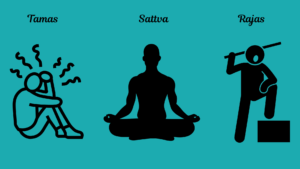
- When we compete, we begin to compare ourselves with others and become enmeshed in duality of love-hate, good-bad etc. Consequently, we become anxious, stressed, miserable and delusional (tamas).
- The desire to compete and win (rajas) infuses passion, and our work becomes driven by expectation, desires, fear, frustration, anger, anxiety and stress. This corrodes our balance and equanimity (sattva) and leads to unhappiness, stress and finally breakdown of body and faculties. However, we do it all the time, at school, college, home, sports, office, society, even as a nation!
- When we become aware of this destructive state and our focus turns to peaceful integration of all stakeholders without compromising on goals, our drive to prosper at any cost diminishes. Instead, we try to develop an inclusive and balanced way to prosperity and reach a state of peace and in equilibrium. This is sattva.
- This type of action (karma) is called sacrifice (yajna) because it requires us to give up our own desires for an overarching state of peace. Sacrifice requires restraining of our senses while performing action which, in turn increases awareness and peace within us.
- So, when we work with our senses under control, an attitude of sacrifice (yajna), without expectation of result but overall betterment, all the negativities of tamas and rajas are avoided. Consequently, this leads to a peaceful, healthy and happy existence.
- Also, since karma is attached to people when they identify themselves with the action, this method is a simple way to avoid debt (ṛṇa) by separating the Self from the act. Unfortunately, this is easier said than done and requires great practice.
Why is this so difficult? Don’t we have a free will? This is addressed in chapter 4.
Some contradictions to accepted positions on sacrifice in karma yoga.
- Action (karma), when used colloquially, it is actually debt (rinn) that has come for repayment.
- While primordial action (adi-karma) comes on account of two identities (atman) in a bond (bandana), action (karma) causes and imbalance within the bond resulting in debt (rinn), which becomes the cause of subsequent identities (atman).
- Can the logic of bonds (bandana) and action (karma) be applied to science? Yes, the concept of yoga is universal (sanatana) and can be applied to Science as well.
Read about it in Śrīmad-bhagavadgītā – chapter 9.
What are the lessons we can learn on karma yoga and sacrifice in chapter 3?
- Everything is action (karma). Action, inaction, approved action or prohibited action. All are action (karma).
- One can’t escape it, one can only try to control one’s impulses, keep one’s senses under control and perform action as a sacrifice, without any expectation of outcome.
The transliteration and translation of Srimad-bhagavad-gita, chapter 3 (Karma-yoga) follows.
The Saṃskṛtaṃ words are in red italics.
Śrī Kṛṣṇa said
(22-24) There is no mandatory action in the three worlds, not anything unattained, to be attained by me, yet I am continuously acting (na me pārthāsti kartavyaṃ triṣu lokeṣu kiñcana । nānavāptamavāptavyaṃ varta eva ca karmaṇi ॥ 3-22॥). Surely, if I did not engage in action ever unwearied, humanity would follow my example (yadi hyahaṃ na varteyaṃ jātu karmaṇyatandritaḥ । mama vartmānuvartante manuṣyāḥ pārtha sarvaśaḥ ॥ 3-23॥). These worlds would be ruined if I did not perform action. Mixing of people would result in their destruction (utsīdeyurime lokā na kuryāṃ karma cedaham । saṅkarasya ca kartā syāmupahanyāmimāḥ prajāḥ ॥ 3-24॥).
(25-26) The ignorant act with attachment to action, the wise act with an attitude of no attachment, for the welfare of the world (saktāḥ karmaṇyavidvāṃso yathā kurvanti bhārata । kuryādvidvāṃstathāsaktaścikīrṣurlokasaṅgraham ॥ 3-25॥). No disturbance of the intellect should arise from actions of the ignorant who are attached to actions, the wise perform all actions with an attitude of balance (na buddhibhedaṃ janayedajñānāṃ karmasaṅginām । joṣayetsarvakarmāṇi vidvānyuktaḥ samācaran ॥ 3-26॥).
(27-29) All actions arise from attributes which arise from prakṛti (prakṛteḥ kriyamāṇāni guṇaiḥ karmāṇi sarvaśaḥ ।), the deluded soul cognises itself as “I am the doer” (ahaṅkāravimūḍhātmā kartāhamiti manyate ॥ 3-27॥). Philosophers know that action comes from the tri-partitioned attributes and controlling these attributes, thus knowing, remain unattached (tattvavittu mahābāho guṇakarmavibhāgayoḥ । guṇā guṇeṣu vartanta iti matvā na sajjate ॥ 3-28॥). Thus, deluded by gunas born of prakṛti find virtue in actions driven by guṇa (prakṛterguṇasammūḍhāḥ sajjante guṇakarmasu ।). The person with complete knowledge should not agitate dull people who have incomplete knowledge (tānakṛtsnavido mandānkṛtsnavinna vicālayet ॥ 3-29॥).
(30-32) Renouncing all action into me, with a consciousness that is meditating on the Primordial Self, without hope, without the sense of Self, becoming free from affliction, fight (mayi sarvāṇi karmāṇi saṃnyasyādhyātmacetasā । nirāśīrnirmamo bhūtvā yudhyasva vigatajvaraḥ ॥ 3-30॥). Also, those people that practice this teaching of mine constantly with dedication and without envy, they are freed from karma (ye me matamidaṃ nityamanutiṣṭhanti mānavāḥ । śraddhāvanto’nasūyanto mucyante te’pi karmabhiḥ ॥ 3-31॥). But those who are envious, not performing my teaching, misinterpreting all knowledge of the Self, their lack of knowledge will lead them to ruin (ye tvetadabhyasūyanto nānutiṣṭhanti me matam । sarvajñānavimūḍhāṃstānviddhi naṣṭānacetasaḥ ॥ 3-32॥).
(33-35) Even a wise man acts in conformance with his or her own nature (prakṛti), likewise other beings follow their own nature (prakṛti), what suppression can creatures accomplish? (sadṛśaṃ ceṣṭate svasyāḥ prakṛterjñānavānapi । prakṛtiṃ yānti bhūtāni nigrahaḥ kiṃ kariṣyati ॥ 3-33॥). Attraction and repulsion find their foundation in the senses and are nourished by the senses, verily they come in the way of those that cannot them (indriyasyendriyasyārthe rāgadveṣau vyavasthitau । tayorna vaśamāgacchettau hyasya paripanthinau ॥ 3-34॥). Excellence in one’s own value system, even if devoid of merit is better than discharging other’s duties, it is better to die following one’s own natural state than performing another’s activity in a state of fear (śreyānsvadharmo viguṇaḥ paradharmātsvanuṣṭhitāt । svadharme nidhanaṃ śreyaḥ paradharmo bhayāvahaḥ ॥ 3-35॥).
Arjuna said (36) Now, by which motivation is a person impelled to performing wretched actions, not wishing to be constrained even by force? (atha kena prayukto’yaṃ pāpaṃ carati pūruṣaḥ । anicchannapi vārṣṇeya balādiva niyojitaḥ ॥ 3-36॥).
Śrī Kṛṣṇa said (37-39) Desire for this and anger at this are expressions of passion, this is a major, voracious and wretched, penetrative foe (kāma eṣa krodha eṣa rajoguṇasamudbhavaḥ । mahāśano mahāpāpmā viddhyenamiha vairiṇam ॥ 3-37॥). Just as smoke envelopes fire. dust covers a mirror, the womb envelops the embryo, so is this covered (dhūmenāvriyate vahniryathādarśo malena ca । yatholbenāvṛto garbhastathā tenedamāvṛtam ॥ 3-38॥). Wisdom of the wise is enveloped by this constant enemy in the form of desire, unsatiated and all-consuming fire (āvṛtaṃ jñānametena jñānino nityavairiṇā । kāmarūpeṇa kaunteya duṣpūreṇānalena ca ॥ 3-39॥).
(40-41) It is said that the senses, cognition, intellect are its abode, it envelopes the wisdom of the embodied and deludes (indriyāṇi mano buddhirasyādhiṣṭhānamucyate । etairvimohayatyeṣa jñānamāvṛtya dehinam ॥ 3-40॥). Therefore, control your senses when stimuli comes and effectively overcome this wretched destroyer of knowledge of the Self and surrounding (tasmāttvamindriyāṇyādau niyamya bharatarṣabha । pāpmānaṃ prajahi hyenaṃ jñānavijñānanāśanam ॥ 3-41॥).
(42-43) They say that the functioning of the senses is superior to the senses; the functioning of cognition is superior to cognition; the functioning of the intellect is superior to intellect; but superior to all is that (indriyāṇi parāṇyāhurindriyebhyaḥ paraṃ manaḥ । manasastu parā buddhiryo buddheḥ paratastu saḥ ॥ 3-42॥). Thus, use intelligence over the intellectual process, restrain the Self by the Self, overcome this enemy which comes in the form of desire (evaṃ buddheḥ paraṃ buddhvā saṃstabhyātmānamātmanā । jahi śatruṃ mahābāho kāmarūpaṃ durāsadam ॥ 3-43॥).
For more on sthithaprajna Chapter 2 – click here

The complete text is available in my book, A Seeker’s Śrīmad-Bhagavadgītā. Buy your copy today – Notion Press home / Flipkart / Amazon / Amazon India / Amazon UK / Amazon US / Amazon Australia
Acknowledgement.
School of Yoga is profoundly grateful to Saṃskṛta scholars and academics Pijus Kanti Pal (pal.pijuskanti@gmail.com) and Dolon Chanpa Mondal for their support in Saṃskṛta transliteration and quality control.