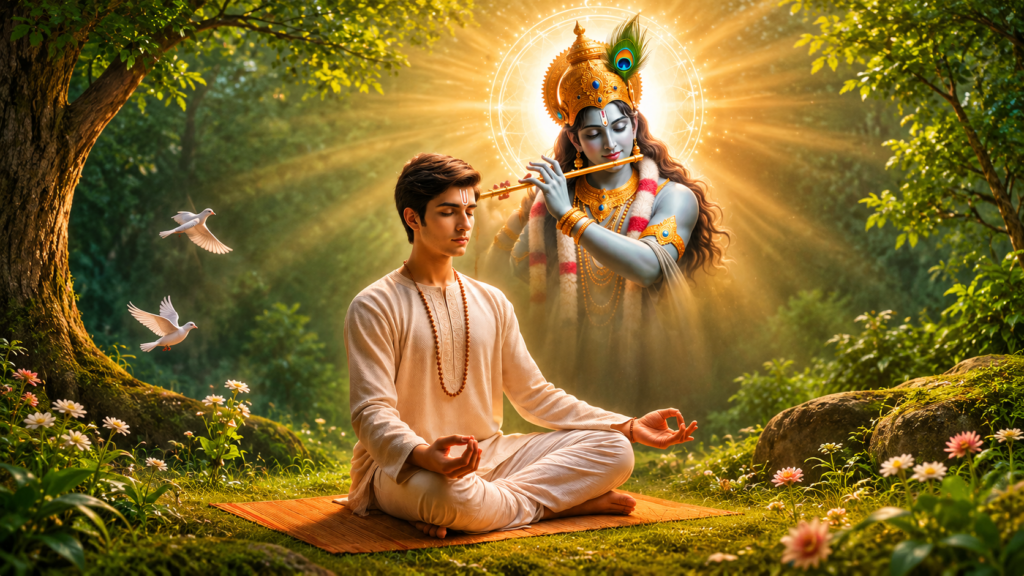
What is bhakti yoga ? What are the different forms of bhakti yoga ?
Bhakti yoga is the technique of transferring the sense of identity (asmita) from ourselves to an external object such as a personal deity (ishtadeva), Guru/ master or teacher.
The conceptual drivers of bhakti yoga are:
- To remove the sense of doership in our actions (ahankara).
- Our self-esteem or self-worth (asmita) is derived from the receipt of appreciation for our actions. When we transfer this outcome to an external entity, self-worth (asmita) and feeling of achievement/ doership (ahankara) are negated.
In fact, bhakti can also denote transference of identity to a concept such as a county. When this occurs, the individual’s sense of identity gets subsumed into that of the object or deity. As a result, there is conscious and unconscious merger of the personality of the practitioner into that of the deity, or Yoga.
There are 9 forms of bhakti yoga, or 9 modes of devotion, namely shravana, kirtana, smarana, padasevana, archana, vandana, dasya, sakhya, and atma nivedana.
How are the 9 forms of bhakti yoga practically applied?
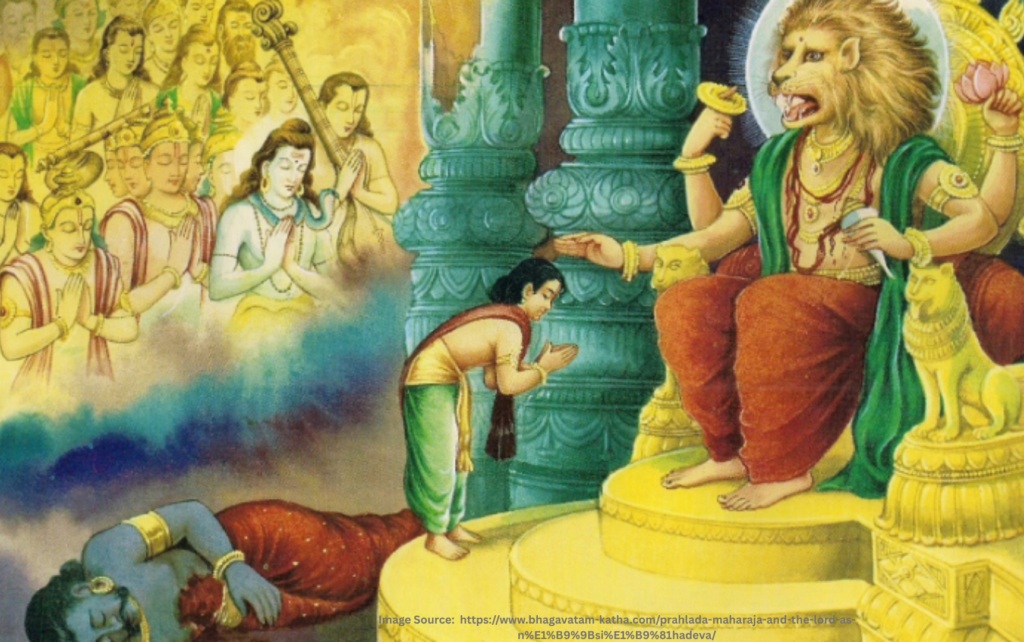
The Srimad Bhagavata Purana (chapter 7.5.23-24) propounds the nine primary tools of bhakti (9 forms of bhakti yoga) as explained by Prahlada the son of Hiranyakashipu and hero of Narasimha avatara (incarnation).
The forms of bhakti yoga are practiced as follows:
- Shravana (listening to achievements of the deity) – Here, we confer upon the deity, the status of a role model. In India, all deities have a character, abilities, and achievements. We start the process of subsuming our identity by listening to the achievements of the deities at their temples. Then we analyse the deity’s life as a role model. After this, we try to introduce these qualities in our own life. In the process, we slowly lose our feeling of doership (ahankara) and sense of Identity (asmita).
What is important here is that we must personify the deity with values that resonate with our ideals. This allows easy surrender and our own evolution into that vision. It is critical that we do not get swayed or allow another person’s interpretation to cloud our vision. The reason for this is, our vision comes from within ourselves and this will make it easier to merge with the deity. Interpretation of other’s will act as interference or impedance and slow down our ability to release our self-esteem (asmita).
For example, Srimad Bhagavad Gita is a conversation between a confused and dejected warrior prince Arjuna with his charioteer Sri Krishna. When one analyses the conversation, one can instantly recognise the applicability of Sri Krishna’s advice to modern living. - Kirtana (praising the achievements of the deity) – Here, we extol specific achievements of the deity. This reinforces specific behavioural patterns which we then imbibe and make our own. (Read to know more about what Prahlada goes on to recommend)
- Smarana (retaining an image of the deity at all time) – this element has two parts:
- We try to retain the deity in an external form in pictures and other forms
- Once the above image has been mastered retention, we try to make sure that our memory is subsumed over time by the image of the deity.
- Padasevana (pada = feet + sevana = service) – Padasevana means service at the feet of the deity or Guru, which can be interpreted as subsuming one’s personality into that of the deity.
- Archana (worshipping the deity with hyperbole) – Almost all prayers, no matter which religion, deal in hyperbole. Consequently, this sets the deity at an unassailable high position. As a result, the practitioner places the deity above his self-worth (asmita). Consequently, he or she is motivated to surrender his or her identity to the deity or object of bhakti.
- Vandana (worshipping the deity) – Whilst archana is worshiping with hyperbole, vandana is deep integration of the self with the deity. In fact, all prayers of all religions have this as the intent.
- Dasya (servitude) – Dasya comes from the root “dasa” or servant. The yogi serves the deity as a servant, and dedicates all his actions and outcomes to the deity, thus negating the sense of personal achievement, opinion and identity.
- Sakhya (companion) – Here, the practitioner treats the deity like a companion, as an equal with whom everything is shared.
- Atma nivedana (atma = soul + nivedana = state of no schism) – It is the state where there is no difference between the yogi and the deity. Initially, the aspirant always views the deity as different, but when the practice of the above techniques progresses and reaches an advanced stage, the aspirant sees no difference between himself and the deity.
All the above forms of bhakti yoga need to be practiced with discipline, sincerity and emotional honesty.
Points to ponder on the forms of bhakti-yoga :
Internal Tags: Dharma (conditioning), Stress and Situational Awareness, Stress and prana, Awareness measures, Hatha Yoga Pradeepika, Patanjali Yoga Sutra, Jnana Yoga, Bhakti Yoga, Karma Yoga, Hatha Yoga and Raja Yoga.
External Tags: Consciousness, Bhakti Movement in India
- What is bhakti yoga?
- Review the elements and forms of bhakti yoga and how they impact evolution of the practitioner?
- How is bhakti yoga implemented?
- Who is your role model? Which qualities have you taken from this entity?
- How is bhakti yoga used in daily life?