What is prana energy?
In any transaction, a medium is required in which the transaction occurs. For example, electricity needs a conductor. In the case of life, it is prana energy or motility, a subtle energy which flows wherever identities exist. Whenever the expression of identity occurs, it happens on the foundation of prana. In Yoga, prana is also known as “motility or life force”.
However, prana is part of a larger system which is both, subtle and experiential. Therefore, this makes a description as well as experience of prana energy and its subtleties very esoteric and challenging.
Prana energy: What is the prana or pranic system?
The prana system is a set of interlocking concepts which are based on intuitive experience (anubhava). However, the experience of one person would be different from another, so, while the general application of the concept would be common to everyone, individual paths would depend on one’s conditioning or dharma, as well as their evolution in Yoga.
Additionally, all matter can be classified into that which is gross or cognisable to the senses (sthula), and that which is subtle or can be perceived only by experience or intuition (sukshma).
Finally, the interlinking concepts which need to be understood for development in the field of yoga are:
a- Pancha-vayu – five airs
b- Pancha-kosha – five sheaths
c- Nadis – energy channels
d- Chakras – vortices.
The details of the above concepts are explained in the yoga asana section – click here
Prana energy flow: How are situational awareness (prajna), chakras, and prana related?
In a situation of calmness or homeostasis, prana energy flows unimpeded through the body and does not get congested or depleted. This ensures healthy functioning of the system.
However, in a stress situation, the prana energy flow becomes agitated. Depending on one’s perception of threat, one or more prana energy centers (chakras) become congested or depleted. This destabilises the prana energy flow, thereby affecting the related vayu (vital airs) and consequently the related organs. Hence, when the prana energy flow is depleted or congested, it should be brought back to a state of equilibrium or homeostasis as soon as possible.
How are the various prana energy centers and motivation related?
It is possible to correlate the functioning of the prana energy centres with the psychological state, as propounded by Abraham Maslow in his 1943 paper “Theory of Motivation”.
This correlation is useful when we try to find solutions to stress. It is known in Yoga and other forms of Oriental healing that the rate of energy flow through these prana centres (chakras) affects the behaviour of the person. As a matter of fact, ancient Oriental texts on this subject from India, China, Korea, and Japan speak of many energy wheels, but all agree that there are six major wheel locations (chakras) in the human body which control all major organs.
The various chakras are:
Base centre (muladhara): (mul = base + adhara = foundation or source):
The first energy vortice aligns itself with the perineum, a flat region above the coccyx and between the anus and genitals. This centre affects the physiological aspects of the individual- the overall energy levels, feeling of safety and health.
Example: People in difficult situations squirm in their seats. When fears for personal safety, there is acute discomfort at the region of the anus. There is an urge to shift in the seat. The rocking action energises the muladhara-chakra.
Self-evolution centre (svadhishthana): (sva = self + adhishthana = evolved place):
This energy vortice corresponds to the sacral region around the genital area. It affects sexuality, social and communications skills of the individual. Control of this centre results in strong nerves and emotional stability.
Example: After a heated argument, there is often an ache in the lower back. This occurs as a result of our need to be able to convince the other person to accept our point of view and the need to communicate effectively. This strains the lumbar arch and results in stress.
Stomach centre (manipura): (manipura = navel):
This energy vortice, is placed around the navel and corresponds to the lumbar area of the spine. This is a centre that controls situational and management skills.
Example: Often, we hear about taking a decision from the gut, the gut feel! How is that possible? After all, it is the brain that decides. Or is it? The stomach does have a role, for the manipura with its acids & bile does signal comfort in a social environment.
Heart centre (anahata): (ana = not + ahata = touched/ material):
Placed at the centre of the chest, this centre responds to the thoracic region on the spine. This is the centre of emotional energy. A clean centre is essential for emotional stability.
Example: Blood pressure is directly related to anger and speech. Generally, doctors advise a person to reduce speaking after a heart attack. Why? Because when a person gets excited, the release of adrenaline has a direct impact on the heart & lungs.
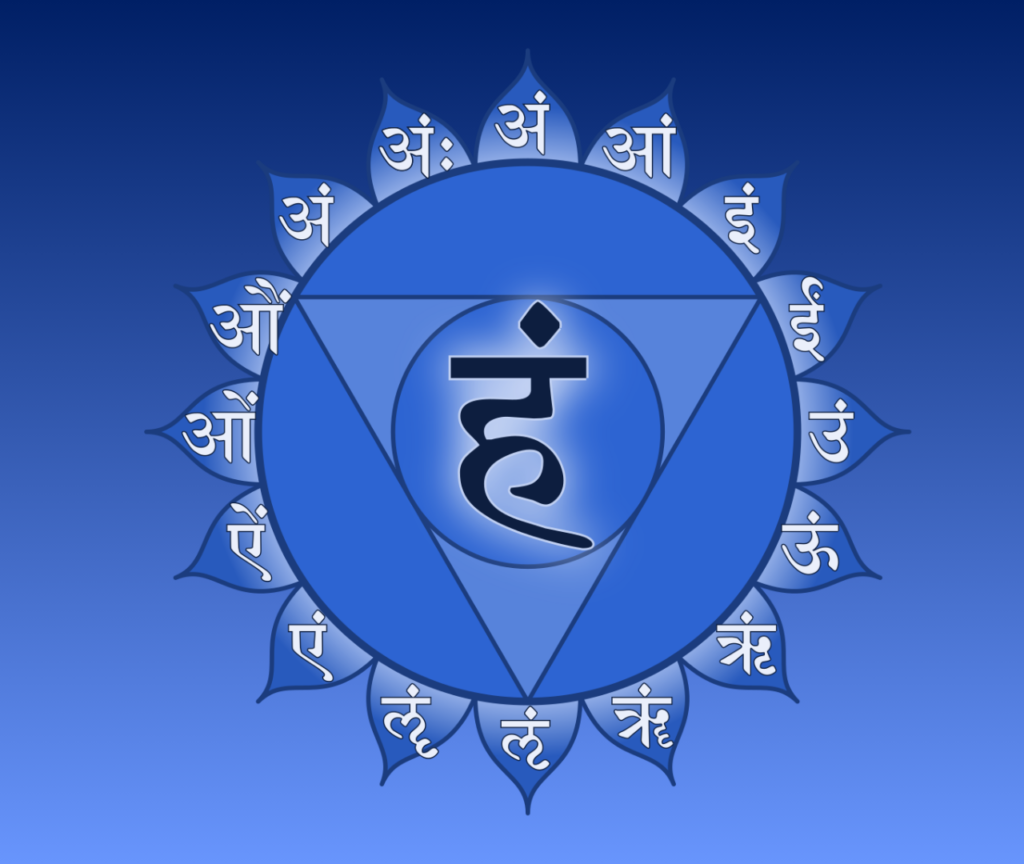
Throat centre (vishuddhi): (vishuddha = extraordinarily pure)
This energy vortice is placed around the Adam’s apple and corresponds to the cervical region in the spine. The thyroid, parathyroid and lymphatic systems, which control metabolic activity reside here. Since metabolism is the ability of the body to convert food into usable energy and rebuilding of tissue, seamless energy flow here is critical.
This is also the area which controls breathing and food intake, so any disruption in our stress levels will immediately impact the quality of our breathing and digestion.
Example: When we are afraid, we often feel choked! Why? Because the prana flow at the vishuddhi is disrupted. The chocking action impacts the thyroid & parathyroid. Consequently, disruption of this centre can lead to various illnesses.
Forehead centre (ajna): (ajna = that which commands)

This energy vortice is placed between the eyebrows in the front of the cranium. It controls the functioning of the other energy vortices. It energizes the amygdala, pituitary and endocrine glands. Consequently, this energy vortice is the primary input point for “fight or flight” stimulus.
The last chakra is sahasrara which is of value only to those interested in emancipation.
Points to ponder on prana energy:
When asanas are practiced, the energy sheaths and vortices begin to get streamlined. Consequently, this rejuvenates the organs, enhances clarity of thought, and increases emotional and spiritual strength.
Internal Links: Dharma (conditioning), Stress and Situational Awareness. Karma, Stress solutions, Prana,
External Links: Chakra, Pancha Tattva, Pancha Kosha, Nadi.
- Have you experienced changes to your physiology in times of stress?
- When you are driving any vehicle and wish to cut across traffic, where is the stress felt most on your body? (It should be along the lower back). How do you become aware of the stress and the coping action?
- Where is the stress and awareness felt when one has a cold?