What is the relevance of Srimad Bhagavad gita in today’s world
No single text discusses or explains the many philosophies which fall under the umbrella of Sanatana Dharma better than Srimad Bhagavad Gita.
Importantly, the relevance of Srimad Bhagavad Gita should be viewed in the light of its importance within the overall philosophy of Yoga.
- Firstly, the ancient Indian philosophical basis is that all existence is impermanent and a farce or illusion (maya).
- Next, iIllusion (maya) rises from Brahman which is a state of imperishable equilibrium or peace, or a state where there is no change.
- Thus, only the Brahman is permanent, everything else is impermanent or relative. Also, the Brahman is known as the Truth, so there is only one absolute Truth, everything else is maya.
- Furthermore, everything in this illusionary state of relativity and impermanence has a natural state (dharma). So, when anything is in this natural state (dharma), it is at material or thermodynamic equilibrium.
- Dharma applies to all entities, from an atom to the primordial elements such as earth, water, fire, air and ether; from the earth to the universe.
- Also, this includes everything, sentient and insentient, even systems, processes, businesses, travel and countries. Since this natural state of peace covers everything, it is called sanatana-dharma or universal natural state.
Relevance of Srimad Bhagavad Gita comes from the fact that it explains how maya (illusion) is governed by sanatana-dharma.
- Importantly, by the very nature of maya, material equilibrium or dharma is continuously subjected to both, sentient and insentient stimuli; hence this equilibrium is constantly getting upset by change, which is called adharma (chaos/ turbulence).
- Consequently, this creates imbalance in the system and since any system that goes out of balance never returns to its original state, chaos (adharma), or entropy (measure of randomness in any system) is forever continuously increasing.
- In fact, the ancient seers (rishis) of this land realised that while realisation of Brahman was the main objective of existence, existence itself had to be structured so that chaos in daily living was minimised and individuals were naturally empowered by life structures to migrate towards the Truth.
- Hence, they integrated this philosophy into the lifestyle of the individual and society so that each life activity could assist the person in transcending maya naturally and reaching Brahman.
- The system that they worked out is called Hinduism today.
Importantly, Hinduism cannot be called a religion in the traditional sense because it has no dogma.
It only has philosophical schools (pravara) which follow broad based practices but these too have a very open structure and a lot of overlap with other philosophical schools in their construct and practices.
The unchanging relevance of Srimad Bhagavad Gita over time
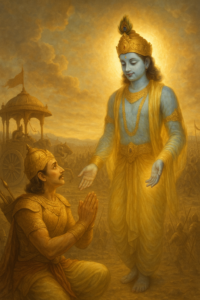
Srimad Bhagavad Gita was composed on a battlefield, more specifically an internecine, fratricidal civil war where the warring factions were all kinsmen. The protagonist, warrior Prince and ace archer Arjuna is beset by fear of chaos which would ensue when so many died and his own personal grief at the thought of losing so many kinsmen as he reviews the battlefield situation. His doubts are answered by Sri Krishna, his charioteer and this forms the background of the text.
The relevance of Srimad Bhagavad Gita manifests as a conversation between Arjuna and Sri Krishna that mirrors our own state in many situations.
- It starts with internal confusion and conflict at the chaos arising from consequences.
- Then, as we read Srimad Bhagavad Gita, it moves to understanding the nature of permanence or the Brahman.
- Next, we learn about work and duty. Also, we learn about how to work without losing our sense of Self (asmita).
- This followed by an explanation of the many paths that we can take to re-establish equilibrium.
- Finally, there is the understanding of the system and society (vijnana), which is followed by our understanding of the Self (jnana).
- So, Srimad Bhagavad Gita is actually a manual which each of us can use to navigate the labyrinth called “Life”.
Timelines that show the incredible relevance of Bhagavad Gita
There are some who have calculated the dates of the Mahabharata battle (commonly called Kurukshetra War) as follows:
- Start – Mrigasheera Shukla Ekadashi = 8th December BCE 3139
- End – 25th December BCE 3139.
The relevance of Bhagavad Gītā also lies in its structure
Srimad Bhagavad Gita is made up of 18 chapters, each chapter is a description of a Yoga or method for harmonising).
These 18 chapters are broadly categorised as
- Chapters 1- 6 Karma Khanda – Volume of action
- Chapters 7 – 12 Upanyasa Khanda – Volume of proof and
- Chapters 13 – 18 Jñāna Khanda – Volume of knowledge
These 18 chapters contain 700 couplets as a conversation that includes 4 participants – the King Dhrithashtra (1 couplet), Sanjaya who oversees the conversation between Arjuna and Sri Krishna (40 couplets), Prince Arjuna who is the confused protagonist (85 couplets) and Sri Krishna (564 couplets).
The relevance of Bhagavad Gītā also comes from the fact that it is the only text in the world that has its own birthday or Jayanthi. It is celebrated on the 11th day of the waxing moon in the month of Margashirsha.
Srimad Bhagavad Gita – Chapter 1: Viṣada Yoga (Yoga of Melancholy)
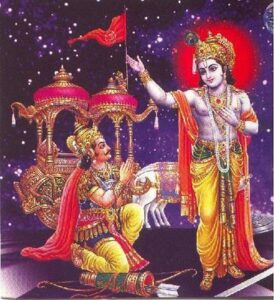
Dhrithrashtra, the blind father of the Kauravas, asks Sanjaya to explain the scene of battle at Kurukshetra. Having seen the Pandavas arrayed in battle opposite them, the Kaurava King Duryodhana approached his Guru Dronacharya and sought benediction and confidence. In response, Dronacharya blew his battle conch, infusing confidence into the Kaurava Army. Likewise, the Pandavas blew on their conches and there was a general exchange of drums and conches. Amidst this, Arjuna asked Sri Krishna to drive between the opposing armies so that he may see the opposing forces. Sri Krishna, his charioteer for the battle, did as asked.
The relevance of Srimad Bhagavad Gita starts with the despondence of Arjuna
Seeing his kinsmen and close relatives on the opposite site, each preparing to slaughter the other, Arjuna spoke with great sorrow that he had lost the strength and confidence to fight and began to question the very premise on which they had gone to battle, saying;
- I do not wish to kill anyone.
- What good will come out of this slaughter?
- How can we be happy killing our own kinsmen despite the fact that their greed does not allow them to have softer sentiments?
- The destruction of any family will result in corruption and destruction of all known social hierarchies and systems. Consequently, this is a great Sin.
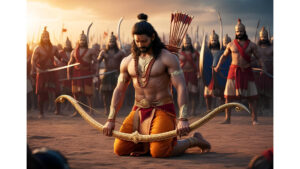
- Putting down his bow, in distress and sorrow Arjuna said – I won’t fight.
The Transliteration of Srimad Bhagavad Gita Chapter 1 follows:
The Sanskrit words are in red italics and meaning, before the words, are in black.
Dhrithrashtra said (1) At the field of correctness, at Kurukshetra, what is the status of my people and also Pandavas who have gathered with a desire for battle (dharma-kshetre-kuruk-kshetre-samaceda-yuyutsavaha-mamakaha-pandavaha-cha-eva-kim-akurvata-sanjaya).
Sanjaya said (2-4) having indeed seen the armies of Pandavas in battle array, Duryodhana, the king, approached his teacher and said (dhrishtva-tu-paandava-neekam-vyoodah-duryodhana-thatha-aacharyam-upasamgamaya-raja-vachanam-abhraveet). Teacher, behold here the great army the sons of Pandu, marshalled by the son of Dhrupada, your talented student (pashyaitam-paandava-putraanam-acharya-mahateem-chamoom-vyoodaan-drupada-putrena-tava-sishya-dheemata). Here are daring warriors, great archers, equal to Bhima and Arjuna in battle, Yuyudhana, Viraata and Drupada the great charioteer (atra-shoora-maheshvaasa-bheema-arjuna-sama-yuddhi-yuyudhaano-viraataha-cha-drupada-cha-mahaarathaha).
(5-7) Drishtaketu and Chiketana, King of Kashi and valiant Purujit, Kuntibhoja and Saibyaha and best of men (dhrishtaketu-chekitaanaha-kaashiraajaha-cha-veeryavaan-purujit-kuntibhoja-cha-shaibhyaha-cha-narapumgavaha). Yudhamanyhu and courageous Uttamouja and the brave son of Subhadra and Draupati and all great charioteers (yudhamanyu-cha-vikrantaha-uttamoujaha-cha-veeryavaan-soubhadraha-draupadeyaha-cha-sarve-eva-maharathaha). Ours also distinguished chiefs those who are knowledgeble, best of twice-born, the leaders of my army, for information, I will recount to you (asmaakam-tu-vishishta-ye-taan-nibhodha-dvijjottam-naayakaha-mama-sainyasya-sanjyaartham-taan-bravimi-te).
(8-10) Yourself, Bhishma and Karna and Kripa and Ashwattama, victorious in war, and even Vikarna, son of Somadatta, (bhavaan-bhishma-cha-karnaha-cha-kripaha-cha-samitim-jayah-ashwattam-vikarnaha-cha-soumadattih-thatha-eva-cha). And many other heroes, for me willing to sacrifice their lives, armed with various weapons, all well skilled in battle (anya-cha-bhavaha-shoora-madh-arthe-thyakth-jeevitah-naanaa-shastra-paharana-sarve-yuddha-visharadha). Unlimited is our strength, marshalled by Bhishma, while their army marshalled by Bhima is insufficient (aparyaaptam-tat-asmaakam-balam-bheeshma-abhirakshataam-paryaaptam-tu-idam-eteshaam-balam-bheem-abhirakshitaam).
(11-13) Indeed, within and everywhere, the strength of the divisions is deployed to protect Bhishma alone (ayeshu-cha-sarveshu-yatha-bhaagam-avasthitha-bhishma-eva-abhirakshantu-bhavantaha-sarva-eva-hi). Therefore, expressing happiness, the oldest of the Kurus, the grandfather loudly let out a lion’s roar and blew his mighty conch (tasya-sanjanayan-harsham-kuruvriddhaha-pitamahaha-simha-naadan-vinagha-uchai-shankham-dadhamou-pratapaavan). Then, conchs and kettledrums and tabors, drums and cow-horns suddenly blared forth in a sound that was tumultuous (tatah-shankha-cha-bheryaha-cha-paNav-aanak-gomukhaha-sahasa-eva-abhya-hanyanta-saha-shabda-tumulaha-abhavataha).
(14-16) Then, seated on a magnificent war-chariot yoked with white horses Madhava and son of Pandu also blew their divine conches (tatah-shweta-hahaihi-yukte-mahati-syandane-sthithou-madhavaha-paandavaha-cha-eva-divyau-shankhai-pradhadhmatuh). Panchajanyam of Hrishikesha, Devadattam of Dhananjaya and Poundra was blown by the doer of terrible deeds, Bhima (panchajanyam-hrshikesha-devattam-dhananjayaha-poundran-dhadhmou-maha-shankham-bheema-karma-vrkodaraha). Raja Kuntiputra Yudhishtira blew the Anantavijayam, Nakul and Sahadeva blew conches named Sughosha and Manipushpaka (ananthvijayam-raaja-kuntiputro-yudhishtiraha-nakulaha-sahadevascha-sughosham-manipushpakou).
(17-20) Supreme archer Kasya, Shikhandi and Drishtadyumna, Viraata and unconquered Satyaki (kaashasya-cha-paramisvasah-shikhandi-cha-maha-rathaha-dhrishtadyumna-viraata-cha-satyaki-cha-aparijita). Drupada, sons of Draupati and all lords of the Earth and the mighty armed son of Subhadra blew their conches one after another (drupado-droupadeyascha-sarveshaha-prithiveepathe-soubhadrascha-mahabahuhu-shankaan-dudmuh-prathak-prathak). That tumultuous resounding battle sound rent the hearts of Dhrithrashtra’s team, from sky to earth (sa-ghoso-dhrthrashtranaam-hrdayani-vyadaarayath-nabhasch-prithveem-cha-eva-tumulou-vyanunaadayan). Now, monkey banner seeing the arrayed Drithirashtas people about to begin discharge of weapons, son of Pandu, taking up the bow then said this to Hrishikesaam, Lord of the Earth (atha-vyavasthithaan-drishtva-dhaarthraashtaan-kapidhvajaha-pravrithe-shaastra-sampate-dhanuhu-udhamya-paandavaha-hrishikeshaam-tadha-vaakyam-idam-aaha-mahipate.
Arjuna said (21-23) Place my chariot in the middle of the armies, Achuta (senayoho-ubhayoho-madhye-ratham-sthapaya-me-achyutha). I wish to see who has assembled here with the intention of fighting, and must be fought by me, in this eve of battle (yaavat-nirikshe-aham-yoddhu-kaamaan-avasthithaan-kaha-maya-saha-yodhavyam-asmin-raN-samudyame). I wish to observe who among those who wish to please the deviant minded sons of Drithrashtra (yothsyamaanaan-avekshye-aham-yaha-yeth-atra-samaa-gataaha-dhrathrasya-durbuddhe-yuddhe-priyachikeersavaha).
Sanjaya said (24-27) Having been addressed by Gudakesa, Bhaarata, Hrishikesha placed the supreme of chariots between the armies. (evam-uktah-hrishikeshaha-goodakeshene-bhaarata-senayoho-ubhayo-madhye-sthapayiythva-ratha-uttam). In front of Bhishma and Drona and all other rulers of the earth, Parth said, behold the Kurus gathered here (bheeshma-drona-sarvesaam-cha-maheekshitaam-uvaacha-parth-pasha-etan-samavetaan-kuroon-iti). Stationed there, Partha saw, fathers, also, grandfathers, teachers, maternal uncles, brothers, sons, grandsons, companions, fathers-in-law, friends and also warriors from both sides (tatra-upashyate-sthithaan-paarth-pitrn-atha-pitamahaan-aacharyaan-maathulaan-bhrathrn-putran-pouthraan-sakheen-thatha-shvashuraan-suhrdaha-cha-eva-senayoho-ubhayoho-api). Having seen all these relatives standing, filled with deep pity and sorrow, Kounteya said (tasan-sameeksha-sah-kounteya-sarvaan-bandhoon-avasthithaan-kripaya-paryaa-aavishtah-visheedan-idam-abhraveet).
Arjuna said (28-30) Seeing my people, arrayed and eager to fight, my limbs fail me, and my mouth is getting parched (drishtva-imam-sva-janam-yuyutsum-sama-upa-sthitham-seedanthi-mama-gaatraNi-mukham-cha-parishushyati). My body is shivering and I am getting goosepimples, the Gandiva is slipping from my hand and my skin is burning (vepathuhu-cha-sharire–me-romaharsha-cha-jayate-gaandivam-sramsate-hastat-tvak-cha-eva-paridahyate). I am unable to stand, it seems that my mind whirls with omens and I see adversity (na-cha-shaknomi-avastaatum-bhramateev-cha-me-manaha-nimmittani-cha-pashyami-vipatitaani).
(31-34) And no good I see in killing my people in battle, I do not desire victory, and not kingdom and other pleasures (na-cha-shreyo-anupashyami-hatva-sva-janam-aahave-na-kaankse-vijayam-na-cha-raajyam-sukhani-cha). What will this kingdom give to us? What pleasure will be get in life? (kim-no-rajyena-kim-bhogaihi-jeevitena-va). The reason we desire enjoyment of kingdom pleasures, they stand ready to give life in battle, having abandoned wealth (yesham-arthe-kaanksitam-no-raajyam-bhogaha-sukhani-cha-tha-ime-avasthithaha-yuddhe-pranaan-tyaktva-dhanaani-cha). Teachers, fathers, sons and grandfathers, maternal uncles, fathers-in-law, grandsons, brothers-in-laws as well as relatives (aacharyaha-pitaraha-putraha-tathaiva-cha-pitamahaha-mathulaha-shvashuraaha-poutraha-shyalaaha-sambandinas-thatha).
(35-37) I do not wish to kill them even if I am killed by them, or for the sake of domination of the three worlds, then why would I do it for earth? (etan-hantum-icchami-ghataha-api-api-trailokya-raajyasya-hetoho-kim-na-mahikrte). What pleasure will we get by killing the sons of Dhrithrashtra, killing these terrorists will only stain us (nihaty-dhartharashtra-nah-ka-preethihi-syaat-paapam-eva-aashrayet-asmaan-hatva-etaan-aatatayinaha). So, we are not justified in killing the sons of Dhrithrashtra, our relatives and kinsmen, indeed, how can we be happy after killing them (tasmaat-na-arha-vayam-hantum-dhaartharaahtraan-svabhaandhavaan-svajanam-hi-katham-hatva-sukheena-syaama).
(38-40) Although these do not see due to intelligence overpowered by greed, the wretchedness wrought by destruction of the clans, and crime brought by hostility to friends (yadyapi-ete-na-pashyanti-lobha-pahata-chetasa-kula-kshaya-kritam-dosham-mitr-droha-cha-paatakam). When I clearly comprehend the wretchedness in the destruction of the clan, why not turn away from this clearly inappropriate act (katham-na-jnyayeyam-asmihi-paapaat-asmaat-nivirtitum-kula-ksaya-krtam-dosham-prapasyadbhih). When the clan perishes, immemorial clan balances and universal practices are destroyed, the whole clan is overcome by chaos indeed (kula-kshaye-praNashyanti-kuladharma-sanatanaha-nashte-kulam-kritsnam-adharma-abhi-bhavati).
(41-43) With the onset of chaos, clan women get corrupted, from women becoming corrupted, mixing of colours occurs (adharma-abhi-bhavaat-pradushyanti-kulastriyaha-strishu-dushtasu-jayate-varNa-samkaraha). Confusion resembling hell exists for killers of the clan from the clan because the forefathers are denied their offering of rice and water (sankaro-nara-kayaiva-kulagnaanam-kulasya-cha-patanti-pitaraha-hi-eshaam-lupta-pindodaka-kriya). Staining by destroyers of the clans causes intermingling of various people, eternal community practices are destroyed as are clan rituals and practices (doshaihi-etaihi-kulaghnanam-varNa-sankara-kaarkaihi-utsahdyante-jaati-dharma-kuladharmaha-cha-sasvataha).
(44-46) Those men, whose clan practices are destroyed, we have heard that they stay in hell for an indefinite period (utsanna-kula-dharmaanaam-manushyaNaam-aniyatam-vaasaha-bhavati-iti-anususruma). Alas, we are prepared to do great wretchedness and kill our kinsmen for the pleasure of kingdom (aho-bath-mahat-paapam-kartum-vyavasita-vayam-yadraajya-sukh-lobhan-hantun-svajana-mudhataha). If the sons of Dhartrashtra were to kill me unresisting and unarmed, with their weapons in hand in the battlefield, that would be better (yadi-maam-apratikaaram-asastram-shastrapaanayaha-dhaartarashtraha-rane-hanyuhu-tath-me-kshemataram-bhavet).
Sanjaya said (46) Thus having spoken, Arjuna in the battlefield, in the chariot, sat down with a distressed mind after throwing away the arrow and bow (evam-uktva-arjunaha-samkhye-rathopasthaha-upavishathaha-visrjya-sasharam-chaapam-shoka-samvignya-manasa).
Once can see how the relevance of Bhagavad Gita starts with confusion, like all of us when we are faced with need to change!
Acknowledgement –
School of Yoga is profoundly grateful to Saṃskṛta scholars and academics Pijus Kanti Pal (pal.pijuskanti@gmail.com) and Dolon Chanpa Mondal for their support in Saṃskṛta transliteration and quality control.
The complete text is available in my book, A Seeker’s Śrīmad-Bhagavadgītā. Buy your copy today – Notion Press home / Flipkart / Amazon / Amazon India / Amazon UK / Amazon US / Amazon Australia