School of Yoga explains Srimad-bhagavad-gita, chapter 7, jnana-vijnana-yoga (Yoga of awareness of the Self in any situation).
What is jnana-vijana Yoga?
- From Chapters 1 to 6, Shri Krishna discourses on action (karma) and the method of transcending it.
- From Chapter 6, Shri Krishna changes tack and heads into the conceptual basis of Yoga, beginning with jnana and vijnana.
- What is jnana? it is cognition of Brahman, the source, Truth or Transcendental Self.
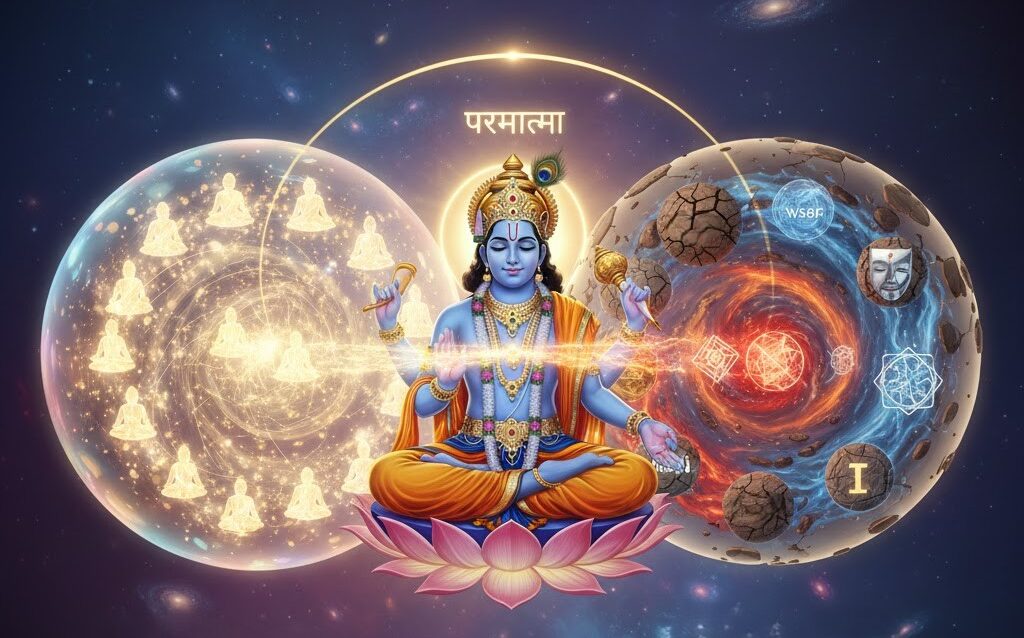
- What is vijnana? It is the conceptual understanding of materiality, cognition of Vishnu – the weave of purusha and prakriti. In fact, it is the awareness of the Self in everything that leads up to jnana.
- At a local level, vijnana includes cognition of the motility of any system or entity.
- Yoga is the union of the impermanent material Self with the state of permanent state or Brahman or Truth. One might also call Yoga as the point where there is merger of jnana and vijnana.
Here, it is important to understand the role of free-will (sankalpa) and consciousness (citta), because consciousness is the connecting medium between jnana and vijnana. Citta is the motility of vijnana and when free-will (sankalpa) is used to subdue the functioning of citta, yoga occurs (yogaścitta-vṛtti-nirodhaḥ).
School of Yoga explains Srimad-bhagavad-gītā, chapter 7, jnana-vijnana-yoga (verse 8-15).
Who is Shri Krishna?
- I define sweet fragrance of earth, brilliance of fire, life in all beings and austerity in ascetics. Thus, I am seed of all beings, intelligence of intelligent and splendour of the splendid.
- I am strength in the strong, without passion or attraction. In beings, I am desire which is not contrary to the state of order/ harmony and natural conditioning (dharma).
- I am creator of sattva (balanced/ harmonious), rajas (passion/ drive/ creativity) and tamas (inertia/ delusional) attitudes. In fact, they are created by me, proceed from me, exist in all including me, but I am not in them. Guṇa’s create illusion (maya), preventing creation from knowing the truth – but taking refuge in the source overcomes this.
School of Yoga explains Srimad-bhagavad-gita, chapter 7, jnana-vijnana-yoga (verse 16-30).
Who is a Yogi? Shri Krishna explains the qualities of the seeker.
- Four types of people who seek my grace (Shri Krishna’s grace) are,
- those in distress,
- those seeking knowledge,
- those seeking wealth and
- those imbibed with wisdom.
- All those who seek my grace are special, but those anchored to (brahman) are dearest to me.
- Often impelled by desire of quick results, people seek other Gods or rites. However, if their devotion is sincere, I enable their devotion to become steady and help them reach their goals. Sometimes, devotees think that blessings have come from deities that they worship when it has actually come from me.
- Furthermore, there is a direct correlation between effort and rewards. Consequently, when a person seeks a boon, he will receive it, be it small, medium or infinite. So, seek carefully…
- However, most people are confused by maya, so they don’t understand me and worship my manifestation. In fact, they don’t comprehend that I am unmanifest and part of the Brahman.
- Also, I know the past, present and future of all beings but opposites arising from attraction and repulsion delude their knowledge of me.
- Only those that have paid their debts and are freed from opposites, find themselves having the ability to remain steadfast in their vows to me.
- As a result, those who recognise me as original creation, deity and sacrifice, strive for deliverance from material attachments to knowledge of the Truth, and come to me in their hour of death.
School of Yoga explains Srimad-bhagavad-gita, chapter 7, jnana-vijnana-yoga.
What is success in Yoga?
There is only one measure of success, which is merger with the Brahman or source/ truth/ infinite peace. This is experienced as a state of infinite peace or nothingness where the Self (atman) experiences no change or karma (nirvikalpa), and does not react to stimulus (citta-vṛtti-nirodha).
What does Shri Krishna mean when he says that he is the quality that drives all creation?
- All creation (srishti) is a combination of the five cardinal elements (pancabhuta): earth (prithvi), water (ap), fire (agni), air (vayu) and ether (akasha). Also, each of these cardinal elements is a combination of guna (attributes).
Example: Prithvi (earth) is predominantly tamas (inertia/ delusional/ self-centred).
- All matter is a combination of the above elements, from the lowly atom to the mighty universe. Each of these entities which come into existence has a centre of identity or Self (atman).
- Each entity also interacts and functions in a system with other entities.
- As a natural corollary, all collection of entities has a centre of identity or Self (atman).
Example: each housing society is defined by a boundary wall and has its own Identity. Similarly, each city, state, region, country or planet have their own centre of Identity. Also, the Sun has an identity, as has Mars, Jupiter, Saturn or Moon. Finally, the biggest entity is the Universe, its center of identity is viṣṇu.
But, Shri Krishna says that he is beyond even that, as well as being the essence of everything that defines materiality.
School of Yoga explains Srimad-bhagavad-gita, chapter 7, jnana-vijnana-yoga.
Shri Krishna establishes some paradigms in Srimad-bhagavad-gita, chapter 7.
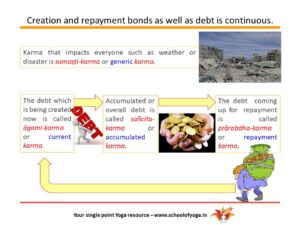
- He is the essence of materiality, the motility in all creation. Also, he clearly states that he is the personality trait (bhava) of every entity.
- However, he also states that he is not responsible for the person’s actions. It is important to understand this difference because personality trait drives action and outcome of action. So, basically Shri Krishna’s underwrites the existence of personality but separates himself from the operation of personality and karma.
- You are on your own! Shri Krishna is the motility of entities but inert. Every time you act, or use free-will, you are getting deeper into a debt trap of action (rnanubandhana). So, free will is a trap. The other solution is to not act. But, that in itself is action, inaction is action! Hence, that is not a solution. The only way out is to not seek action but diffuse every situation that comes one’s way without creating subsidiary action. Consequently, one will need to address every situation with discrimination (viveka) and dispassion (vairagya), avoiding duality of like-dislike, good-bad etc.
- Finally, Shri Krishna says that anyone desiring liberation should completely surrender and submit himself to Shri Krishna’s will. What is this state and how does it operate? What happens is that the person’s will (sankalpa) becomes dysfunctional and while prarabdha-karma acts, further agami-karma ceases to get created because no debt is created. Shri Krishna, by being the focus of surrender acts as the enabler of this metamorphosis.
The Transliteration of Srimad-bhagavad-gita, chapter 7, jnana-vijnana-yoga follows.
Sanskrit words are in red italics.
Śrī Kṛṣṇa said (8-9) First, I am the essence of water in water I am the illumination of the Moon and Sun, the OM in Vedas, sound in ether, manliness in men (raso’hamapsu kaunteya prabhāsmi śaśisūryayoḥ । praṇavaḥ sarvavedeṣu śabdaḥ khe pauruṣaṃ nṛṣu ॥ 7-8॥). Fragrance of pure earth and splendour in fire am I, I am life in all beings and austerity in ascetics (puṇyo gandhaḥ pṛthivyāṃ ca tejaścāsmi vibhāvasau । jīvanaṃ sarvabhūteṣu tapaścāsmi tapasviṣu ॥ 7-9॥).
(10-12) I am the seed of all creation know that I am eternal, I am the intelligence of the intelligent, the splendour of the splendid am I (bījaṃ māṃ sarvabhūtānāṃ viddhi pārtha sanātanam । buddhirbuddhimatāmasmi tejastejasvināmaham ॥ 7-10॥). I am strength of the strong (balaṃ balavatāṃ cāhaṃ), who is devoid of passion or desire (kāmarāgavivarjitam ।). I am passion contrary to harmony in creation (dharmāviruddho bhūteṣu kāmo’smi bharatarṣabha ॥ 7-11॥). Truly, whatever harmonious traits (ye caiva sāttvikā bhāvā) and whatever passionate or delusion (rājasāstāmasāśca ye ।), truly, know that they proceed from me but are not in me (matta eveti tānviddhi na tvahaṃ teṣu te mayi ॥ 7-12॥).
(13-15) All in this world are deluded by the three attributes that drive perceptual traits and by these do not cognise my absolute supreme imperishable nature (tribhirguṇamayairbhāvairebhiḥ sarvamidaṃ jagat । mohitaṃ nābhijānāti māmebhyaḥ paramavyayam ॥ 7-13॥). Verily, my divinity is unfathomable due to this illusion created by attributes (daivī hyeṣā guṇamayī mama māyā duratyayā ।). Only they who take refuge in me can cross this illusion (māmeva ye prapadyante māyāmetāṃ taranti te ॥ 7-14॥). Wicked people, delusional and abject people seek illusion that is deprived of knowledge and are demonical in nature and do not attain me (na māṃ duṣkṛtino mūḍhāḥ prapadyante narādhamāḥ । māyayāpahṛtajñānā āsuraṃ bhāvamāśritāḥ ॥ 7-15॥).
(16-19) Four classes of virtuous people worship me (caturvidhā bhajante māṃ janāḥ sukṛtino’rjuna ।). Importantly, the distressed, the seeker of wisdom, seeker of wealth and the wise (ārto jijñāsurarthārthī jñānī ca bharatarṣabha ॥ 7-16॥). Of them, the wise always intent with single minded devotion excels (teṣāṃ jñānī nityayukta ekabhaktirviśiṣyate ।). Truly, exceeding among the wise is he that loves me and I love in return (priyo hi jñānino’tyarthamahaṃ sa ca mama priyaḥ ॥ 7-17॥). Exemplary all these surely are but the true wise soul, in my opinion (udārāḥ sarva evaite jñānī tvātmaiva me matam ।), is truly he that steadfast soul who is wholly intent upon me as the highest goal (āsthitaḥ sa hi yuktātmā māmevānuttamāṃ gatim ॥ 7-18॥). Of the many births and deaths, the wise reach me (bahūnāṃ janmanāmante jñānavānmāṃ prapadyate ।). Thus, Vaasudeva, among all, such a great soul is difficult to find (vāsudevaḥ sarvamiti sa mahātmā sudurlabhaḥ ॥ 7-19॥).
(20-23) By desires, by this or that, due to lack of knowledge who become worshippers of other Gods (kāmaistaistairhṛtajñānāḥ prapadyante’nyadevatāḥ ।), having followed this or that set of rules or depending on their own prakṛti (taṃ taṃ niyamamāsthāya prakṛtyā niyatāḥ svayā ॥ 7-20॥). Who, who, which, which manifestation the devotee worships with unflinching dedication, those desires that come from devotion I surely grant (yo yo yāṃ yāṃ tanuṃ bhaktaḥ śraddhayārcitumicchati । tasya tasyācalāṃ śraddhāṃ tāmeva vidadhāmyaham ॥ 7-21॥). He who worships with absorbed dedication obtains those wishes, for those genuine desires and such others are actually bestowed by me (sa tayā śraddhayā yuktastasyārādhanamīhate । labhate ca tataḥ kāmānmayaiva vihitānhi tān ॥ 7-22॥). Truly, to them that are of low intelligence, fruits are limited (antavattu phalaṃ teṣāṃ tadbhavatyalpamedhasām ।). To the deities go worshippers of deities. my devotees go to me only (devāndevayajo yānti madbhaktā yānti māmapi ॥ 7-23॥).
(24-26) Those of immature intellect cognise me who is unmanifest as acquiring manifestation of highest not intuiting me as immutable unsurpassed (avyaktaṃ vyaktimāpannaṃ manyante māmabuddhayaḥ । paraṃ bhāvamajānanto mamāvyayamanuttamam ॥ 7-24॥). I am not illuminated, I am universal yoga concealed in māyā (nāhaṃ prakāśaḥ sarvasya yogamāyāsamāvṛtaḥ ।), the deluded of this world do not know that I am unborn imperishable (mūḍho’yaṃ nābhijānāti loko māmajamavyayam ॥ 7-25॥). I know that which has occurred long ago, that which is present and the future, and some living people do not really know me (vedāhaṃ samatītāni vartamānāni cārjuna । bhaviṣyāṇi ca bhūtāni māṃ tu veda na kaścana ॥ 7-26॥).
(27-30) Rising from desire aversion deluded by duality (icchādveṣasamutthena dvandvamohena bhārata ।), from birth, all beings are subject to delusion (sarvabhūtāni sammohaṃ sarge yānti parantapa ॥ 7-27॥). At the end, men of stained birth but virtuous action they who are free from delusion of opposites worship me with firm vows (yeṣāṃ tvantagataṃ pāpaṃ janānāṃ puṇyakarmaṇām । te dvandvamohanirmuktā bhajante māṃ dṛḍhavratāḥ ॥ 7-28॥). For liberation from old age and death, who take refuge in me and make an effort, they know that the Brahman is the complete transcendental Self and repository of action (jarāmaraṇamokṣāya māmāśritya yatanti ye । te brahma tadviduḥ kṛtsnamadhyātmaṃ karma cākhilam ॥ 7-29॥). Who have steadfast consciousness on me know me to be primordial creation, primordial deity and primordial sacrifice even at the hour of death (sādhibhūtādhidaivaṃ māṃ sādhiyajñaṃ ca ye viduḥ । prayāṇakāle’pi ca māṃ te viduryuktacetasaḥ ॥ 7-30॥).
The complete text is available in my book, A Seeker’s Śrīmad-Bhagavadgītā. Buy your copy today – Notion Press home / Flipkart / Amazon / Amazon India / Amazon UK / Amazon US / Amazon Australia
Acknowledgement –
School of Yoga is profoundly grateful to Saṃskṛta scholars and academics Pijus Kanti Pal (pal.pijuskanti@gmail.com) and Dolon Chanpa Mondal for their support in Saṃskṛta transliteration and quality control.