What is creation in Srimad-bhagavad-gita, chapter 7, jnana-vijnana-yoga (Yoga of awareness of the Self in any situation)?
What is the relationship between creation and awareness?
- From Chapters 1 to 6, Shri Krishna discourses on action (karma) and the method of transcending it.
- From Chapter 6, Shri Krishna changes tack and heads into the conceptual basis of Yoga, beginning with jnana and vijnana.
- What is jnana? it is cognition of Brahman, the source, Truth or Transcendental Self.
- What is vijnana? It is the conceptual understanding of materiality, cognition of Vishnu, and the weave of purusha and prakriti. In fact, it is the awareness of the Self in everything that leads up to jnana.
- At a local level, vijnana includes cognition of environment around us, and includes cognition of the motility of any system or entity.
- Yoga is the union of the impermanent material Self with the state of permanent state or Brahman or Truth. One might also call Yoga as the point where there is merger of jnana and vijnana.
Here, it is important to understand the role of free-will (sankalpa) and consciousness (citta), because consciousness is the connecting medium between jnana and vijnana. Citta is the motility of vijnana and when free-will (sankalpa) is used to subdue the functioning of citta, yoga occurs (yogaschitta-vrtti-nirodhah).
Shri Krishna explains creation in Srimad-bhagavad-gita, chapter 7, jnana-vijnana-yoga (verse 1-3).
-
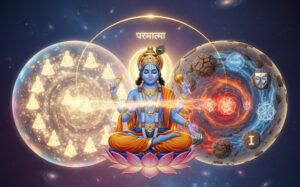
Shri Krishna controls both lower and higher states First, Shri Krishna speaks about the value of surrender; how complete surrender leads to subduing of the Self (asmita). While he recommends surrender unto him (Shri Krishna), this surrender could be any entity because the quality of surrender is the same in all instances.
- Next, Shri Krishna divides creation into two, lower and higher order of creation.
- First, comes lower order of creation (lower prakriti) or the material creation. This constitutes the material universe and has an eightfold divided state comprising earth (prithivi), water (ap), fire (agni), air (vayu), ether (akasha), seat of cognition (manas – where all the sensory stimuli are collated), seat of intelligence (buddhi, where the incoming stimulus is compared with conditioning or dharma and reaction is formulated) and the feeling that I am the doer (ahankara).
- Second, there is a higher level of creation (Brahman) that creates lower the order of creation, also called prakriti. Brahman pervades everything and provides the motive force for creation, sustenance and dissolution of all matter.
- Shri Krishna then declares that all creation proceeds from him and he is the motility that drives their natural state (dharma).
- Additionally, Shri Krishna says that he is passion and all contrary attributes that are natural to any entity. For example, hate, anger, delusion, negativity, divisiveness, prejudice etc. proceed from Shri Krishna also!
- Finally, Shri Krishna states that although he is the creator and nature of all existence, he is not the participant. Consequently, karma or experience of the doer does not affect him.
So, what is Shri Krishna’s position and role in the overall scheme of things? How is he linked to Brahman? Is he some transition point between Brahman and creation? Shri Krishna also seems to be positioning himself as the transition between jnana and vijnana.
School of Yoga explains Srimad-bhagavad-gita, chapter 7, jnana-vijnana-yoga.
What is Creation?
Definition: A divided state is one where there are two discrete states that may or may not be linked. However, in this case, since Brahman is the underlying foundation and motility of both, the two states are inextricably linked.
The higher-level state starts from Brahman and ends with the beginning of creation (jnana), followed by the lower-level state which encompasses creation, maintenance and dissolution of all entities (vijnana).
How are the two states of jnana and vijnana linked? Jnana is the cognition of the Self or the Brahman, vijnana is the cognition of the identity of all material existence (maya) that emerge downstream from Brahman. Common to both states is prajna, which is awareness of Brahman, while consciousness (citta) is the medium that carries the cognition of motility (vijnana) in material existence (maya).
How are these two states different? We know that Brahman is the underlying foundation of both states, providing the motive force for creating, activating, sustaining and destroying all elements, entities and systems. So, let us first understand Brahman.
What is Brahman?
Brahman is that state of infinite, imperishable (cannot die) and immutable (cannot change) state of peace. This state can be compared to a state of null (nothing) or infinity, the “null” being a state of nothing and “infinity” being a state of expanding illusion (maya) that equals 1/0. The difference between null and infinity is that null has no material while infinity has material which is based on the foundation of null (illusion).
- From Brahman emerges a weave of purusha (Identity or experiencer) and prakriti (creation). Brahman provides the motility for both but does not participate.
- The weave of purusha and prakriti results in two possibilities. Brahman with attributes (saguna-brahman), where both purusha and prakriti weave with each other to create materiality (maya) and Brahman without attributes (nirguna–brahman), where prakriti does not manifest and the experiencer or identity (purusha) exists only as pure identity but without motility (prakriti).
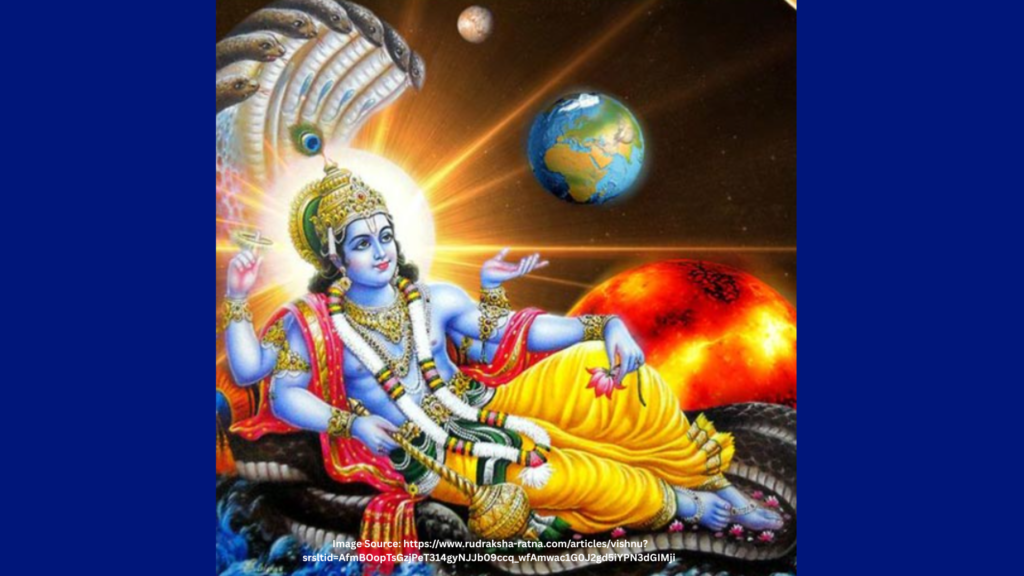
- Saguna–brahman is also known as Vishnu and cognition of Vishnu is vijnana.
- Additionally, when Brahman manifests in saguna state, Brahman becomes materiality or illusion (maya), forming the basis for material cognition. This is the lower order of creation and the state where karma (action) operates.
- Next, the higher order of creation is an unmanifested state called nirguna-brahman (Brahman that has an identity but has not been able to manifest with material attributes). Here, Brahman has emerged from its state of infinite, imperishable (cannot die) and immutable (cannot change) state of peace but it has not got into a state saguna–brahman where it becomes material. So, here purusha remains unmanifested or reverts back into the state of null or Brahman.
- However, both nirguna–brahman and saguna–brahman states are derivatives of the primary state, Brahman.
- Lastly, when saguna-brahman and nirguna–brahman finally reverse integrate back to Brahman, that is called pralaya (merger of maya with the source or Brahman).
- Cognition of Brahman is jnana and the experience is called nirvikalpa-samadhi (uninterrupted and unchanging state of peace).
What is the lower order of creation hiranyagarbha? Who is Vishnu?
- Purusha and prakriti weave as saguna–brahman, and the primordial outcome is called – root of creation (mula-prakriti).
- Also from this weave emerges the supreme soul (paramatman) and this weave develops into, what is called the golden egg or hiranyagarbha (golden womb), brahmanda (egg of Brahman) or the universe.
- From Brahman emerges Ishvara or the observer of maya, that which observes but does not interfere. All of us can experience Ishvara when we step back, become still and just observe.
- Importantly, Hiranyagarbha develops in two ways, first as a big bang, with spontaneous creation of Universal matter. Simultaneously, the second development is unit evolution, creation of quanta or unit building block of matter.
- The weave of purusha and prakriti is the source of action (karma). Karma creates transactions and bonds, and each bond results in the creation of a new identity (atman).
- Atman (soul) is a primary unit of the weave of purusha and prakriti.
- Also, atman is the location where debt resides.
- Since prarabdha-karma exists until the debt is paid off, entities get separated once their debt is reconciled. They then create new bonds with new souls (atman) along with reconstituted debt.
- As a result, multiple identities/ souls or atman of varying complexities are created and dissolved continuously.
- Multiple souls (atman) integrate to form a composite soul that has a discrete form (rupa). Also, this discrete unit can be a sentient being (jiva) or insentient entity (jadam).
- Small, medium and large bonds create small, medium or large systems and entities, each with their own identity (atman).
- As a result of creation and dissolution, a massive supra-eco-system is created where entities, small systems, subsystems and macro-systems of varying complexities exist in the supra-system.
- This macro-ecosystem which houses this continuously evolving and changing mass of entities and systems is called the universe or hiranyagarbha (golden egg).
- Lastly, like all systems, this supra-system or hiranyagarbha (golden egg) also has its own centre of super-identity (paramatman) called Vishnu.
- However, it can be seen that this creation, maintenance and destruction is not real. It exists, changes and morphs. This is called maya (farce or illusion).
- Importantly, the sense of identity (atman) of hiranyagarbha or the universe does not change even though it is evolving continuously. It remains as Vishu and continues to be a creation of the weave of purusha with prakriti, which are a manifestation of the Brahman.
- Consequently, vijnana is the cognition of paramatman, Vishnu, brahmanda, or hiranyagarbha of any system at a material (saguna) level (all the above names mean the same entity).
- Since all existence within saguna–brahman, consequently hiranyagarbha is impermanent and everything is a manifestation of the Brahman, hiranyagarbha and everything within it is an illusion (maya).
- Consequently, Vishnu can be termed as the repository of maya (farce or illusion).
Note – Bṛhadāraṇyaka-upaniṣad states that first, there is nothing, like the state of death. This is the cognitive state of the Brahman.
Then, Brahman expresses itself by creating cognition and intelligence. This also means that it got an identity (purusha). But, we know that there are no free lunches, so how can Brahman express itself when it is in a state of nothing? Obviously, there must be with some sort of sacrifice.
But how can any sacrifice come out of nothing? One thing can be sacrificed. The state of nothing itself. Confused?
Consider this. You are standing in a queue doing nothing and a tough looking person breaks it. You were in a state of nothing, but now you see your line being broken and your sense of order (dharma) is challenged and there is turbulence within.
But, before confronting the bully, you need to confront yourself and sacrifice your fears. Otherwise, you will remain in the state of nothing. There will be turbulence but no outcome.
This sacrifice of the Self for the Self is called yajna. The personality you project is purusha and your actions, which will be a manifestation of your personality (svabhava) is prakriti. The outcome of your effort is karma, this means that whether you act in accordance with dharma, it is karma, don’t act (akarma) or act inappropriately or against dharma (vikarma), you are stuck with the consequences. This outcome is stored for repayment/ reconciliation in your soul (atma).
What are Shiva, Shakti and tantra?
- We have seen that the weave of purusha (experiencer or Identity) with prakriti (manifestation of purusha) creates an Identity called atman which is the repository of debt (rinn).
- However, this continuous and complex series of combinations that creates, sustains and dissolves the Universe must have a constituent, foundational, quanta or unit element or identity on which the whole Universe is built and exists (that point where further break down is not possible).
- What is the constituent primary element / building block of purusha and prakriti? In other words, what is the quanta (micro, unit, smallest building block) that emerges from the Brahman.
- This quanta identity is Shiva, which manifests as Shakti.
- Shiva is the quanta (micro, unit, smallest building block) entity of purusha, which is the experiencer in a macro form. Consequently, this makes Shiva, the quanta or micro-experiencer.
- Similarly, Shakti is the quanta (micro, quanta unit, smallest building block) entity of prakriti.
- Thus, while prakriti is the manifestation of puruṣa, Shakti is the manifestation of Shiva. Purusha weaves with prakriti while Shiva weaves with Shakti.
- Also, while the unit level weave of purusha and prakriti is the Soul or Self (atman), the unit weave of Shiva with Shakti is prana (unit motility).
- Additionally, this weave in both cases is called tantra or weave and the yoking of one with the other in both cases is called yoga.
How do Shiva and Shakti weave to form purusha and prakriti?
- In fact, it can be derived that when quanta Shiva / Shakti bonds with another quanta Shiva / Shakti, a composite or complex identity is created due to karma, which evolves to become the weave of Purusha (experiencer) with Prakriti.
- Also, as the combinations become complex, the composite unit gets a material form (rupa) and becomes both, the Universe and its constituent (hiranyagarbha).
- Thus, we can derive that Shiva is the primary or quanta constituent element of material Brahman (saguna–brahman).
- When Shiva does not manifest, it does not mean that Shiva has ceased to exist, It means that Shiva is in an unmanifested Brahman or nirguna–brahman
- Therefore, Shiva (quanta identity) is present in all the states of Brahman and is called Sada-shiva (perpetual Shiva).
- Thus, it is clear that the weave of Shiva andShakti or Purusha with Prakriti is an experiential state, it has to be cognised/ experienced.
- This awareness is called prajna. When the awareness relates to the Self (purusha) in the environment, it is called vijnana and when it is about the person’s awareness of the Self (Purusha), it is called jnana.
- One can also say that the awareness of a person of the weave (tantra) his or her identity (purusha) with his or her actions (prakriti) is the calibre of his individuality (svatantra) and this applies to all entities, even countries.
Who are the three embodiments (tri-murti) – Brahma, Vishnu and Shiva and their consorts
- Purusha and prakriti weave as saguna–brahman and form the root of creation (mula-prakṛti), or supreme soul (paramatman).
- From saguna–brahman emerges Hiranyagarbha (golden egg), Brahmanda (creation of Brahman) or the universe. This happens in two ways; as big bang, with spontaneous creation of matter along with its constituent unit evolution, as quanta creation of matter. This is the world of brahma, primarily driven by passion (rajoguna), for creation.
- Since creation itself can be irresponsible and passionate, the framework of creation needs to function in systemic harmony, otherwise the system will collapse. Hence, it needs an identity (Vishnu), which brings balance to the various conflicting forces to ensure harmony within the universe (Hiranyagarbha or Brahmanda).
- Since Vishnu creates harmony or balance between rajas and tamas, it is sattvika.
- Lastly, there is Shiva. Shiva is primordial or quanta Identity, predominantly governed by fear of loss of Identity, hence lethargic and delusional. So, Shiva is tamasika-guna. Since Shiva is the quanta identity, it is the building block of all creation, which includes purusha.
The three embodiments (trimurti), each have a consort (devi), these being embodiments of prakriti. Without these tridevi’s, the trimurti’s are irrelevant and cannot function.
- Brahma, as a creator has knowledge (Sarasvati) as its consort. It’s obvious that without knowledge no creative effort will succeed.
- Lakshmi is materiality without which Vishnu cannot have a framework to balance,
- Shakti or Parvathi is energy which drives all delusion and fear which define Shiva’s identity.
The Transliteration of Srimad-bhagavad-gita, chapter 7, jnana-vijnana-yoga follows.
Sanskrit words are in red italics.
Shri Krishna said (1-3) Anchor your cognition on me, take refuge in me, practice yoga, without doubt I will reveal everything to you (mayyāsaktamanāḥ pārtha yogaṃ yuñjanmadāśrayaḥ । asaṃśayaṃ samagraṃ māṃ yathā jñāsyasi tacchṛṇu ॥ 7-1॥). To you, I will reveal in totality this knowledge along with correct interpretation which having known nothing more not even residue remains of knowing (jñānaṃ te’haṃ savijñānamidaṃ vakṣyāmyaśeṣataḥ । yajjñātvā neha bhūyo’nyajjñātavyamavaśiṣyate ॥ 7-2॥). Among thousands of men, only some strive for perfection, among those striving, anyone who becomes perfect knows my essence (manuṣyāṇāṃ sahasreṣu kaścidyatati siddhaye । yatatāmapi siddhānāṃ kaścinmāṃ vetti tattvataḥ ॥ 7-3॥).
(4-5) Earth, water, fire, air, ether seat of cognition, seat of logic, and also feeling that I am the doer form my eightfold divided state of nature (bhūmirāpo’nalo vāyuḥ khaṃ mano buddhireva ca । ahaṅkāra itīyaṃ me bhinnā prakṛtiraṣṭadhā ॥ 7-4॥). Also, from this lower but of different nature is this knowledge of my absolute state the life material by which this the universe is maintained (apareyamitastvanyāṃ prakṛtiṃ viddhi me parām । jīvabhūtāṃ mahābāho yayedaṃ dhāryate jagat ॥ 7-5॥).
(6-7) Therefore, know me to be the source of all creation I am the sole reason of creation and dissolution (etadyonīni bhūtāni sarvāṇītyupadhāraya । ahaṃ kṛtsnasya jagataḥ prabhavaḥ pralayastathā ॥ 7-6॥). In fact, other than me no other is higher, all this are strung on me like a string of pearls (mattaḥ parataraṃ nānyatkiñcidasti dhanañjaya । mayi sarvamidaṃ protaṃ sūtre maṇigaṇā iva ॥ 7-7॥).
The complete text is available in my book, A Seeker’s Śrīmad-Bhagavadgītā. Buy your copy today – Notion Press home / Flipkart / Amazon / Amazon India / Amazon UK / Amazon US / Amazon Australia
Acknowledgement –
School of Yoga is profoundly grateful to Saṃskṛta scholars and academics Pijus Kanti Pal (pal.pijuskanti@gmail.com) and Dolon Chanpa Mondal for their support in Saṃskṛta transliteration and quality control.