What is the basis of Hindu Temple art?
Indian texts call the builders and craftsmen temple art as ‘‘Shilpin’’, which is derived from ‘‘Shilpa’’. One of earliest mentions of Sanskrit word Shilpa is in Atharvaveda, from before 1000 BC, which foreign scholars have often translated as “work of art”. However, no single English word actually describes “Shilpa” or ‘‘Shilpin’’.
Definition of Shilpa and Shilpin in Hindu Temple art?
Shilpa is a multilayered/ multifaceted word which incorporates dharma or Hindu conceptual philosophy with temple art, skill, capability, ingenuity, imagination, awareness and inventiveness of any art or craft. Similarly, a Shilpin is any person who synergises consciousness into art, science, culture, skill, rhythm and employs creative principles to produce any divine form of expression that elevates the consciousness of the worshipper.
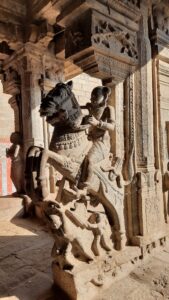
According to ancient Sanskrit text, the Shilpins who built Hindu temples as well as the art works and sculpture within them, were expected to deploy 64 techniques or Kala (techniques) and 32 scientific principles or Vidya to bring forth an unlimited and varied expression of divine art.
Who was considered qualified to express Temple art?
The Hindu manuals of temple art and construction describe the education, characteristics of good artists and architects. The general education of a Hindu Shilpin in ancient India included Lekha or Lipi (alphabet, reading and writing), Rupa (drawing and geometry), Ganana (arithmetic). These were imparted from age 5 to 12. The advanced students of temple art would then continue in higher stages of Shilpa Sastra studies till about the age of 25.
Importantly. apart from specialist technical competence in temple art, manuals suggest that best Shilpins who built Hindu temples were thos who understood the conceptual essence of the Vedas, Tantra, Yoga and Agama. Not only that, the best shilpins often considered themselves to be lifelong students, constantly keeping themselves well versed with principles of traditional sciences and mathematics, painting and geography.
Further, they were expected to have a high moral and ethical consciousness, be kind, free from jealousy, righteous, have their senses under control and of a happy nature in everything they do.
How does Temple art come to life?
According to Shilparatna, a Hindu temple project would start with a Yajamana (patron), and include a Sthapaka (guru, spiritual guide and architect-priest), a Sthapati (architect) who would design the building, a Sutragrahin (surveyor), and many Vardhakins (workers, masons, painters, plasterers, overseers) and Taksakas (sculptors). While the temple was under construction, all those working on the temple were revered and considered sacred by the patron as well as others witnessing the construction.
Importantly, all tools and materials used in temple building as well as all creative work undertaken had the sanction of a sacrament. For example, if a carpenter or sculptor needed to fell a tree or cut a rock from a hill, he would propitiate the tree or rock with prayers, seeking forgiveness for cutting it from its surroundings, and explaining his intent and purpose. The axe used to cut the tree would be anointed with butter to minimize the hurt to the tree.
In fact, even today, craftsmen of Bharat propitiate their tools and trade during Visvakarma Puja, a festival that occurs every year, when the craftsmen and artists worship their arts, tools and materials.
Temple art come in a variety of Styles
Hindu temples are found in diverse locations each incorporating different methods of construction and styles:(a) Mountain temples (b) Forest temples (c) River bank and sea shore temples (d) Step well temples and (e) Cave temples. Of these we shall discuss the last two which are special and different from the others.