Introduction to Hindu temple Art
The typical, ancient Hindu temple art is infused with a profusion of cognitive anchor points – from paintings to sculpture, from symbolic icons to engravings, from thoughtful layout of space to fusion of mathematical principles with Hindu sense of time and cardinality. Importantly, all these art forms are meant to elevate the worshipper from the mundane to moksha or liberation.
Classification of Hindu Temple art according to projection
Ancient Sanskrit texts classify idols and images in number of ways. For example, one method of classification of idols or vigraha in Hindu Temple art is the dimensionality of projection:
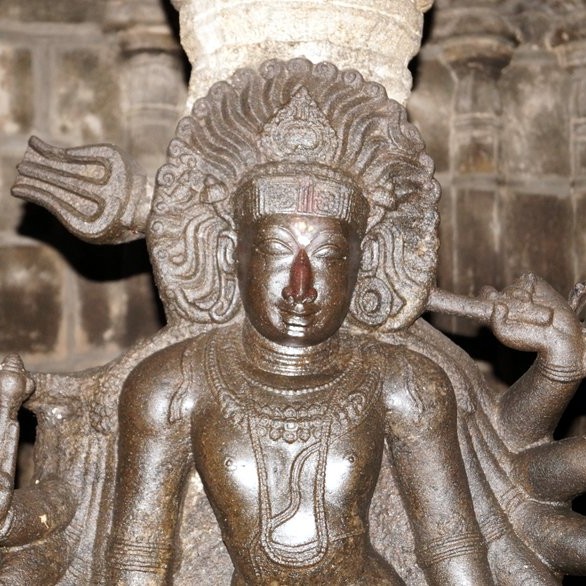
- Chitra: images that are three-dimensional and completely formed
- Chitrardha: images that are engraved in half relief
- Chitrabhasa: images that are two-dimensional such as paintings on walls and cloth
Classification of Hindu Temple art according to sentiment
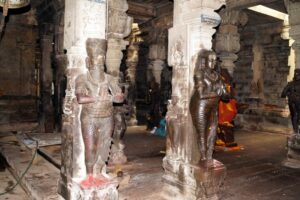
Another way of classification is by the expressive state of the image:
- Raudra or Ugra: are images that were meant to terrify, induce fear. These typically have wide, circular eyes, carry weapons, have skulls and bones as adornment. These idols were worshiped by soldiers before going to war, or by people in times of distress or terrors. Raudra deity temples were not set up inside villages or towns, but invariably outside and in remote areas of a kingdom.
- Shanta and Saumya: are images that were pacific, peaceful and expressive of love, compassion, kindness and other virtues in Hindu pantheon. These images would carry symbolic icons of peace, knowledge, music, wealth, flowers, sensuality among other things. In ancient India, these temples were predominant inside villages and towns.
Relationship between Hindu Temple Art and liberation
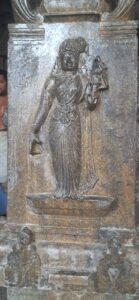
A Hindu temple may or may not include an idol or images, but larger temples usually do. Personal Hindu temples at home or a hermitage may have a pada for yoga or meditation, but be devoid of idols. To a Hindu yogi, one who has realised Self and the Universal Principle within himself, there is no need for any temple or divine image for worship. However, for those who have yet to reach this height of realization, various symbolic manifestations through images, idols and icons as well as mental modes of worship are offered as one of the spiritual paths in the Hindu way of life. This belief is repeated in ancient Hindu scriptures. For example, the Jabaladarshana Upanishad states:
शिवमात्मनि पश्यन्ति प्रतिमासु न योगिनः |
अज्ञानं भावनार्थाय प्रतिमाः परिकल्पिताः || ५९ ||
Meaning – A yogin perceives God (Siva) within himself, images are for those who have not reached this knowledge.
History of the development of Hindu Temple Art
A number of ancient Indian texts suggest the prevalence of Hindu Temple art and it’s many idols, temples and shrines in Indian subcontinent for thousands of years. For example, the temples of the Koshala kingdom are mentioned in the Valmiki Ramayana (various recent scholars’ estimates for the earliest stage of the text range from the 7th to 4th centuries BCE, with later stages extending up to the 3rd century CE). The 5th century BC text, Astadhyayi, mentions male deity (images/idols) of Agni, Indra, Varuna, Rudra, urya, and Soma being worshipped, as well as the worship of female goddesses such as Indrani, Varunani, Usha, Bhavani and Prithivi.
The 2nd Century BC “Mahabhashya” of Patanjali extensively describes temples of Dhanapati (deity of wealth, Kubera), as well as temples of Rama and Kesava, wherein the worship included dance, music and extensive rituals. It also describes the rituals for Krishna, Vishnu and Siva. An image recovered from Mathura in north India has been dated to the 2nd century B.C.
Kautilya’s Arthashastra from 4th Century BC describes a city of temples, each enshrining various Vedic and Puranic deities. All three of these sources have common names, describe common rituals, symbolism and significance possibly suggesting that the idea of idols, temples and shrines passed from one generation to next, in ancient India, at least from the 4th century BC. The oldest temples were built of brick and wood. Stone became the preferred material of construction later.
Early Jain and Buddhist literature, along with Kautilya’s Arthashastra, describe structures and designs of these temples – all with motifs and deities currently prevalent in Hinduism. Bas-reliefs and idols have been found from 2nd to 3rd Century, but none of the temple structures have survived. Scholars theorize that those ancient temples of India, later referred to as Hindu temples, were modeled after domestic structure – a house or a palace. Beyond shrines, nature was revered, in forms such as trees, rivers, and stupas, before the time of Buddha and Vardhamana Mahavira. As Jainism and Buddhism branched off from the religious tradition later to be called Hinduism, the ideas, designs and plans of ancient Vedic and Upanishad era shrines were adopted and evolved, likely from the competitive development of temples and arts in Jainism and Buddhism.