Importance of step wells and water
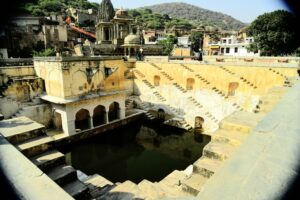
In arid western parts of India, especially Rajasthan and Gujarat, water is critical for survival, and people have to often trudge long distances to get water. So, people here have elevated water to divinity to reflect the sacred nature of water for survival. In fact, no matter where a person goes in Rajasthan or Gujarat, they will first be offered a glass of water to signify the importance of the visitor by offering the most important thing available in the house, water.
There are five primordial elements, Earth (Prithvi), Water (ap), Fire (Agni), Air (Vayu) and Space (Akasha). This makes water a cardinal and divine element in Hindu philosophy and consciousness.
Folklore from Rajasthan on the cultural importance of water
Folklore has it that the Battle of Haldi Ghati in 1576 AD was triggered because Maharana Pratap did not offer water to Raja Man Singh when he came to Chittorgarh for peace talks. A furious Raja Man Singh is said to have fumed “Aisi kya dushmani hai ki pani bhi nahi pilaya (what kind of enmity is this I was not even given a sip of water)” as he strode out of the ramparts of Chittorgarh fort. This shows how water was viewed by the valiant Rajputs, that even an enemy was not denied a drink of water.
Design of Step wells
The criticality of water made it nectar and this triggered Hindu communities in these two states, as well as many other parts of Bharat, to synergise temples and build large walk-in wells that served not only as a source of water in dry months, but also as a social and spiritual meeting place that carried religious significance.
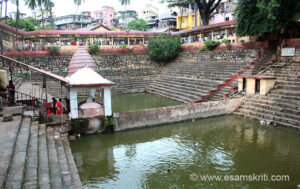
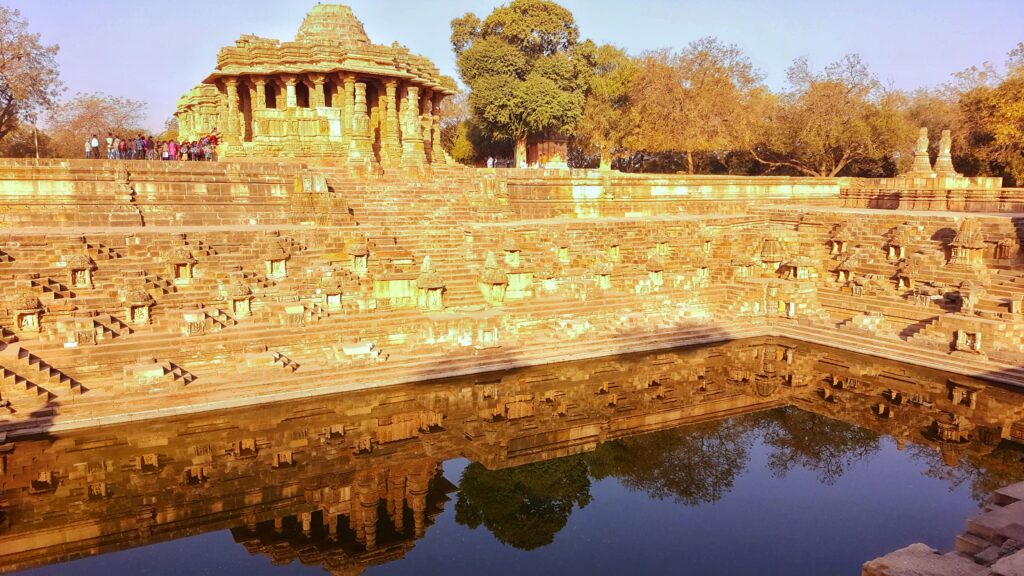
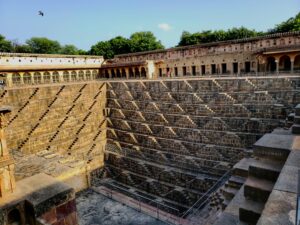
A step well is a subterranean water storage and harvesting structure that dive deep into the water table and are approached by linear and architecturally synchorised flights of steps. In fact, many of these beautiful monuments went into earth towards subterranean water, sometimes up to seven storeys, and are often part of a temple complex.
Importantly, step well designs were sturdy and often designed to withstand earthquakes. Also, their design had two components. First, a vertical shaft which was often fitted out with Persian Wheels which were driven by bullocks and accessed the water from deep under the earth and second, multiple flights of steps that decended to the waterline.
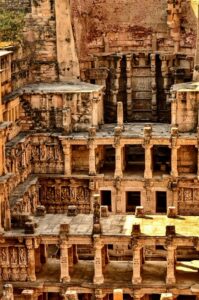
Additionally, these baoris or vav (stepwells) had intricate art reliefs on the walls, with numerous idols and images of Hindu deities, water spirits and symbols.
Today, with the advent of modern water management systems, step wells no longer have the centrality that they once enjoyed in the cultural, social and religious landscape of their societies. However, their beauty and aesthetics, as well as sacred spaces continue to draw people, making these places important religious tourism destinations.
Some important step wells
Furthermore, step wells were often named after Hindu deities; for example, Mata Bhavani’s Stepwell, Ankol Mata Vav, Sikotari Vav are some examples. In fact, the temples varied in size, from small single pada (cell) structures to large nearby complexes. Furthermore, these stepwells and their temple compounds have been variously dated from late 1st millennium BC through 11th century AD. In fact, there is a step well in Kerala at Peralasherry Temple. and at Kamakhya Temple at Guwahati.
Importantly, Rani ki vav, with hundreds of art reliefs including many of Vishnu deity avatars, has been declared a UNESCO World Heritage site.
You can read more about step wells @ https://www.esamskriti.com/theme/STEP~WELLS-India.aspx
Photo credits – Kalpa Shah-Maniar and esamskriti