
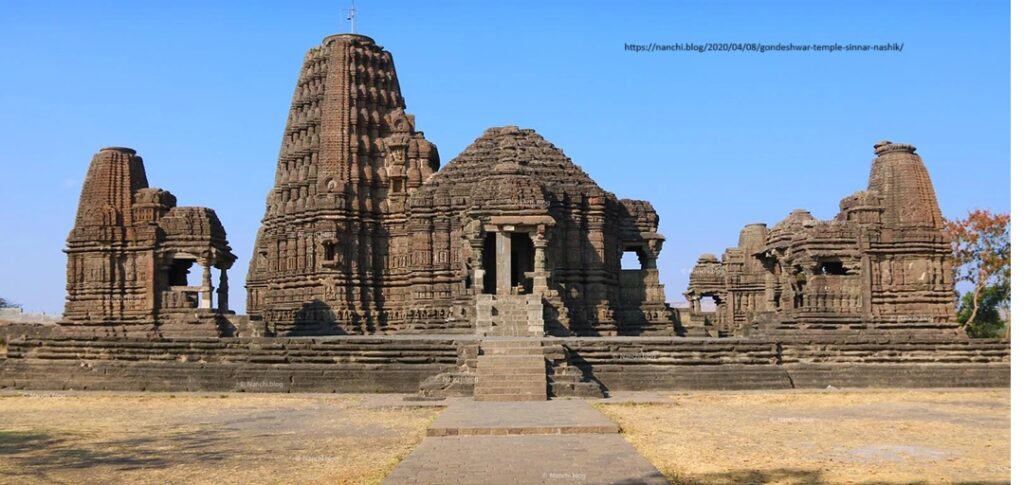
Introduction to Hindu temple designs
Hindu temple designs take two forms: a house or a palace. In fact, as per ancient Sanskrit texts such as Brihat Samhita, the appropriate site for the siting of a temple is near water and gardens, where lotus and flowers bloom, where swans, ducks and other birds are heard, where animals rest without fear of injury or harm. Also, the ground should be clean with no blemishes. Moreover, these harmonious places were recommended in the ancient texts because these places where gods are considered to play, and thus the best sites for the placement of a temple.
Importantly, while major Hindu temples are recommended at sangams (confluence of rivers), river banks, lakes and seashore, Puranas suggest temples may also be built where a natural source of water is not present. In such cases, they recommend that a pond be built in front or to the left of the temple with water gardens surrounding the area. Additionally, Visnudharmottara suggests that Temples may also be built, inside caves and carved stones, on hill tops affording peaceful views, mountain slopes overlooking beautiful valleys, inside forests and hermitages, next to gardens, or at the head of a town street.
So, the intention is straightforward. Find a site that is physically clean and salubrious, so that the consciousness finds natural peace and resonates with dharma.
Temple design and Architecture
Ancient builders of Hindu temples created manuals of architecture, called Vastu-Sastra (literally “science” of dwelling; vas-tu is a composite Sanskrit word; vas means “reside”, tu means “you”). In fact, many Vastu-Sastras manuscripts exist and these covers myriad topics such as Temple design and construction, home layout planning and construction, town planning, how kingdoms should integrate temples, water bodies and gardens in their layout to achieve harmony with nature and dharma of it’s residents.
Thus, Hindu temple designs were conceived to ensure that temples served as anchors of art and culture, and formed an integral part of Hindu civilisational, social and spiritual life, also known as sanathana dharma.
The Silpa Prakasa of Odisha, authored by Ramachandra Bhattaraka Kaulachara in the ninth or tenth centuries AD, is an important Sanskrit treatise on Temple Design and Architecture. Importantly, it describes the geometric principles in every aspect of the temple and symbolism such as 16 emotions of human beings carved as 16 types of female figures. Moreover, Silpa Prakasa provides brief introduction to 12 types of Hindu temples. In fact, these styles were perfected in Hindu temples prevalent in eastern states of India and continue to influence temple designs today.
Additionally, other ancient texts expand these architectural principles, suggesting that different parts of India developed and added their own interpretations. For example, in Saurastra tradition of temple design and building found in western states of India, the feminine form, expressions and emotions are depicted in 32 types of Nataka-stri. Furthermore, other texts such as Pancharatra Prasada Prasadhana and Silpa Ratnakara provide a more extensive list of Hindu temple designs, layouts and overall presentation.
Ancient Sanskrit manuals for temple construction discovered in Rajasthan, include Sutradhara Mandana’s Prasadamandana. Also, Manasara Shilpa Shastra is an ancient 7th century AD Sanskrit guidebook of approximately 70 chapters and 10,000 shlokas on South Indian Temple design and construction, as well as town planning, architecture and sculpture. Isanasivagurudeva paddhati is another Sanskrit text from the 9th century describes the art of temple design and building in India in south and central India. Additionally, in north India, Brihat-samhita by Varāhamihira is the widely cited ancient Sanskrit manual from 6th century describing the design and construction of Nagara style of Hindu temples.
Loved the article for it’s detailed research into the architecture of ancient temples of Bharat. Isn’t it so wonderful that the architecture changes in practically every state.