Click here to read the previous article on karma.
What is the role of karma ? How do the ancient seers (rishis) explain this?
There have been many references on why people perform action. Most people perform action for an outcome. Outcome is generally motivated by desire which is quantifiable, objective, or visible (drishtaphala), or for an outcome that is not visible or quantifiable (adrishtaphala).
Examples of visible karma (drishtaphala) or karma with visible outcomes – We study and get the results that are commensurate with our efforts. Similarly, when we buy something, we get direct inputs on the quality of the item that we have bought.
Examples of invisible karma (adrishtaphala) or karma that occurs without our cognition – our heart beats, out stomach churns and blood circulates, yet, we do not cognise it. We speak with someone, we can only gauge how much they have understood. We use cars without cognising the impact on climate change. Similarly, we travel without tickets, or cheat on our taxes, without fully cognising the impact on our country.
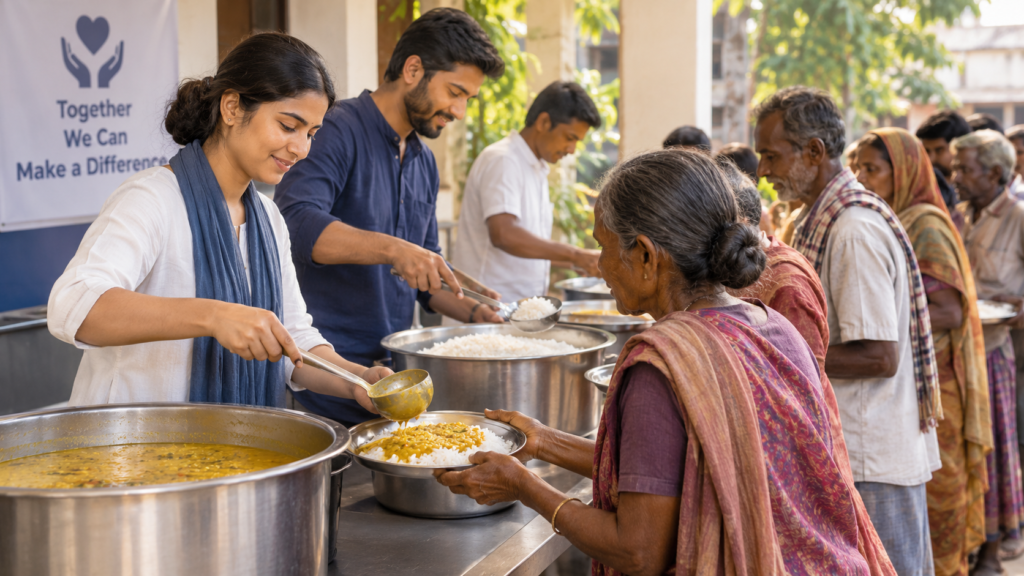
Charity (dana) is both drishta and adrishtaphala. Charity where we are directly involved, e.g. feeding the poor , i.e. anna-dana , is drishtaphala. However, just giving money(lakshmi-dana) is adrishtaphala, because one is never sure how the money will be used. So, since we control the outcome, drishtaphala is always better than adrishtaphala.
Importantly, since our cognition is limited by our awareness, most karma is adrishtaphala. This is why Shri Krishna tells Arjuna in Srimad-Bhagavad-Gita that the current of karma runs deep :
Chapter 4 – Also, should be known of action, as should be known prohibited action and knowledge of inaction, because action is deep (karmano hyapi boddhavyam boddhavyam ca vikarmanah । akarmanasca boddhavyam gahana karmano gatih ॥ 4-17॥). He who perceives action in inaction and inaction in action is wise among men and in complete union in all action (karmanyakarma yah pasyedakarmani ca karma yah । sa buddhimanmanusyesu sa yuktah krtsnakarmakrt ॥ 4-18॥).
What is the role of karma according to Jaimini’s purva-mimamsa (early reflections)
- Jaimini’s purva-mimamsa is one of the earliest attempts to classify how life should be lived. It was written around 300-200 BCE.
- Jaimini states that all actions (karma) should be performed as a sacrifice (yajna).
The classification of karma is as follows:
- Nitya-karma (perpetual, mandatory or daily sacrifices) – covers the five major sacrifices (pancha-maha-yajnas) that any individual is supposed to perform. These five (pancha-maha-yajna) are – rishi-yajna (sacrifice to the seers), deva-yajna (sacrifice to the deities, represented by the vedas) and pitr-yajna (sacrifice to the manes), which are covered in a ritual called brahma-yajna. Bhuta-yajna, which covers supporting all sentient and insentient creations and finally manusyaka-yajna which covers helping other less fortunate human beings. Nitya-karma also covers regular rituals such as sandhya-vandana (salutation to the various transitions of the Sun), tarpana and shraddha (ceremonies to feed the manes) as well as other prescribed rituals.
Importantly, nitya-karma is a hygiene factor. Doing it will not add value, but not doing it will create debt.
- Naimittika-karma (periodic or optional karma) – covers sacrifices that are performed to support various rites-of-passage (samskara) such as naming ceremony, marriage ceremony, death ceremony etc. Naimittika-karma also covers upanayana-samskara which is performed whenever there is knowledge transmission. Also, naimittika-karma is generally performed with a selfish objective that does not harm anyone. Consequently, it creates debt.
- Kamya-karma (karma motivated by desire) – covers optional sacrifices and refers to any sacrifice performed with a desire for material gain. This karma creates more debt than naimittika-karma because there will be winners and losers.
- Nisada-karma (forbidden action) – covers any action that goes against order and harmony (dharma). This is also called vikarma in Srimad-Bhagavad-Geeta, chapter 4. Obviously, this karma is to be avoided.
- It is important to note that both nitya and naimittika-karma are obligatory and must be performed as prescribed. These sacrifices do not yield any fruits, they are mandatory maintenance actions for maintaining personal dharma (svadharma). Failure to do so will result in debt (rnanubandha).
- Both kamya-karma and nisada-karma will result in debt, depending on the severity of impact of the action.
The essence and role of karma according to Shri Krishna in Srimad-Bhagavad-Gita :
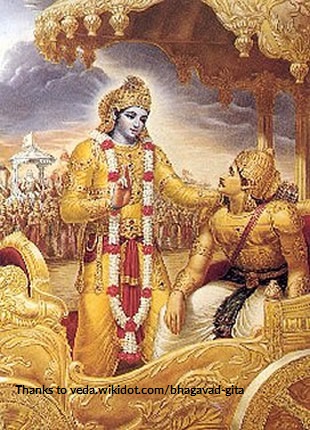
The Srimad Bhagavad Gita beautifully explains the role of karma.
Shri Krishna classifies action into three types, action (karma), inaction (akarma), and forbidden action (vikarma) in Chapter 4. Importantly, Sri Krishna states that even inaction is action, and only action which is performed as a sacrifice (yajna) is karma that will not result in debt (rna).
- First, sacrifice is where action is performed without desire (niskamya-karma). Here, action and result are experienced without duality such as like-dislike, good-bad or right-wrong.
- Next, sacrifice also occurs when one renounces the fruit of one’s action (karmaphala-tyaga), which means that the person becomes indifferent to success or failure of the result.
- Lastly, sacrifice occurs when the person is in a state of renunciation when acting (karma-sannyasa).
What this means is that when a person removes individuality or sense of doership from the action, there is no rna or generation of debt.
What is the role of karma in rebirth or samsara ?
As mentioned above, all actions (karma) result in an outcome. Some we like, others we dislike. This like-dislike / give-take dichotomy drives us to identifying the outcome with the person. Consequently, we pull the person closer or push the person away. Also, this transaction is never equal. in fact, we either give or get more. As a result, there is a generation of debt by us or towards us.
Consequently, this debt, like all other debt, has to be paid off, there is no free lunch. So, if karma generated in this birth is not paid off in this life, then there comes a need for another birth to pay the debt off. This is the basis of the concept of rebirth (samsara). This explains the role of karma in rebirth.
How can we avoid rebirth?
Thanks to Sri Ron Wells for asking the question.
- Karma, by itself, is inert. It doesn’t care who does what.
- Next, debt is generated when value is ascribed to the effort as well as entity in the transaction.
- Since there is a disparity in give and take, and one of the entities gives or gets more, there is a creditor or debtor in the transaction.
- This debit and credit needs to be reconciled, if not in this birth, then in the next.
- Importantly, this bond exists for as long as the debt exists. Thereafter, the bond between the entities will dissolve.
- Also, this debt is carried by the sense of Identity (purusa). So, the debt exists as long as the sense of identity exists. This means that if the person were to negate his or her sense of Identity, then karma will cease to get created, because there is no one to credit or debit it to. For example, our debt to the bank exists only for as long as we are alive. Thereafter, there is neither debit nor credit.
So, how can we stop the identity (purusa) from creating karma? Through the practice of Yoga! When we practice yoga, the consciousness slowly stops seeking validation, becomes steady within the Self and finally stops moving. The state when it stops moving is called samadhi. In this state, even though action may be happening, there is no generation of debt because there is no creation or destruction of value.
Some points to ponder on the role of karma :
Internal Tags: Self Awareness or Asmita, Karma Yoga (Bhagawat Gita – chapter 3)
External Tags: vasana (karmic image), purva-mimamsa, nitya-karma, brahma-yajna,
- How do situations impact karma?
- Can a hurtful word impact karma?
- How does obsession impact karma?