Renunciation meaning in jnana-karma-sannyasa-yoga (yoga of renunciation of the Self in action).
Renunciation meaning in jnana-karma-sannyasa-yoga – Introduction.
What is the contextual renunciation meaning in jnana-karma-sannyasa-yoga or Yoga of renunciation of the Self in action.
- What is jnana? Jnana means “knowledge of the Self”. Here, jnana-yoga means that knowledge which yokes a person’s awareness of the Self to Brahman.
- What is karma? Karma means action. In this chapter, Shri Krishna explains how action can be performed without accruing debt (rinn).
- What is sannyasa? Sannyasa means renunciation.
Renunciation meaning in jnana-karma-sannyasa-yoga – Synopsis.
- We have seen in chapter 1, Arjuna experiences deep melancholy at having to fight his kinsmen.
- Shri Krishna, after chiding him, tells him that his logic is incorrect and explains the philosophy of living in chapter 2 (sankhya-yoga).
- Following this, in chapter 3, Shri Krishna explains karma-yoga or the attitude with which action must be performed, so that no debt is accrued.
- In this chapter, Shri Krishna starts by speaking about his own origin and role in creation. Then, he delves into the qualities of action (karma) and sacrifice (yajna).
- The central message, as depicted in the heading is, that action should be performed for merger (yoga) of the Self with the Brahman (jnana) and this is possible only with an attitude of renunciation (sannyasa) when performing action as a sacrifice (yajna).
- Therefore, the chapter 4 covers knowledge of karma and its renunciation through sacrifice of one’s action (yajna).
Renunciation meaning in jnana-karma-sannyasa-yoga (verse 1 – 15).
Arjuna’s doubt.
Shri Krishna tells Arjuna that he taught yoga to the Sun. Arjuna, sceptical, counters that this would not be possible because the Sun came before him, Shri Krishna. Shri Krishna explains many things about himself, and moves away from the image of a person he had projected himself to be and shows himself to be different.
What is Shri Krishna saying about himself in this chapter?
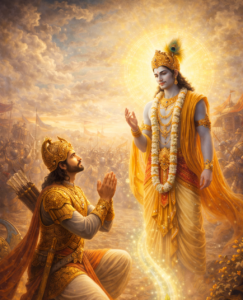
In this chapter, Shri Krishna reveals himself and these need to be understood with respect to the concept of Yoga.
- I taught yoga to the Sun who taught it to the world. I existed before everything (verse 1-4).
- “I can control prakriti and creation”. So, Shri Krishna is indicating that he is a trigger and control for creation prakṛti. However, it is unclear what he means by calling himself Lord of all beings and his relationship to Brahman (Ch 4 verse 6).
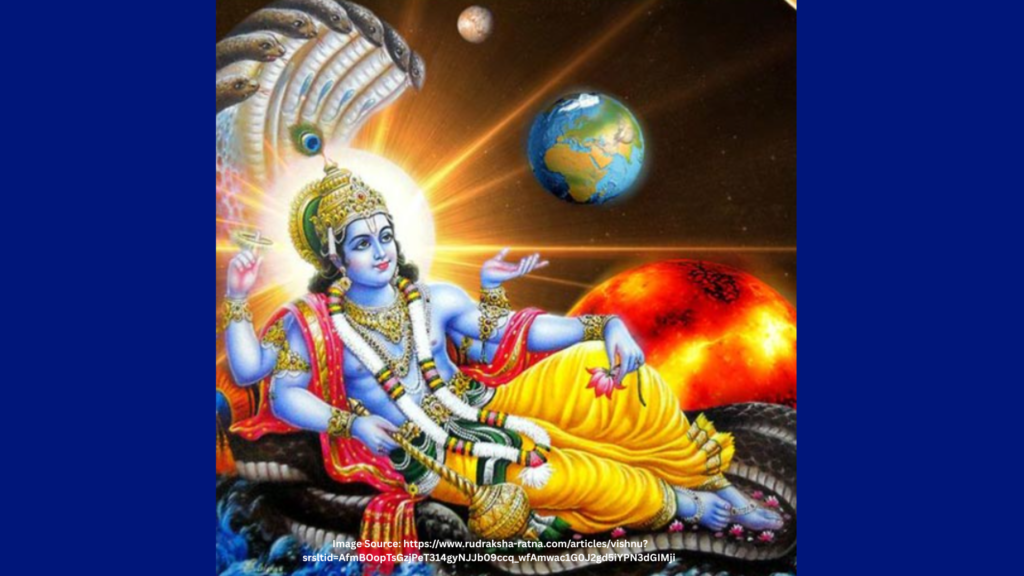
- When natural state (dharma) decays and there is increase in chaos (adharma), I embody myself. For protection of the virtuous and destruction of wicked and for re-establishment of natural balance I take birth in every era. This is borne out by the ten avataras of Vishnu in dasa-avatara (verse 7-8).
- Shri Krishna seems to be indicating that his permanent state is not material, but a transient or trigger state between Brahman and maya, one that allows free movement between the two states.
- “In whatever way people approach me, I reward those people who follow my path only”. Shri Krishna asserts in verse 14 and verse 35 that submission to him is akin to submission to Brahman (verse 11).
- “Four categories of people are created by me based on their orientation to action (guṇa-karma-vibhagasah), also know that though I am also the initiator, I am not engaged and imperishable”. This is a confusing verse – are the categories (varna) created by him, people or both. This also separates him from the motility aspect of Brahman (verse 13).
- “Actions do not taint me, nor do I desire the fruits of action, thus those that know me are not bound by actions”. Shri Krishna says that like him, that anyone merging with Brahman becomes Brahman (verse 14).
- Not knowing this one will commit to delusion repeatedly, by this all beings see in their Self me also. Shri Krishna reinforces the message that when the practitioner merges with Brahman, there is no difference between him and the practitioner. Clearly, Shri Krishna is saying that he has merged with Brahman (verse 35).
Conclusion: Shri Krishna in the Shrimad-Bhagavad-Gita cannot be viewed as a person. He has to be looked upon as a yogi who has reached the highest levels of Yoga. Also, it is dangerous to view Shri Krishna as a role model for modern living, because throughout Mahabharata he is engaged in destroying a society that has been built on a particular tradition with a capability that is out of the envelope of normal existence.
Hence, it is advisable for one to extract lessons from the Shrimad-Bhagavad-Gita and find his or her own solutions to achieving perfection in yoga.
Renunciation meaning in jnana-karma-sannyasa-yoga (verse 16 – 22).
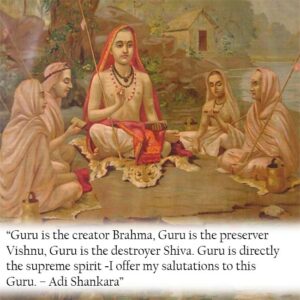
When performing, one should be cognisant of prohibited action and be aware of action in inaction. He who perceives action in inaction and inaction in action is wise among men and in complete union in all action.
Start all undertakings without desire or expectation and abandon fruits of effort. Also, be ever content and not dependent on anything when engaged in action.
That person who acts with an integrated consciousness and sense of self-worth (asmita), abandons all commission (ahankara), using only the body for performing action, gets no injustice.
Such a person is content with whatever profit come spontaneously, is free from opposites, unselfish, always balanced in success and failure and not bound by actions.
Renunciation meaning in jnana-karma-sannyasa-yoga (verse 19-23).
- Action (karma) occurs everywhere, even when one thinks that they are not acting.
- There are three types of action, approved action (karma), inaction (akarma) and prohibited action (vikarma). Approved action is that which is in conformance with dharma (natural state), inaction is that which occurs when we think we are not acting and prohibited action is that which causes chaos (adharma).
- Hence, to understand action and transcend it (jnana-karma-yoga), one must act with awareness of the self (prajna) when engaged in action (karma).
- These include;
- performing action as a sacrifice
- abandoning fruits of action and commissions
- being content with whatever outcome occurs, balanced in success and failure
- acting without expectations, not being attached to outcome
- being free from opposites, unselfish
- integrating consciousness (citta) with Self (atman).
Renunciation meaning in jnana-karma-sannyasa-yoga– What is Dharma?
- The key factors for achieving jñāna-karma-yoga are – acting according to dharma, avoiding duality in action, remaining in equanimity during and after action and having no attachments to the outcome.
- The starting point of approved action (karma) is practice of dharma in action. But what is dharma?
- We are at peace in certain situations but become agitated in other situations. The contributing factors which underpin our ability to be in a natural state of peace is our dharma. These factors will vary for each individual or entity.
- Whenever we get stimulus that is congruent to this natural state, we remain in our natural state (dharma) and respond peacefully/ in harmony. Conversely, when we get stimulus that is out of congruence with our natural state, our balance gets disturbed and we go into a state of agitation or chaos (adharma).
- Thus, dharma, which can also be referred to as natural state or conditioning, and is the basis on which we decide whether we like or dislike something, and also the basis of our response (karma).
- Hence, we can say that dharma (conditioning) is that core aspect of our personality which drives decision-making as well as our responses or action (karma) and consequently our sense of self-worth (asmita).
- Importantly embedded in dharma are other decision-factors such as, avoiding duality in action, remaining in equanimity during and after action and having no attachments to the outcome.
- This is the importance of dharma and acting in accordance with that deep internal harmony.
Renunciation meaning in jnana-karma-sannyasa-yoga – Dharma concept.
Let us look at how we develop our natural state (dharma) and what makes each of us different!
- We are like computers! First, we get our DNA from our parents. When we are born, we only know how to cry, eat, sleep and perform basic body functions.
- Next, our parents load us with values and ability to live in society, this becomes our operating systems and forms the basis of our decision parameters. Also, schools augment our values with knowledge, while society help us integrate into a network that is fundamentally hierarchical.
- So, our Identity and approach to life becomes defined by a personalised and unique decision-making framework. We judge everything and everyone based on this conditioning.
- This conditioning or value system is our natural state of balance, where we are at peace and is called dharma.
Renunciation meaning in jnana-karma-sannyasa-yoga – Categorisation of dharma.
- Generic natural state or samanya-dharma.
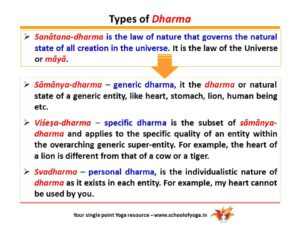
Generic natural state or samanya-dharma can be defined as those characteristics which are common to any family of entities.
For example: Gold has specific characteristics which are different from lead or silver. However, all of them come under a common category of metals. All metals have a common natural state and this is called samanya-dharma.
Similarly, metals as a category, exhibit characteristics which are different from animals, trees, fishes or humans. This specific defining character which defines each category, family or genus is called samanya-dharma.
- Specific natural state or vishesha-dharma.
Specific natural state or vishesha-dharma is the natural state of individual entities within a family of entities.
For example: Within metals, gold is different from copper, silver or iron. In wood, teak is different from oak or rubber. The family of wood will conform to a generic or samanya-dharma. However, the unique natural state (vishesha-dharma) of teak will be different from oak, elm or rosewood.
This logic can be expanded in multiple directions. For instance, the unique natural state (vishesha-dharma) of a table will be different from that of a chair or sofa, even though they may both be made from the same tree. Thus, all tables will exhibit a unique natural state, regardless of the material used to make them.
In fact, this concept is applicable to all entities. A heart has a unique natural state, regardless of the body. It cannot do the job of the stomach, even though both may be in the same body.
- Individual natural state or sva-dharma.
Each of us behaves differently. This is on account of conditioning brought about by DNA, family, upbringing, societal norms, diet and habits. Consequently, this allows individuals to select information, analyse and process it in a unique manner and behave in the way they do.
This specific characteristics of capability at an individual level is called svadharma (sva = self + dharma = conditioning).
- Universal natural state or sanatana-dharma.
Dharma covers all animate and inanimate entities, including planets, galaxies and nations. Everything can be classified under generic (samanya), unique (vishesha) or personal (svadharma) natural state. This concept is universal in its applicability; hence it is called universal-natural-state or sanatana-dharma.
For example – the natural state of the earth is position, shape, atmosphere and ability to sustain life. In the case of a nation, its dharma can possibly be its constitution, flag, states, people etc.
Now, the important question – what is the relationship between dharma and jnana-karma?
All our actions (karma) are determined by conditioning (dharma)! Let’s look at some examples,
- As humans, we exhibit certain characteristics that make us humans.
- As individuals, we behave uniquely because we have unique DNA and are brought up in a certain way, therefore exhibit specific responses to stimuli.
- Similarly, everything we do, including how we drink water, eat food or choose and drive a car are unique to us and exhibit specific capabilities, characteristics and responses.
Why is this important? this means that almost all that we do, think or say comes from being conditioned (dharma), so to achieve jnana-karma, we will first need to transcend our notions of right-wrong, good-bad, like-dislike and get comfortable with a state of treating everything without prior judgement. It is aso important to recognise that unless all three aspects of generic (samanya), unique (vishesha) or personal (svadharma) are in their natural state, there can be no peace.
For all entities, this means that all must institute an intrinsic process of dumping baggage that is no longer relevant in order to ensure that responses are relevant to the current stimulus. So, memory is not always an asset and must be purged regularly.
The question is, can we transcend dharma? When conditioning drives so much of our comfort levels, do we have any free will to change?
Shri Krishna say that this is possible through sacrifice (yajna).
Renunciation meaning in jnana-karma-sannyasa-yoga – The transliteration and translation of Srimad-bhagavad-gita, chapter 4
The Sanskrit words are in red italics.
Śrī Kṛṣṇa said (1-3) I taught this imperishable yoga to the Sun who taught it to Manu, who taught it to īkṣvāku (imaṃ vivasvate yogaṃ proktavānahamavyayam । vivasvānmanave prāha manurikṣvākave’bravīt ॥ 4-1॥). Thus, this was handed down through the generations of royal seers who knew it but over time and long period this yoga has been lost (evaṃ paramparāprāptamimaṃ rājarṣayo viduḥ । sa kāleneha mahatā yogo naṣṭaḥ parantapa ॥ 4-2॥). This yoga also, that I teach you today, has been known since ancient times to devotees and since you are my friend, so I am revealing this supreme secret to you (sa evāyaṃ mayā te’dya yogaḥ proktaḥ purātanaḥ । bhakto’si me sakhā ceti rahasyaṃ hyetaduttamam ॥ 4-3॥).
Arjuna asked (4) You were born after the Sun. How am I to comprehend that you taught this in the beginning of times? (aparaṃ bhavato janma paraṃ janma vivasvataḥ । kathametadvijānīyāṃ tvamādau proktavāniti ॥ 4-4॥).
(5-6) Śrī Kṛṣṇa said – I have taken many births just like you but unlike you, remember them all (bahūni me vyatītāni janmāni tava cārjuna । tānyahaṃ veda sarvāṇi na tvaṃ vettha parantapa ॥ 4-5॥). I am an imperishable soul, the Lord of all beings also, since I control the emergence of prakṛti, I can create the illusion of my own existence (ajo’pi sannavyayātmā bhūtānāmīśvaro’pi san । prakṛtiṃ svāmadhiṣṭhāya sambhavāmyātmamāyayā ॥ 4-6॥).
(7-8) When natural state decays and there is increase in chaos, I embody myself (yadā yadā hi dharmasya glānirbhavati bhārata । abhyutthānamadharmasya tadātmānaṃ sṛjāmyaham ॥ 4-7॥). For protection of the virtuous and destruction of wicked and for re-establishment of natural balance, I take birth in every era (paritrāṇāya sādhūnāṃ vināśāya ca duṣkṛtām । dharmasaṃsthāpanārthāya sambhavāmi yuge yuge ॥ 4-8॥).
(9-10) He who understands my divine activities in its subtleties, when he abandons his body stops having further births and comes to me (janma karma ca me divyamevaṃ yo vetti tattvataḥ । tyaktvā dehaṃ punarjanma naiti māmeti so’rjuna ॥ 4-9॥). Freed from attachment, fear, anger, absorbed in me and taking refuge in me, many who have sacrificed their knowledge of the Self have attained my state (vītarāgabhayakrodhā manmayā māmupāśritāḥ । bahavo jñānatapasā pūtā madbhāvamāgatāḥ ॥ 4-10॥).
(11-12) In whatever way people approach me, I reward those people who follow my path only (ye yathā māṃ prapadyante tāṃstathaiva bhajāmyaham । mama vartmānuvartante manuṣyāḥ pārtha sarvaśaḥ ॥ 4-11॥). Sacrifice longing for success in action to the deivas quickly, because in this human world, success is achieved when there is action (kāṅkṣantaḥ karmaṇāṃ siddhiṃ yajanta iha devatāḥ । kṣipraṃ hi mānuṣe loke siddhirbhavati karmajā ॥ 4-12॥).
(13-15) The are four categories of people are created by me based on their orientation to action (guṇakarmavibhāgaśaḥ), also know that though I am also the initiator, I am not engaged and imperishable (cāturvarṇyaṃ mayā sṛṣṭaṃ guṇakarmavibhāgaśaḥ । tasya kartāramapi māṃ viddhyakartāramavyayam ॥ 4-13॥), Actions do not taint me, nor do I desire the fruits of action, thus those that know me are not bound by actions (na māṃ karmāṇi limpanti na me karmaphale spṛhā । iti māṃ yo’bhijānāti karmabhirna sa badhyate ॥ 4-14॥). Thus, having known how fervent ancient seekers of the Truth performed karma, perform karma as the ancients did (evaṃ jñātvā kṛtaṃ karma pūrvairapi mumukṣubhiḥ । kuru karmaiva tasmāttvaṃ pūrvaiḥ pūrvataraṃ kṛtam ॥ 4-15॥).
(16 – 18) What is action, what is inaction, which deludes even the poets? I shall teach you, knowing which you can achieve liberation from that which is inappropriate (kiṃ karma kimakarmeti kavayo’pyatra mohitāḥ । tatte karma pravakṣyāmi yajjñātvā mokṣyase’śubhāt ॥ 4-16॥). Also, should be known of action, as should be known prohibited action and knowledge of inaction, because action is deep (karmaṇo hyapi boddhavyaṃ boddhavyaṃ ca vikarmaṇaḥ । akarmaṇaśca boddhavyaṃ gahanā karmaṇo gatiḥ ॥ 4-17॥). He who perceives action in inaction and inaction in action is wise among men and in complete union in all action (karmaṇyakarma yaḥ paśyedakarmaṇi ca karma yaḥ । sa buddhimānmanuṣyeṣu sa yuktaḥ kṛtsnakarmakṛt ॥ 4-18॥).
(19-20) He who starts all undertakings without desire or expectation, whose action have been tempered in the fire of knowledge is called a wise scholar (yasya sarve samārambhāḥ kāmasaṅkalpavarjitāḥ । jñānāgnidagdhakarmāṇaṃ tamāhuḥ paṇḍitaṃ budhāḥ ॥ 4-19॥). He who has abandoned fruits of effort, is ever content and not dependent on anything when engaged in action, truly he does nothing (tyaktvā karmaphalāsaṅgaṃ nityatṛpto nirāśrayaḥ । karmaṇyabhipravṛtto’pi naiva kiñcitkaroti saḥ ॥ 4-20॥).
(21-23) Without expectation, with an integrated consciousness and Self, abandoning all commission using only the body for performing action, that person gets no injustice (nirāśīryatacittātmā tyaktasarvaparigrahaḥ । śārīraṃ kevalaṃ karma kurvannāpnoti kilbiṣam ॥ 4-21॥). The words parigraha and kilbiṣa are key words and have no appropriate English equivalent. Content with whatever profit come spontaneously free from opposites, unselfish, always balanced in success and failure and not bound by actions (yadṛcchālābhasantuṣṭo dvandvātīto vimatsaraḥ । samaḥ siddhāvasiddhau ca kṛtvāpi na nibadhyate ॥ 4-22॥). One who is devoid of attachment, liberated with conscious knowledge like Vasishta, performing action for sacrifice ceases to exist (gatasaṅgasya muktasya jñānāvasthitacetasaḥ । yajñāyācarataḥ karma samagraṃ pravilīyate ॥ 4-23॥). Here, pravilīyate means dissolved, but we have translated it as ceases to exist.
The complete text is available in my book, A Seeker’s Śrīmad-Bhagavadgītā. Buy your copy today – Notion Press home / Flipkart / Amazon / Amazon India / Amazon UK / Amazon US / Amazon Australia
Acknowledgement.
School of Yoga is profoundly grateful to Saṃskṛta scholars and academics Pijus Kanti Pal (pal.pijuskanti@gmail.com) and Dolon Chanpa Mondal for their support in Saṃskṛta transliteration and quality control.