School of Yoga explains Srimad-bhagavad-gita – chapter 13, kshetra kshetrajna vibhaga yoga (yoga of discrimination between kshetra (region/ field) and kshetrajna (awareness of the region/ field).
Kshetra kshetrajna vibhaga yoga is an incredible chapter where Shri Krishna explains the spatial cognition of ourselves or kshetra (region/ field) and our environment or kshetrajna (awareness of the region/ field)
Introduction to kshetra kshetrajna vibhaga yoga.
-
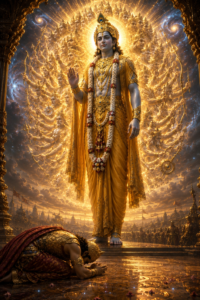
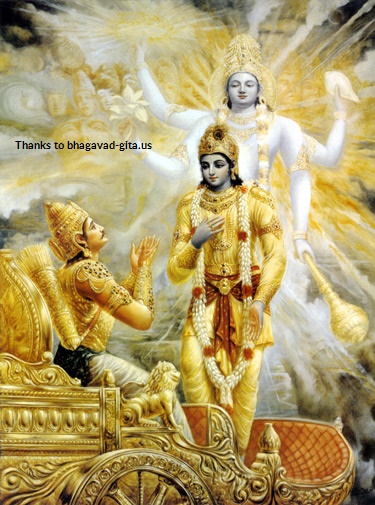
The Universal form of Shri Krishna In chapters 10 and 11, Shri Krishna shows Arjuna his actual Self. This obviously confuses as well as amazes and scares Arjuna making him circumspect with respect to his relationship with Shri Krishna, just like a soldier who is confronted with the fact that the person he thought was a friend is actually the Head of State.
- In chapter 13, he moves to the next step, and explains how sentience and awareness allow a person to cognise beyond the visible or gross (sthūla) To evolve to the next level, a person should be able to cognise the subtle (sūkṣma) state as well as the causal (kāraṇa) state.
- What are these states? How does one evolve to the next level of personal development?
- Before starting this chapter, we recommend that you review,
- Chapter 2 (sankha-yoga).
- Chapter 11 (viśvarūpadarśana-yoga).
- Importantly, one must recognise that development in Yoga is experiential and everything that is said in Srimad-bhagavad-gita can only create value when there is introspection and practice.
School of Yoga explains Srimad-bhagavad-gita, chapter 13, verse 1-12 kshetra kshetrajna vibhaga yoga.
How does Shri Krishna explain purusha, prakriti, kshetra and kshetrajna in kshetra kshetrajna vibhaga yoga.
 Arjuna said: Educate me on prakriti and purusha, kshetra and kshetrajna.
Shri Krishna said: This body is the kshetra (region/ field) and anyone who is wise to its functioning is a kshetrajna. In fact, many consider me to be the knowledge of the kshetra. Hence, I will explain the features and functions of the kshetra.
- The cardinal elements (mahabhuta), the sense of being the doer (ahankara), logic (buddhi) and those unmanifested (avyakta), the ten senses (indriya) and five objects of the senses (indriyagocara). Also, desire, repulsion, happiness, pain, intelligence, fortitude and their amalgamations form the kṣetra.
- To increase knowledge of the kshetra (kshetrajna), cultivate selfless-ness (humility), unpretentiousness, non-violence, peacefulness, straightforwardness, service to teacher, cleanliness, steadiness, controlling/ restraining the soul (atma-vinigraha).
- Cultivate dispassion towards sense objects, eschew the sense of doer-ship (ahankara), negativity towards birth, death, old age, sickness and pain. Also, be detached from everything, without intense attachment to the wife, son, home or society. Finally, treat everything with equal demeanour, whether they are desirable or undesirable.
- By meditating on the soul (self), some can experience the soul in others; others achieve this through knowledge of the Self through jnana-yoga, yet others by karma-yoga. Also, others who may have no conceptual knowledge, follow paths that others speak of and reach perfection by practicing what they have heard.
School of Yoga explains Srimad-bhagavad-gita, chapter 13, kshetra kshetrajna vibhaga yoga.
The concept of kshetra (region/ field) and kshetrajna (awareness of the region/ field) in kshetra kshetrajna vibhaga yoga.
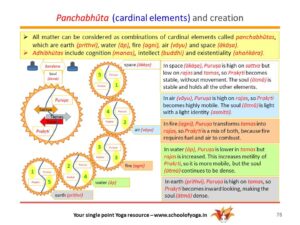 Our body is a kshetra (region/ field). It has an Identity and we identify ourselves with it. So, when we act, karma occurs and debt (rinn or agami-karma) is created. This debt (rinn) is stored as sancita-karma (overall debt) by the jiva (soul) and manifests as prarabdha-karma when the time for repayment/ reconciliation fructifies.
- Just as the body may be considered as an entity with a soul (jiva), entities such as heart, liver, kidneys and lungs as well as red blood corpuscle (RBC) elements within the body that operate independently can also be considered as minor souls (jiva) who also perform karma in their own way and create and reconcile their own debt (rinn).
- All matter is made up of the cardinal elements (pancha-mahabhuta – earth, water, fire, air and ether) in various combinations and its properties come from its combinations. For example – the heart can be considered as a combination of earth, water and fire; lungs may be considered to comprise of a combination of earth, water and air, and so on.
- Hence, it can be assumed that the relationship between various entities within a system will remain for as long as there is debt between them. When debt is reconciled, the relationship ceases to exist. For example – the kidneys will function for as long as they have a debt (rinn) with the body and other organs within the body but will fail naturally when their debt has been reconciled. However, when we force the kidneys to function after their debt has been cleared through medication, dialysis or replacement, we are re-enacting the cycle of action (karma). When our identity (asmita) experiences fear of loss of identity (death), it forces us to incur fresh karma as the old debt (rinn) has been discharged. This insecurity of self-worth (asmita) is the reason why some people continue treatment and others stop fighting.
- Also, kidneys will fail when they are abused and if the abuse is on account of free-will, then fresh karma is generated.
School of Yoga explains Śrīmad-bhagavad-gītā,chapter 13, kṣetra-kṣetrajña-vibhāga-yoga (verse 12-13) kshetra kshetrajna vibhaga yoga.
What is the Brahman in kshetra kshetrajna vibhaga yoga?
- Yoke yourself to me with no differentiation between us, seek seclusion. Also, be constant in the awareness of the self, staying focussed on understanding the concept of the Self, for this is the most exalted knowledge.
- Now, I will describe the supreme Brahman which neither exists nor not-exists. Brahman envelops all, with hands feet, eyes, mouths everywhere. Also, while Brahman defines attributes of the senses, it has no senses. Though it is unattached, supporting all, with no attributes (gunas), yet defines the experience of all attributes.
- Brahman exists outside and inside all beings, neither dynamic or static because of its subtlety incomprehensible, far and near. Also, Brahman is undivided; yet appears as different in beings that are supported by it, generating and destroying.
- It is the essence behind light, beyond darkness, knowledge which is to be known, its goal, its seat in the heart of all beings. Thus, kshetra (region) and that which is to be known is described.
- Finally, those that know this can merge with me.
School of Yoga explains Srimad-bhagavad-gita, chapter 13, kshetra kshetrajna vibhaga yoga.
The concept of Brahman (source) in kshetra kshetrajna vibhaga yoga.
What is the Brahman? Bṛhadāraṇyakopaniṣad states “ahaṃ-brahmāsmi“. This means that the Brahman and the Self or Soul are one and the same.
In Srimad-bhagavad-gita – chapter 2 (sankhya-yoga), Shri Krishna, states that the Soul is indestructible. Since the Soul and Brahman are the same, Brahman is indestructible.
Also, Taittirīyopaniṣad states,
ॐ पूर्णमदः पूर्णमिदं पूर्णात्पुर्णमुदच्यते
पूर्णश्य पूर्णमादाय पूर्णमेवावशिष्यते ॥
ॐ शान्तिः शान्तिः शान्तिः ॥
oṃ pūrṇamadaḥ pūrṇamidaṃ pūrṇātpurṇamudacyate
pūrṇaśya pūrṇamādāya pūrṇamevāvaśiṣyate ॥
oṃ śāntiḥ śāntiḥ śāntiḥ ॥
Meaning:
Aum! That (Brahman) is infinite, and This (Self/ Soul) is infinite.
Infinite (soul) proceeds from the infinite (Brahman).
From infinity, when infinity is removed, infinity is the balance (infinity remains).
Aum! Peace! Peace! Peace!
Shloka taken from: https://www.templepurohit.com/mantras-slokas-stotras/shanti-mantra/om-purnamadah-purnamidam
- The above means that the Brahman is infinite and indestructible, because no matter what is added or removed, its quality remains unchanged.
- Similarly, since the atma, Soul or Self emerges from the same infinity (Brahman), it is infinite and indestructible.
- As a result, since both are indestructible and infinite, there is no difference between the two (Brahman and the atma, Self or Soul).
Brahman is more than the source. It is the source, that which sustains everything and motility. Importantly, it is undivided, which means that it is continuous and everywhere. Also, it is the essence of everything – the energy of the sun, the lighting capability of light, burning capability of fire, enveloping capability of a building, protection capability of a constitution, patriotic capability of a flag etc.
Direct explanation of Brahman is impossible, one can only describe Brahman using correlations and qualities. For example, to experience an approximation of Brahman, stand in the middle of railway tracks and look at the tracks. They seem to merge somewhere in the distance, which we know is not true. This feeling of merger at a distance can be approximated as Brahman.
The transliteration and translation of Srimad-bhagavad-gita, chapter 13 kshetra kshetrajna vibhaga yoga follows.
The Sanskrit diacritic words are in red italics.
Arjuna asked (1) primordial manifestation and primordial Identity as well as battle field and knowledge of the field (prakṛtiṃ puruṣaṃ caiva kṣetraṃ kṣetrajñameva ca ।), this I wish to know whatever is necessary to know (etadveditumicchāmi jñānaṃ jñeyaṃ ca keśava ॥ 13-1॥).
Śrī Kṛṣṇa replied (2-3) this body is called the field, he that understands it is called knower of the field (idaṃ śarīraṃ kaunteya kṣetramityabhidhīyate । etadyo vetti taṃ prāhuḥ kṣetrajña iti tadvidaḥ ॥ 13-2॥). Know me to be the knower of all fields, the field and knowledge of the field is cognition of me (kṣetrajñaṃ cāpi māṃ viddhi sarvakṣetreṣu bhārata । kṣetrakṣetrajñayorjñānaṃ yattajjñānaṃ mataṃ mama ॥ 13-3॥).
(4-5) What is the field, what is it like, what changes occur to in and in what circumstances, what are its powers, in brief, hear (tatkṣetraṃ yacca yādṛkca yadvikāri yataśca yat । sa ca yo yatprabhāvaśca tatsamāsena me śaṛṇu ॥ 13-4॥). Many seers have chanted various distinct descriptions about Brahman which are decisive and full of reasoning (ṛṣibhirbahudhā gītaṃ chandobhirvividhaiḥ pṛthak । brahmasūtrapadaiścaiva hetumadbhirviniścitaiḥ ॥ 13-5॥).
(6-7) Great elements, feeling that I am the doer, intellect, the one unmanifested and even the ten senses and the five objects of the senses (mahābhūtānyahaṅkāro buddhiravyaktameva ca । indriyāṇi daśaikaṃ ca pañca cendriyagocarāḥ ॥ 13-6॥). Desire, dislike, pleasure, pain, the steady aggregate consciousness, this field with its modifications has been described (icchā dveṣaḥ sukhaṃ duḥkhaṃ saṅghātaścetanā dhṛtiḥ । etatkṣetraṃ samāsena savikāramudāhṛtam ॥ 13-7॥).
(8-9) Humility, unpretentiousness, non-injury, tranquillity, uprightness, service to the teacher, purity, steadiness and subduing the Self (amānitvamadambhitvamahiṃsā kṣāntirārjavam । ācāryopāsanaṃ śaucaṃ sthairyamātmavinigrahaḥ ॥ 13-8॥). Dispassion towards materiality, absence of doer-ship and even disregard for the affliction of birth-death, old age, infirmity and suffering (indriyārtheṣu vairāgyamanahaṅkāra eva ca । janmamṛtyujarāvyādhiduḥkhadoṣānudarśanam ॥ 13-9॥).
(10-12) Non-attachment, non-identification of the Self with son, wife and family, having constant and even consciousness in the justification of the desirable and undesirable (asaktiranabhiṣvaṅgaḥ putradāragṛhādiṣu । nityaṃ ca samacittatvamiṣṭāniṣṭopapattiṣu ॥ 13-10॥). To me, with unswerving focussed yoga of devotion, resort to lonely places and avoid people (mayi cānanyayogena bhaktiravyabhicāriṇī । viviktadeśasevitvamaratirjanasaṃsadi ॥ 13-11॥). Constantly seeking cognition of the primordial Self, the subtle wisdom seen in materiality, this wisdom which is thus declared is the opposite of ignorance (adhyātmajñānanityatvaṃ tattvajñānārthadarśanam । etajjñānamiti proktamajñānaṃ yadato’nyathā ॥ 13-12॥).
(13-14) That which should be cognised, I will declare, which on cognising one will attain immortality by merging with the beginningless supreme Brahman which is said not to have value nor not have value (jñeyaṃ yattatpravakṣyāmi yajjñātvāmṛtamaśnute । anādimatparaṃ brahma na sattannāsaducyate ॥ 13-13॥). With hands and feet that are everywhere, everywhere with eyes, head and mouth, everywhere with ears, it exists covering everything in the world (sarvataḥ pāṇipādaṃ tatsarvato’kṣiśiromukham । sarvataḥ śrutimalloke sarvamāvṛtya tiṣṭhati ॥ 13-14॥).
The complete text is available in my book, A Seeker’s Śrīmad-Bhagavadgītā.
Buy your copy today – Notion Press home / Flipkart / Amazon / Amazon India / Amazon UK / Amazon US / Amazon Australia
Acknowledgement –
School of Yoga is profoundly grateful to Saṃskṛta scholars and academics Pijus Kanti Pal (pal.pijuskanti@gmail.com) and Dolon Chanpa Mondal for their support in Saṃskṛta transliteration and quality control.