School of Yoga explains Srimad-bhagavad-gita, chapter 12, Bhakti Yoga.
Introduction – Bhakti Yoga is a yoga method where the identity of Self is transferred to a deity or role model such as a Guru.
Some terms that need to be understood about Bhakti Yoga.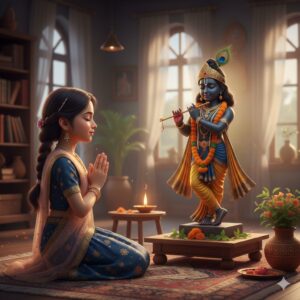
- Shraddha: Shraddha is a combination of intent, dedication, patience, sincerity, enterprise, focus and effort. It is quality of input into any activity and is not dependent on capability. Also, it is also not dependent of outcome or result.
- Consequently, a person may not have the requisite capability or be successful in a particular activity, but because of Shraddha, his success is considered as assured.
- Renunciation of action (karma-tyaga) – here the practitioner sacrifices his or her action to the owner of sacrifice (Shri krishna). A sacrifice into sacrifice nullifies all action because it is akin to adding null to null, which is null.
कर्मात्मनां च देवानां सोऽसृजत् प्राणिनां प्रभुः ।
साध्यानां च गणं सूक्ष्मं यज्ञं चैव सनातनम् ॥ २२ ॥
karmātmanāṃ ca devānāṃ so’sṛjat prāṇināṃ prabhuḥ |
sādhyānāṃ ca gaṇaṃ sūkṣmaṃ yajñaṃ caiva sanātanam || 22 ||
For the sake of living being’s intent upon action, he created the eternal sacrifice; as also the host of Gods and the subtle multitude of the lesser divinities, the sadhyas (22)
Arjuna starts Bhakti Yoga by asking: Which is better? Worshiping you or the imperishable Brahman?
Shri Krishna replied: Those that worship me with sincerity and devotion (shraddha), I consider perfect in Yoga, but even those that worship the Brahman – living with restrained senses, even in their dealings and working for the welfare of all, they too come to me. The problem of worshipping the Brahman is that it is very difficult to visualise and focus on the unmanifest.
- However, by renouncing all actions into me and regarding me as the supreme goal is easier.
- So, focus on me as the supreme goal and I will deliver you from the cycle of birth and death. Fix your consciousness on me and make me the source of your intellect. Thereafter, you will live in me.
- If you are unable to steadily focus your awareness on me, then reach me with abhyasa-yoga (Yoga of rigorous practice). In case you are unable to practice abhyasa-yoga, sacrifice the intent of your actions to me. If you are unable to do even that, just renounce the fruit of your action to me and attain perfection.
- Verse 12 – This is an important verse where Shri Krishna explain the meditation process with a solution. Wisdom of the Self (jnana) is better than practice of surrender to the deity (ishta-deva), in this case Shri Krishna (abhyasa). In the process of acquisition of wisdom (jnana) meditation (dhyana) ensures success. However, during meditation, when a person practices renunciation of the fruits of action (karma-phala-tyaga), there is immediate peace. This quickens the process of achieving perfection.
- In the above verse, Shri Krishna is suggesting a hybrid solution where one element from one path acts as a catalyst to another path. This is a method which can be seen throughout Srimad-bhagavad-gita. Shri Krishna is not a purist, but a pragmatist who tries to increase the number of options by suggesting solutions that fit individual capability and capacity.
School of Yoga explains Srimad-bhagavad-gita, chapter 12, Bhakti Yoga, verse 13 to 19.
Shri Krishna explains the qualities of the Bhakti Yoga practitioner.
- Hating none, friendly and compassionate; with no feeling of being the doer (nirahankara), content in whatever comes and living without expectations (santosha); steady in yoga, with cognition (manas) and intelligence (buddhi) under control the practitioner becomes dear to me.
- Dear to me is also one who does not get agitated at the world or does not spread agitation; who is free from exuberance, envy, fear or anxiety. Also, dear is also one who has no expectations, is pure, dextrous, untroubled, without ambition and renounces all undertaking. He who neither rejoices nor rejects, grieves or desires, renounces superstition and devoted to me is dear to me.
- He who treats friend and foe alike, also honour or dishonour, heat or cold, pleasure or pain and is free from attachment; to whom praise or censure is the same, content with anything, homeless and steady in mind, he is dear to me. Practitioners who practice this conditioning with sincerity and devotion are dear to me.
Srimad-bhagavad-purana propounds nine primary tools of Bhakti Yoga.
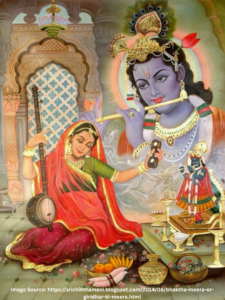
- Shravana (listening to achievements of the deity) – practitioners view the deity as a role model, analyse the deity’s life and try to emulate those qualities in their own life.
- Kirtana (praising the achievements of the deity) – practitioner examines the mythological life in great detail and understand the qualities of their deity. This leads to them being able to extol and emulate their favourite deity (ishta-deva).
- Smarana (retaining an image of the deity at all time) – practitioners try to retain the deity in an external form in pictures and then internalise it.
- Pada-sevana (pada = feet + sevana = service) – means service at the feet. Since Bhakti Yoga can also be to a living entity like a Guru, country or system like Yoga, service before Self becomes a critical experiential exercise in subduing the Self.
- Suracana (worshipping the deity with hyperbole) – When a practitioner extols using hyperbole, there is natural desire to reach for the same outcomes. A vision is created for oneself and effort gets aligned to those goals. Also, such prayers keep the deity at a high position, thus motivating one to surrender one’s Self.
- Vandana (worshipping the deity) – integration of the self with the deity.
- Dasya (servitude) – negating the sense of Self by serving as a servant.
- Sakhya (retaining a base of friendship) – Maintaining company of like-minded individuals allows the yogi to stay integrated with the deity 24 x 7.
- Atmanivedana (atma = soul + nivedana = state of no schism) or state where there is no difference between the yogi and the deity. This is achieved when the practitioner practices all the above steps and constantly views him or herself as an extension of the deity.
Example of bhakti yoga.
At the end of the Ramayana, Hanuman returned to Ayodhya with Rāma, now the king. One day, while Rama was performing a sacrifice, a relative shot a bird which fell into the sacrificial fire, defiling it. An angry Rama, ordered that the miscreant be put to death. The terrified relative surrendered to Hanuman and sought shelter. When Hanuman refused to surrender the relative, stating that rules of dharma required that he protect anyone who surrendered to him, Rama challenged him to a duel. At the appointed hour, Hanuman took the relative to the site of the duel, encircled him with his tail and sitting on top of the hive like structure, went into samadhi. When Rāma came out and saw Hanuman, he prepared for battle. Knowing the quality of Hanumān’s chivalry, Rama sent his most powerful missile – the Rama-bana, instructing it to destroy Hanuman. The missile went towards Hanuman, circled him and returned to Rama without doing anything. A perplexed Rama kept shooting the missile with no change in result. When he meditated on why the missile was malfunctioning, he intuited that the missile was unable to find Hanumaān, there was only Rama!
Hanuman has subsumed his identity into Rama, this is the highest form of bhakti yoga samadhi.
School of Yoga explains Srimad-bhagavad-gita, chapter 12, bhakti yoga.
Some contradictions to accepted positions on bhakti yoga.
- There is considerable difference between bhakti yoga and religion as practiced in the Abrahamic tradition.
- In religion, the individual accepts a subordinate position to that of a deity, there is supplication of the devotee to the deity. However, since the person does not lose his or her identity and remains separated from the deity there is a subtle filter between the practitioner and deity which hinders complete merger with the deity.
- In Yoga, the deity is assumed to be a role model but equal in Identity. So, there is no supplication. There is only surrender. This means that the Yogi does everything to transfer his or her sense of identity on to the target identity (deity).
- When the practitioner applies Shri Krishna’s bhakti yoga advise to the target, then the person’s identity slowly gets subsumed into the target Identity.
- When this happens, the person’s purusha becomes zero, this brings prakriti to nirguna state, resulting in merger with the Brahman.
- So, we can see that when a person surrenders completely and subsumes his or her identity with the target entity, the merger with the deity actually results in a merger with the Brahman.
- So, bhakti yoga is not confined to Shri Krishna It can be to any deity, Guru or teacher, subject, thought, country or even task.
School of Yoga explains Srimad-bhagavad-gita, chapter 12, Bhakti Yoga.
Lessons learned in Chapter 12 (Bhakti Yoga).
- Shri Krishna is a manifestable state that controls creation and maintenance but does not participate in the operations.
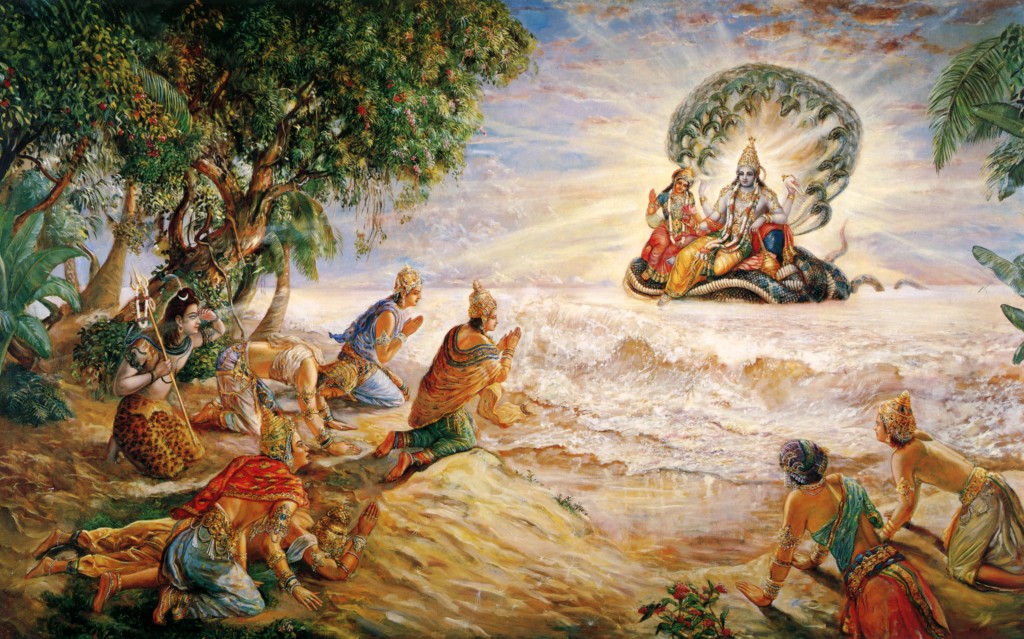
- From the description of Arjuna’s vision, one can conclude that birth, living and death is brutal and without sentiment.
The Transliteration of Srimad-bhagavad-gita, chapter 12 on Bhakti Yoga follows,
The Sanskrit words are in red italics.
Arjuna said (1) Between those that worship you and those that worship the imperishable, unmanifested Brahman, who is likely to succeed (evaṃ satatayuktā ye bhaktāstvāṃ paryupāsate । ye cāpyakṣaramavyaktaṃ teṣāṃ ke yogavittamāḥ ॥ 12-1॥).
Śrī Kṛṣṇa said (2-4) Those that fix their cognition on me with steadfast focus and serve me with dedication and sincerity, these are endowed with qualities to become realised souls, in my opinion (mayyāveśya mano ye māṃ nityayuktā upāsate । śraddhayā parayopetāḥ te me yuktatamā matāḥ ॥ 12-2॥). Those who worship the indestructible, indefinable, omnipresent, unthinkable, immovable, eternal (ye tvakṣaramanirdeśyamavyaktaṃ paryupāsate । sarvatragamacintyañca kūṭasthamacalandhruvam ॥ 12-3॥). Having restrained the multitude of senses, even minded everywhere, they obtain me only, those that rejoice in the welfare of all creation (sanniyamyendriyagrāmaṃ sarvatra samabuddhayaḥ । te prāpnuvanti māmeva sarvabhūtahite ratāḥ ॥ 12-4॥).
(5-6) The struggle is greater for those whose consciousness is focused on the indistinct unmanifested Brahman as a goal, it is a painful journey for the embodied (kleśo’dhikatarasteṣāmavyaktāsaktacetasām । avyaktā hi gatirduḥkhaṃ dehavadbhiravāpyate ॥ 12-5॥). But those that renounce all actions to me, regard me as the supreme goal, meditation in calmness with undistracted union (ye tu sarvāṇi karmāṇi mayi saṃnyasya matparāḥ । ananyenaiva yogena māṃ dhyāyanta upāsate ॥ 12-6॥).
(7-8) For those with a focussed consciousness I am the navigator who ultimately brings them out of the sea of cycle of rebirth (teṣāmahaṃ samuddhartā mṛtyusaṃsārasāgarāt । bhavāmi nacirātpārtha mayyāveśitacetasām ॥ 12-7॥). Fix your cognition on me only, let your intellect be placed on me, you will live in me alone hereafter, without doubt (mayyeva mana ādhatsva mayi buddhiṃ niveśaya । nivasiṣyasi mayyeva ata ūrdhvaṃ na saṃśayaḥ ॥ 12-8॥).
(9-10) If you are unable to fix the consciousness steadily on me by practice of Yoga, then wish to reach me (atha cittaṃ samādhātuṃ na śaknoṣi mayi sthiram । abhyāsayogena tato māmicchāptuṃ dhanañjaya ॥ 12-9॥). If also by practice you are unable, then let the focus of your actions, also action be for my sake and in this process, you will attain perfection (abhyāse’pyasamartho’si matkarmaparamo bhava । madarthamapi karmāṇi kurvansiddhimavāpsyasi ॥ 12-10॥).
(11-12) If you are unable to do even this, take refuge in my Yoga by renouncing all the fruits of your action with a self-restrained Soul (athaitadapyaśakto’si kartuṃ madyogamāśritaḥ । sarvakarmaphalatyāgaṃ tataḥ kuru yatātmavān ॥ 12-11॥). Indeed, wisdom of the Self is better than practice, in wisdom meditation excels, in meditation renunciation of the fruits of action, in renunciation there is immediate peace (śreyo hi jñānamabhyāsājjñānāddhyānaṃ viśiṣyate । dhyānātkarmaphalatyāgastyāgācchāntiranantaram ॥ 12-12॥).
(13-14) Without rejecting any of creation, friendly, kind, and also without the feeling of the Self, without feeling of being the doer, same in adversity and gain (adveṣṭā sarvabhūtānāṃ maitraḥ karuṇa eva ca । nirmamo nirahaṅkāraḥ samaduḥkhasukhaḥ kṣamī ॥ 12-13॥). Always content, the yogī is self-restrained, having firm conviction, who offers cognition and logic to me, this devotee is dear to me (santuṣṭaḥ satataṃ yogī yatātmā dṛḍhaniścayaḥ । mayyarpitamanobuddhiryo madbhaktaḥ sa me priyaḥ ॥ 12-14॥).
(15-16) He who is not agitated by the world and who does not agitate the world and who is free from joy, impatience, fear and agitation, he is dear to me (yasmānnodvijate loko lokānnodvijate ca yaḥ । harṣāmarṣabhayodvegairmukto yaḥ sa ca me priyaḥ ॥ 12-15॥). One is free from need, clean, diligent, unconcerned, who has renounced all new ventures, such a devotee is dear to me (anapekṣaḥ śucirdakṣa udāsīno gatavyathaḥ । sarvārambhaparityāgī yo madbhaktaḥ sa me priyaḥ ॥ 12-16॥).
(17-18) He who neither rejoices nor rejects, does not grieve nor hankers, who has renounced auspicious and inauspicious, he who is completely devoted to me is dear to me (yo na hṛṣyati na dveṣṭi na śocati na kāṅkṣati । śubhāśubhaparityāgī bhaktimānyaḥ sa me priyaḥ ॥ 12-17॥). He who treats friend and foe alike and is the same when respected or insulted, in cold or heat, same in happiness or sadness and free from attachment (samaḥ śatrau ca mitre ca tathā mānāpamānayoḥ । śītoṣṇasukhaduḥkheṣu samaḥ saṅgavivarjitaḥ ॥ 12-18॥).
(19-20) Who is modulated in praise or criticism, silent, content in all situations, homeless, steadfast in devotion to me, that human is dear to me (tulyanindāstutirmaunī santuṣṭo yena kenacit । aniketaḥ sthiramatirbhaktimānme priyo naraḥ ॥ 12-19॥). Whoever devotee follows this immortal dharma as declared here, with sincerity and dedication regarding me as supreme, they are exceedingly dear to me (ye tu dharmyāmṛtamidaṃ yathoktaṃ paryupāsate । śraddadhānā matparamā bhaktāste’tīva me priyāḥ ॥ 12-20॥).
The complete text is available in my book, A Seeker’s Śrīmad-Bhagavadgītā.
Buy your copy today – Notion Press home / Flipkart / Amazon / Amazon India / Amazon UK / Amazon US / Amazon Australia
Acknowledgement –
School of Yoga is profoundly grateful to Saṃskṛta scholars and academics Pijus Kanti Pal (pal.pijuskanti@gmail.com) and Dolon Chanpa Mondal for their support in Saṃskṛta transliteration and quality control.