
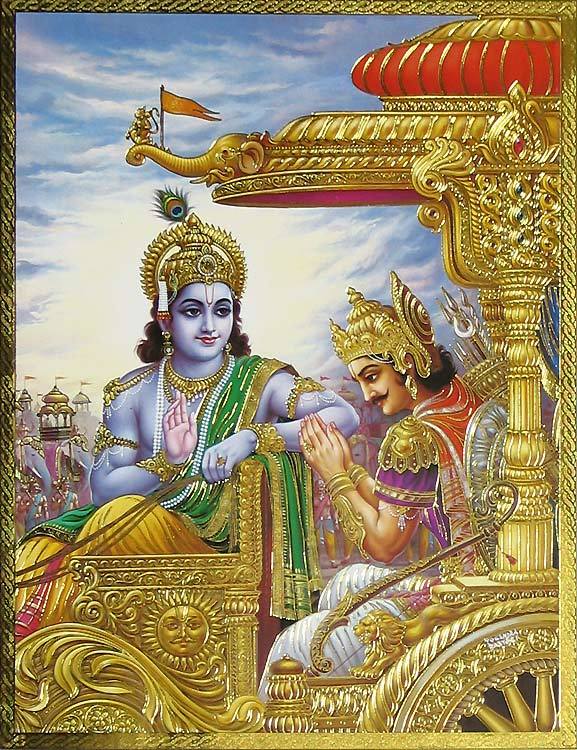
School of Yoga explains Srimad-bhagavad-gita, chapter 8, akshara-brahma-yoga (yoga of the imperishable Brahman).
What is Brahman?
What is akshara-brahma-yoga? akshara means alphabet, which is indestructible. Brahman is the source of creation, sustenance and dissolution. Hence, this chapter covers the qualities of Brahman and Shri Krishna‘s relationship with it.
Arjuna asked – What is that Brahman? What is adhyatman? What are karma, adhibhuta and adhidaiva? Who and how does adiyajna exist in this body? Finally, how is it cognised by self-restrained soul at time of death? (verse1-2).
Shri Krishna replied – Imperishable Brahman is supreme and indestructible. In fact, its nature is transcendental and it causes creation as an expression of itself. Also, this creation and this transformation is called karma. Next, adibhuta (primordial creation) is any perishable state. Also, purusha is adhyatman (primordial soul). I (Shri Krishna) alone represent adiyajna (primordial sacrifice / transformation or change) in existence (in the body or embodied) (verse 3-4).
Notes: adi or primordial means anything that existed since the beginning of time and transcendental is anything that goes beyond material, sensory or conceptual.
It is important to understand that deva or deity is not God. In fact, deity is entity that acts as a representative of a particular task, role or concept. For example, savita is a deity that represents the qualities/ energy of the Sun. Also, it is important to realise that, there is no concept of God in Yoga, there is only Brahman. The individual is considered to be Brahman wrapped in maya (illusion) due to ignorance (avidya). Yoga is the process of removing this veil of ignorance and merging the Individual with Truth (Brahman).
Who is Brahman?
Let us start with this shloka…
oṃ pūrṇamadaḥ pūrṇamidaṃ pūrṇātpūrṇamudacyate।
pūrṇasya pūrṇamādāya pūrṇamevāvaśiṣyate॥
oṃ śāntiḥ śāntiḥ śāntiḥ।
ॐ पूर्णमदः पूर्णमिदं पूर्णात्पूर्णमुदच्यते।
पूर्णस्य पूर्णमादाय पूर्णमेवावशिष्यते॥
ॐ शान्तिः शान्तिः शान्तिः।
(Credit: Thanks to: https://www.templepurohit.com/mantras-slokas-stotras/shanti-mantra/om-purnamadah-purnamidam )
Which means,
- That is infinite, this is infinite, from infinity proceeds infinity,
- From infinity, when infinity is subtracted, truly, infinity is left as a remnant.
Next, let us understand Brahman on the basis of mahavakyas (major aphorisms), which are four in number,
- prajnanam brahma (प्रज्ञानं ब्रह्म) – all awareness is Brahman
- ayam atma brahma (अयम् आत्मा ब्रह्म) – this soul is the Brahman
- tat tvam asi (तत् त्वम् असि) – that thou art or you are Brahman
- aham brahmasmi (अहं ब्रह्मास्मि) – I am Brahman
School of Yoga explains Srimad-bhagavad-gita, chapter 8, akshara-brahma-yoga (verse 3-4, 8-13).
Why Brahman is a state of awareness.
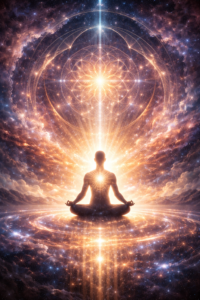
The above state corresponds to everything that Shri Krishna describes brahman to be – an indestructible, unchanging, eternal and infinite state which is the source of everything and nothing as well. That can only be called an experience of peace which can be found in the state of null or infinity!
- First, Brahman is a state, and the yogi must experience THAT state, and he must become THAT.
- Second, Brahman is infinite, which means one must overcome (transcend) time, space and matter.
- Third, Brahman is changeless which means that the yogi must transcend physical form and impact of stimuli on the Self because, when stimuli is annulled, there is no change.
- Fourth, Brahman is tranquillity, which means that this is a state of “no agitation”.
- Last, everything proceeds from Brahman, it is the source and motility of materiality.
What are the qualities of Brahman?
First, imperishable Brahman is adhyatman (primordial Self) within the body.
Next, it is the cause of creation and transformation, this is called karma.
Brahman causes motility in creation and this is called adhibhūta (primordial creation).
Also, purusha is adhidaivata or primordial deity and he (Shri Krishna) as adiyajna (primordial sacrifice, transformation or change) within the body.
How does maya come from Brahman? (verse 3-4). 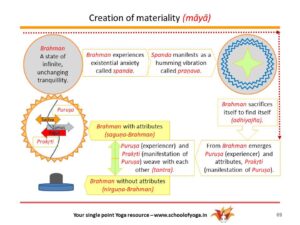
- First, everything comes from the Source/ Truth/ Origin or Brahman. This is a state of infinite changelessness, eternal peace and nothingness.
But, how does the Brahman manifest if it is a state of nothing but eternal, changeless peace?
- What happens is that, Brahman experiences existential anxiety (do I exist?) and desires self-expression (What am I? What is this? Do I exist? I want to see myself).
- How does this anxiety manifest? Brahman experiences an atemporal vibration or creative pulse called spandana.
For example – When we say that we have a eureka moment, that insight comes to us from nowhere (Brahman) and we experience a creative outpouring (spandana). We know of two great scientists who had eureka moments, Newton (gravity) and Archimedes (buoyancy).
-
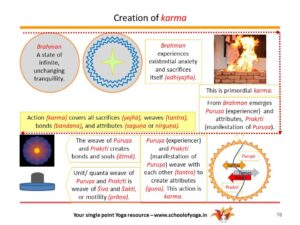
So, from a state of nothingness, it suddenly becomes curious about itself and seeks to express itself.
- Hence, Brahman sacrifices itself to express its Self (adhyatman).
- This sacrifice of Brahman is called primordial sacrifice (adiyajna), which is whatShri Krishna says he is.
- As a result of the sacrifice, it manifests as purusha (experiencer) and prakriti (manifestation). The primordial expression of this manifestation is called pranava.
- Then, purusha and prakriti weave with each other to create manifested (saguna-Brahman) and unmanifested (nirguna-Brahman) In fact, that aspect of Brahman which can be cognised is called saguna-Brahman (manifested) and the rest is nirguna-Brahman (unmanifested).
- So, when prakriti and purusha weave and there is engagement with the environment, this is called (saguna–Brahman). However, prakriti does not always manifest or when it does, it does not always get a response, in which case purusha experiences only itself. This is called (nirguna–Brahman).
- Importantly, nirguna does not mean lack of existence, it means lack of manifestation.
- From purusha, citta (consciousness) emerges. However, citta is inert and takes on the quality (bhava) of the entity that it is interacting with. Hence, it is the carrier of experiences.
- Also, purusha is continuously experiencing itself (jnana) or stimulus coming from outside (vijnana).
- Furthermore, from prakrti (action), guna (attributes) emerge. In fact, gunas are a mix of purusha and prakriti.
- Firstly, when purusha is ascendant over prakriti, it is called tamas (delusion). Similarly, when prakriti is ascendant over purusha, the attribute is called rajas (passion or flow). Finally, when purusha and prakriti are in balance, this is called sattva (harmony or balance).
- Since, purusha and prakriti have to work in order to create, maintain or destroy the universe, this is called action or Hence, karma emerges from the weave of purusha and prakriti.
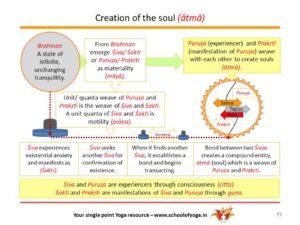
Importantly, one must recognise that Brahman is permanence or Truth, but starting with primordial sacrifice (adiyajna), the state of Shri Krishna, everything is impermanent, can decay and die!
- So, everything that is impermanent is a veil of ignorance (ajnana) covering of the Brahman and hence it is maya (illusion).
Example of the progression of Brahman is from imperishable, changeless peace to manifestation.
- First, we are in a state of nothing (Brahman). Then, we get an idea!
- If the idea is strong enough, then we make the sacrifice to make the idea work (adiyajna).
- When the idea manifests, this is called saguna–Brahman (manifested Brahman). Next, we experience anxiety that the idea should succeed.
- If we were to consider the idea to be an entity then, for the idea, we are Brahman (adhyatman), we are in the idea, but the idea is not in us!
- Similarly, there are many ideas within us that never manifest, but remain within us. They are not dead, just unmanifested. These are called nirguna–Brahman (unmanifested Brahman)
The transliteration and translation of Srimad-bhagavad-gita, chapter 8, akshara-brahma-yoga follows.
The Sanskrit words are in red italics.
Arjuna asked (1-2) What is that brahman? what is adhyātman? what is karma, adhibhuta and adhidaiva? what is that which is called adidaiva? (kiṃ tad brahma kimadhyātmaṃ kiṃ karma puruṣottama । adhibhūtaṃ ca kiṃ proktamadhidaivaṃ kimucyate ॥ 8-1॥)? Who and how does ādiyajña exist in this body? How is it cognised by self-restrained soul at time of death (adhiyajñaḥ kathaṃ ko’tra dehe’sminmadhusūdana । prayāṇakāle ca kathaṃ jñeyo’si niyatātmabhiḥ ॥ 8-2॥)?
Śrī Kṛṣṇa said (3-4) The imperishable brahman is supreme, they say that its nature is transcendental (akṣaraṃ brahma paramaṃ svabhāvo’dhyātmamucyate ।), it causes self-expression in creation which is called karma (bhūtabhāvodbhavakaro visargaḥ karmasaṃjñitaḥ ॥ 8-3॥). Primordial creation is any perishable situation/ state puruṣa is the primordial deity, I alone am primordial sacrifice in the body or the embodied (adhibhūtaṃ kṣaro bhāvaḥ puruṣaścādhidaivatam । adhiyajño’hamevātra dehe dehabhṛtāṃ vara ॥ 8-4॥).
The complete text is available in my book, A Seeker’s Śrīmad-Bhagavadgītā. Buy your copy today – Notion Press home / Flipkart / Amazon / Amazon India / Amazon UK / Amazon US / Amazon Australia
Acknowledgement –
School of Yoga is profoundly grateful to Saṃskṛta scholars and academics Pijus Kanti Pal (pal.pijuskanti@gmail.com) and Dolon Chanpa Mondal for their support in Saṃskṛta transliteration and quality control.
One of the best articles I have come across. Scientifically explains, interprets and enlightens the concept of Aksharabramha and how to attain freedom from Birth-death cycle effectively. The article also enables to pursue the path of Karma to attain moksha. Hearty Congratulations for the contributors.
Thank you for your encouragement. Everything in this website is Original, there is no plagiarism. Please do read and comment on the other articles also.
Sorry for the delayed response. Thank you for your feedback. We are also in the process of rewriting and adding more examples to make Srimad Bhagavad-gita more relevant to daily use and would welcome your suggestions. Vishwanath, School of Yoga