School of Yoga explains the metaphysics embedded Srimad-bhagavad-gita, chapter 8, akshara-brahma-yoga.
Introduction to Hindu metaphysics in Chapter 8. What is Hindu metaphysics?
 Hindu metaphysics is the study of occult and abstract aspects of life and living that define our reality such as life, living, free-will, space, time, and change through the lens of dharma. This is the essence of Srimad Bhagavad Gita.
Hindu metaphysics – Let us review what we know…
- First, motility for karma comes from Brahman.
- Also, karma results in creation of transactions and bonds, these in turn result in creation of multiple identities/ Souls or atman of varying complexities.
- As a result of the creation of multiple and complex transactions, bonds and entities, the universe is created and this is called golden egg (hiranyagarbha).
- Also, the centre of Identity of the Universe (hiranyagarbha) is called Vishnu.
- Additionally, all karma occurs within the hiranyagarbha, which is the manifested aspect of the Brahman (saguna–Brahman).
- Since Brahman underwrites the motility of karma, Brahman exists everywhere.
- Also, since all karma require a sacrifice (yajna) for manifestation, Shri Krishna, as adi, is everywhere and is the starting point of materiality.
Example.
- Each housing society is defined by a boundary wall and has its own Identity. Similarly, each city, state, region, country or planet have their own centre of Identity.
- The Sun has a unique Identity which comes from its qualities, such as its name, colour, size as well as its capability to produce light and heat and its position as the centre of the Solar system.
- Similarly, other planets such as Mars, Jupiter, Saturn or Moon have their own identities. The biggest extant entity is the Universe, and shri Krishna says that he is beyond even that.
- Since, he claims the position of adiyajna, Shri krishna becomes is a state of existence who has transcended material and merged with the source (Brahman). This allows him to participate and become the underwriting qualities of all the various entities (atmans) without becoming involved in their experience of existence.
School of Yoga explains the Hindu metaphysics of Srimad-bhagavad-gita, chapter 8, akshara-brahma-yoga.
What is the Hindu metaphysics in the concept of death?
 According to Shri Krishna, in Chapter 2, body perishes but the Soul (atman) moves to another body to repay its debts, based on its past karma. How can we explain the metaphysics of this transformation?
- To understand this, we need to understand rebirth. Why does rebirth occur?
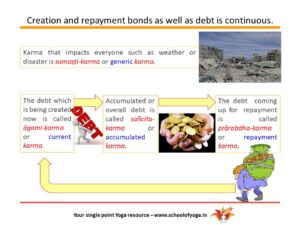
- The answer to this lies in karma. We are born on account of debt (rinn) and throughout, we are either debtors or creditors. This is called prarabdha-karma (karma that has come up for reconciliation). Here, karma actually means debt (rinn). Consequently, this loose use of karma terminology can be confusing.
- All main events, people and situations we encounter in our lives occur because of prarabdha-karma.
- Throughout life, in the process of reconciling prarabdha-karma, we act. So, during the process of reconciliation, in addition to reconciling old karma accounts, we are also creating new ones through our ongoing actions and these go into our overall book of debt. This is called agami-karma (present state karma).
- This overall register of debt is called sancita-karma (overall karma). This karma is the reason for rebirth, because all debt cannot be squared -off in one life. Remember, when it comes to karma, one may either be a creditor or a debtor and reconciliation spares no one.
- At death a person becomes a sentiment (bhava), a residue of unfulfilled desires, regrets or vasanas, which will become a part of the template for subsequent life (samsara).
- In fact, they will manifest as motivation (vasana) which will be exhibited as personality (bhava) when the person is reborn.
Then in Hindu metaphysics, is there any way for an individual to break this cycle of samsara (birth and death) through karma?
- All debts are carried by our Self or atman. Therefore, if the Self were to cease to exist, then there would be no one for clearance of karma (debt or credit).
- The soul (atman), is after all a manifestation of the unmanifest (Brahman).
- Karma is accrued to that aspect which considers itself the doer (ahankara). Karma here means debt (rinn) as opposed to action (karma). Consequently, this loose interpretation of terminology could be confusing.
- K
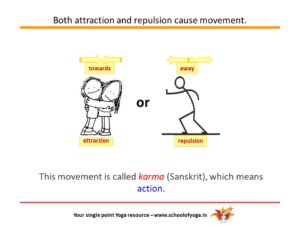 arma occurs on account of duality (like-dislike, good-bad, truth-lies, God-Devil, merit-sin, love-hate) etc. When we like something, we bring it closer (raga) and when we dislike something, we push it away (dvesha). This act of pushing and pulling results in and the imbalance causes debt (rinn) which needs to be repaid.
 - So, this means that no karma is accrued when there is no doer or Soul (atman). So, when the Self (atman) is indifferent to duality (like-dislike, good-bad etc.), there is no karma.
- This state also occurs when the person acts without the sentiment of being the doer (ahankara), when activity is performed as sacrifice (selflessness, not selfishness). Also, sacrifice may be defined as work done without expectation of return, this can also be called duty!
- Another way is when action is dedicated to another entity that cannot return the debt, like Shri Krishna, a deity, Guru, Country or society.
- So, when Shri Krishna says “dedicate your activity to Me (Shri Krishna)”, he means that when one dedicates any activity as sacrifice, there is no karma because there is no experience of being a doer (ahankara). Consequently, this breaks the cycle of rebirth (samsara) and enables one to transcend existence.
- Another interesting aspect in the explanation of Shri Krishna is his position as the owner of yajna or sacrifice, the state which occurs before there is expression of the Soul (aman). So, when sacrifice is offered to sacrifice, there is no This situation is hypothetical and difficult to achieve.
- All the above methods are overt or gross (sthula) methods of controlling debt (rinn or karma).
- However, even when it’s not acting, the Self (atman) still exists and this has to be neutered. The Self has to be brought to a point where it’s individual Identity or Soul (atman) ceases to exist. This is the subtle (sukshma)
- When this completely neutered state is reached, the Self (atman) experiences no change or karma (nirvikalpa), it does not react to stimulus (citta-vṛtti-nirodha).
- This place of no-change is also a state of infinite peace or nothingness. It is the state of permanence (Brahman).
- The yoking of the Self (atman) with the Brahman is yoga, and in this state, there is no rebirth.
Obviously, this is difficult, which is why transcending rebirth is not for the faint hearted.
School of Yoga explains the Hindu metaphysics in Srimad-bhagavad-gita, chapter 8, akshara-brahma-yoga.
The Hindu metaphysics description of death and rebirth.
If a person had unsuccessfully wished to complete a PhD, see a child, sibling or person before dying, go to a particular place or had some bucket list, then that overriding sentiment is carried away at death as karma.
- We have seen how karma creates debt which has to be reconciled. So, when a person dies with any sentiment of want, desire or regret, he or she holds on to that sentiment as the greatest unfulfilled desire in life.
- This becomes the defining aspect of the individual at rebirth and when the person is reborn, they become fixations in the personality, called embedded memory (vasana) on account of prarabdha-karma.
- The first suggestion of Shri Krishna is that a yogi who wishes to avoid rebirth, should focus his consciousness (citta) on the purusha (adhidaiva). While Shri Krishna explains the qualities of purusha, but these are abstract and not of much use. This suggestion is not easy to implement.
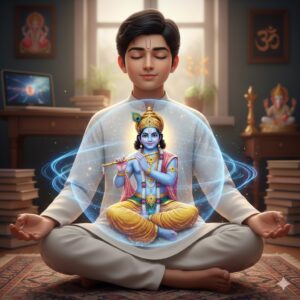 Instead, it would be simpler for the yogi to follow Shri Krishna’s instruction and anchor (yukta) his consciousness (citta) on his prana at the centre of eyebrows and reach immortality at death.
- Also, one could practice thinking of Shri Krishna all the time, so that at death, the person merges in Shri Krishna and does not return because Shri Krishna is adiyajna. Instead, the person goes to the place where great souls (mahatman) have reached and does not return. This suggestion is not just valid for Shri Krishna but one could apply this to any favourite deity (ishta-devata).
- A good practice which Shri Krishna explains that can be used at death is:
- Control all the gates (eyes, ears, tongue, olfactory, nasal, legs, hands, sexual organs, anus, urination organs), Control means that these organs should be without stress or tension and there should be a feeling of peace, there should be no input or output.
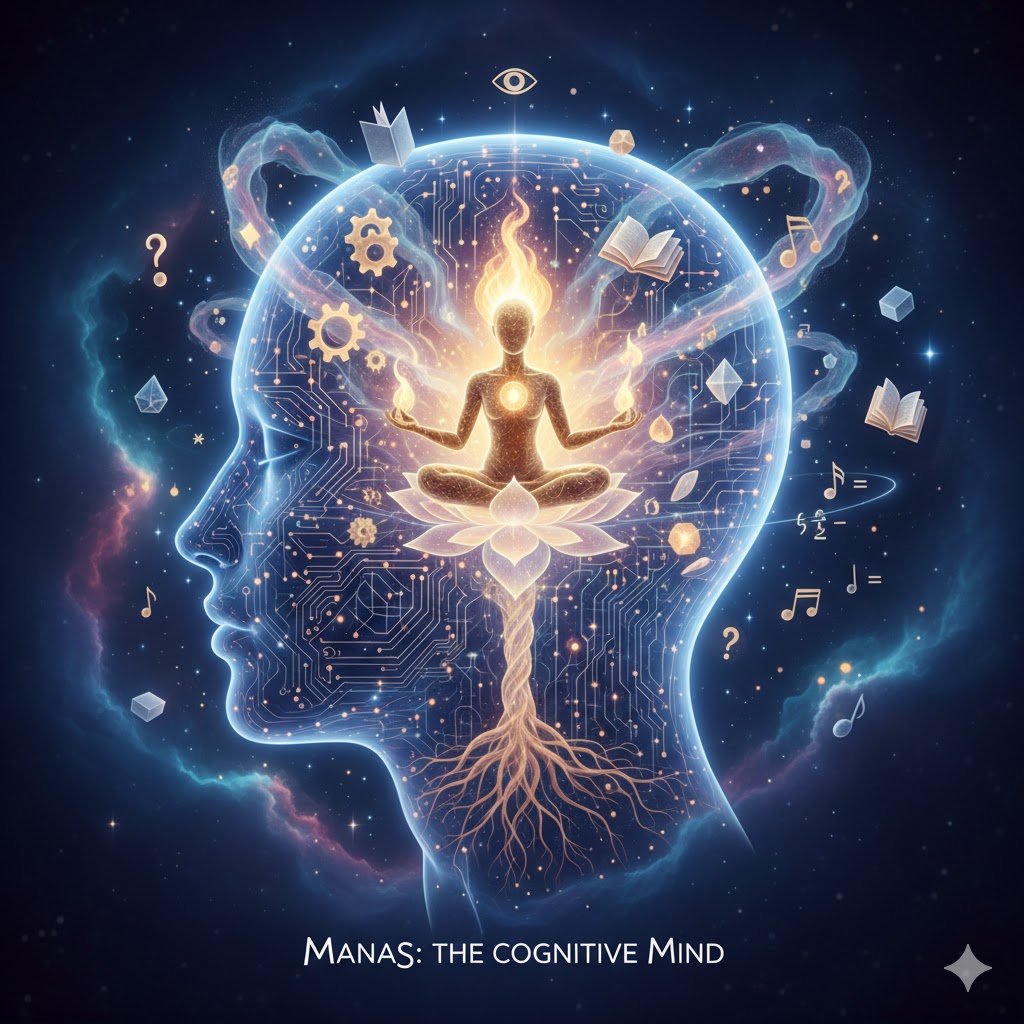
- Next, centre the cognition (manas) in the heart region.
- After this, place the Self (Identity) in the frontal lobe of the brain (muladhi).
- To achieve this, the yogi must stop his or her consciousness or cognition (citta) from flowing out and steady it in the frontal lobe area without movement. There will be slight compression, tightness or pressure in the frontal lobe and the yogi must slowly make the sensation placid, peaceful, calm or without pressure.
- Lastly, let the prana be in harmonic meditation (this means that the prana should move unstressed within the body).
- Finally, when leaving the body, utter OM, or any bījakshara (Shri Krishna says any akshara or single syllables). This stops other regrets and desires from becoming karma.
- A bijakshara (bija = root+ akshara = syllable) is any single alphabet. In Sanskrit, all akshara-s have certain frequency control. So, what happens is that when a person focuses on an alphabet, then there is loss of Identity into the Self. This results in stoppage of rebirth.
- Remember Brahman or Shri Krishna or any favourite deity (ishta-devata).
The above practices are very practical and doable, if one were to practice this kind of meditation regularly, then it will be easy to fall into that state at the time of death.
School of Yoga explains the Hindu metaphysics in Srimad-bhagavad-gita, chapter 8, akshara-brahma-yoga (verse 5-7).
Shri Krishna explains himself with respect to Hindu metaphysics.
Shri Krishna says that he is that point in the supra-system where there is no Identity. So, anyone who focusses his or her cognition and intelligence on him (Shri Krishna) shall reach that point and not be born again.
- This argument may seem counter-intuitive. If there is a Shri Krishna who is cognised, there must be a Self (atman) that cognises Shri Krishna, which means that yoga is not complete because the Self still exists and has not been neutralised.
- However, this is possible if the yogi were to adopt a technique that requires one to lose his or her identity (atman) completely in Shri Krishna. In this condition, the Self ceases to exist.
- It does not matter whether Shri Krishna exists or not, nor in what state. What matters is that the Self should cease to exist.
- This yoga is called bhakti-yoga (refer Chapter-12).
- Additionally, this method is not confined to Shri Krishna but can be used with other deities as well.
Conclusion: Shri Krishna is a yogi who has reached an extremely high level of “sthitaprajna “ or “situational awareness”. Hence, Shri Krishna is able to explain the nuances of his position with respect to Brahman.
School of Yoga explains Hindu metaphysics in Srimad-bhagavad-gita, chapter 8, akshara-brahma-yoga (verse 23-28).
The Hindu metaphysics of creation.
Those who know that brahma’s day (Brahma is different from the source, Brahman) lasts a thousand yugas, also know that his nights last a thousand yugas. At beginning of his day, manifestation occurs from the Brahman (source) and at night, all that is perishable merges back into him. Beyond this, is the region of the imperishable. I reside in this abode. Only through unwavering focus can one reach me and thence this abode of the Imperishable.
Those who die when sun is moving north (uttarayana) for 6 months, during waxing moon (shukla-paksha) and in day go to Brahman. Those who die when the sun is moving South (dakshinayana), during the waning moon (krishna-paksha) and at night, return. Any yogi who understands this yoga needs no other knowledge.
How does the Hindu metaphysics math of creation work? What is a kalpa?
- Firstly, the Universe or hiranyagarbha is an identity called Vishu.
- Next, Brahma emerges from Vishnu. Brahma’s lifespan is calculated as follows:
- 1 human day = 8 yāma
- 1 day of the pitṛs (ancestors) = 1 month/ 30 days
- Lifespan of pitṛs = 100 years or 3000 human years.
- 1 day of daivas (deities or divinities) = 1 human year
- Lifespan of daivas = 12000 years = 4320000 human years.
- 1 mahāyuga = 12000 years = 4320000 human years
- 1 day of Brahmā = 1 kalpa = 1000 mahāyuga = 4.32 billion human years
- 1 day and night of Brahmā = 2 kalpa = 8.64 billion human years
- Lifespan of Brahmā (mahā-kalpa) = 100 Years = 311.04 trillion human years.
Note: it is important to distinguish Brahma (the creator) from Brahman (the source) and brahmana or brahmin (a human being whose sole purpose is to realise the Brahman and disseminate that knowledge (brahma-vidya) to the world.
Some contradictions to Hindu metaphysics logic – conclusion on verse 23-26.
- There is a problem with Shri Krishna’s assertion (verse 23-26) that the time of death determines rebirth or escape from it. The reason for this conflict is his assertion in verses 5-16 where he states that a person would be reborn according to his sentiment (bhava) at death.
- In fact, the advice in verses 5-16 are in conformance with the rest of Srimad-bhagavadgita and also to Shri Krishna’s own laws of karma while verses 23-26 run are out of conformance to the rest of the text.
- Next, in verses 11-16, Shri Krishna also advises Arjuna on how a person should die to avoid rebirth, and it is independent of time of death.
- Lastly, if a person gets the merit of his or her own actions, then his rebirth cannot be governed by the time of death. Instead, if we were to accept the law of karma, a person would die when his karma required his departure.
Hence, verses 23-26 are out of congruence from the rest of Srimad-bhagavadgita. The practitioner may draw his or her own conclusions.
Hindu metaphysics in Srimad-bhagavad-purana explains this process of confronting death.
When a person has completed the duties as specified by the ashrama, the person should then begin to realise that he or she must confront death.
The key to dispassion is to draw down on use of energy and become minimalist. This is done by minimising consumption of cooked food and slowly migrating to natural foods such as nuts, milk and other simple foods /cereals. The person should keep minimum stock of food. The person should also maintain a simple wardrobe, giving away clothes as soon as fresh ones are procured. He is expected to minimise living space and reduce travel. Also, the person is encouraged to stop spending too much time in personal appearance as well as stop being fussy about his surroundings.
When the person slowly becomes infirm, that person is encouraged to reduce intake, harmonise his or her prāṇa and give up identification with the body in the following manner.
- Control of the senses is done by merging the apertures of the body, viz, the two eyes, ears, nostrils, mouth and organs of urination and defecation in ether (akasha or space).
- Next the internal heat of the body is controlled by not allowing it to emanate from the body. This will also merge the five vayu (prana, apana, vyana, udana, samana) into the cosmic airflow (vayu).
- Then the person should merge the various parts of the body into their primordial elements – earth, water, fire, air and ether (space). For instance, speech should be bestowed to fire, hands and craftsmanship to Indra, locomotion to Viṣṇu, sensual pleasures to Prajapati etc.
- Then asmita (I am this/ sense of identity or self-worth) and ahankara should be merged with Rudra.
- When this is steady, then the soul (atma) slowly merges with the source (Brahman).
- After this the person should cease functioning like a fire that has run out of resources.
Clearly, dying in a conscious state, fully merged with the Brahman is the preferred method of dying.
Lessons in Hindu metaphysics learned in Srimad-bhagavad-gita, chapter 8, akshara-brahma-yoga.
- The process of creation has never been detailed properly in any ancient text due to differences in interpretations. The delineation that are detailed in this version of Srimad-bhagavadgita are a distillation of the myriad proposals in Srimad-bhagavadgita, Srimad-bhagavad-purana and Manu-smriti. However, since there is no clear linkage between the myriad terms, some assumptions have been made, resulting in the process detailed above and in the various chapters.
- One aspect which the living often miss, is the dying. How do we die, what happens to the Soul, where does it go, how does the debt get reconciled and programmed into another Soul for reinsertion on Earth, etc.?
- Again, while ancient texts do shed some light on the journey of the Soul, that is not always clear and subject to interpretation.
- However, for the living, one clear direction is provided by Shri Krishna. You can prepare for death by practicing how your consciousness (citta) will exit the body. While one’s state at death may vary, with practice we can condition our consciousness, which means that we have a fighting chance at controlling the movement of the Soul after it exits from the body.
- But Shri Krishna’s tool of controlling the consciousness requires discipline (abhyasa) and sacrifice (yajna).
The transliteration and translation of Srimad-bhagavad-gita, chapter 8, akshara-brahma-yoga follows.
The Sanskrit words are in red italics.
Śrī Kṛṣṇa said (5-6) When dying and leaving the body remember me only (antakāle ca māmeva smaranmuktvā kalevaram ।), he who makes effort goes to my being (yaḥ prayāti sa madbhāvaṃ), here is no doubt (yāti nāstyatra saṃśayaḥ ॥ 8-5॥). Whatever intuition or memory even, one leaves the body at the end, to that steady state the spirit is transformed (yaṃ yaṃ vāpi smaranbhāvaṃ tyajatyante kalevaram । taṃ tamevaiti kaunteya sadā tadbhāvabhāvitaḥ ॥ 8-6॥).
(7-8) Therefore, at all times think of me, and fight (tasmātsarveṣu kāleṣu māmanusmara yudhya ca।). Transfer your cognition and intelligence upon me, to me alone will you come, without doubt (mayyarpitamanobuddhirmāmevaiṣyasyasaṃśayaḥ ॥ 8-7॥). Practice yoga with focussed consciousness which is not wandering (abhyāsayogayuktena cetasā nānyagāminā ।), reach by constantly thinking, the divine supreme puruṣa (paramaṃ puruṣaṃ divyaṃ yāti pārthānucintayan ॥ 8-8॥).
(9-10) Ancient Seer lawful Ruler, more minute than the atom or memory, who supports everything and is of incomprehensible form with the colour of the Sun (kaviṃ purāṇamanuśāsitāra- maṇoraṇīyaṃsamanusmaredyaḥ । sarvasya dhātāramacintyarūpa- mādityavarṇaṃ tamasaḥ parastāt ॥ 8-9॥). At the time of departure, with unwavering cognition, devotion united by strength of Yoga and only by bringing the prāṇa exactly between the eyebrows, he merges with the supreme divine puruṣa (prayāṇakāle manasā’calena- bhaktyā yukto yogabalena caiva । bhruvormadhye prāṇamāveśya samyak- sa taṃ paraṃ puruṣamupaiti divyam ॥ 8-10॥).
(11-13) That which knowers of the Vedas proclaim as imperishable, which ascetics freed from attachment and those desires by practicing brahmacharyam enter the goal that I will explain to you (yadakṣaraṃ vedavido vadanti- viśanti yadyatayo vītarāgāḥ । yadicchanto brahmacaryaṃ caranti- tatte padaṃ saṅgraheṇa pravakṣye ॥ 8-11॥). Having controlled all the gates controlling cognition and the heart and having placed the Soul in the forehead, anchor the prāṇa for continuous harmony in meditation (sarvadvārāṇi saṃyamya mano hṛdi nirudhya ca । mūrdhnyādhāyātmanaḥ prāṇamāsthito yogadhāraṇām ॥ 8-12॥). Thus, he who departs and leaves the body uttering OM, any single- syllable, remembering brahman or me, he attains the supreme goal (omityekākṣaraṃ brahma vyāharanmāmanusmaran । yaḥ prayāti tyajandehaṃ sa yāti paramāṃ gatim ॥ 8-13॥).
(14-16) Who has a consciousness that is not fragmented constantly remembers me always, to him constant harmonisation in Yoga is easy (ananyacetāḥ satataṃ yo māṃ smarati nityaśaḥ । tasyāhaṃ sulabhaḥ pārtha nityayuktasya yoginaḥ ॥ 8-14॥). He who has reached me does not get to any place of pain in another birth but goes to an eternal, exalted place which great Souls that have attained perfection reach (māmupetya punarjanma duḥkhālayamaśāśvatam । nāpnuvanti mahātmānaḥ saṃsiddhiṃ paramāṃ gatāḥ ॥ 8-15॥). Upto the world of Brahma one may return again, but having attained me, previous births do not occur (ābrahmabhuvanāllokāḥ punarāvartino’rjuna । māmupetya tu kaunteya punarjanma na vidyate ॥ 8-16॥).
(17-19) The people that know night and day know that the day of Brahma ends after a thousand years, the night end after a thousand years (sahasrayugaparyantamaharyad brahmaṇo viduḥ । rātriṃ yugasahasrāntāṃ te’horātravido janāḥ ॥ 8-17॥). From the unmanifested proceed all manifestations at the coming of day (avyaktād vyaktayaḥ sarvāḥ prabhavantyaharāgame ।). Next, at the coming of night, dissolution truly happens and becomes unmanifested (rātryāgame pralīyante tatraivāvyaktasaṃjñake ॥ 8-18॥). Multitude of beings that are born again and again and are dissolved at the coming of night are truly helpless at this occurrence when day ends (bhūtagrāmaḥ sa evāyaṃ bhūtvā bhūtvā pralīyate । rātryāgame’vaśaḥ pārtha prabhavatyaharāgame ॥ 8-19॥).
(20-22) Higher than that but existing is another unmanifested other than the unmanifested which is eternal who is in all beings which on perishing does not get destroyed (parastasmāttu bhāvo’nyo’vyakto’vyaktātsanātanaḥ । yaḥ sa sarveṣu bhūteṣu naśyatsu na vinaśyati ॥ 8-20॥). Unmanifested and imperishable, this is called That, they say it is the supreme goal, which having attained, there is no return and that supreme home is mine (avyakto’kṣara ityuktastamāhuḥ paramāṃ gatim । yaṃ prāpya na nivartante taddhāma paramaṃ mama ॥ 8-21॥). Puruṣa is supreme undoubtedly, attainable by devotion, when nothing else is there in being, then all this is That (puruṣaḥ sa paraḥ pārtha bhaktyā labhyastvananyayā । yasyāntaḥsthāni bhūtāni yena sarvamidaṃ tatam ॥ 8-22॥).
(23-26) Also, I will tell you what happens at death about non-return or return and even about where yogīs go after death (yatra kāle tvanāvṛttimāvṛttiṃ caiva yoginaḥ । prayātā yānti taṃ kālaṃ vakṣyāmi bharatarṣabha ॥ 8-23॥). First, fire, light, day, ascending lunar fortnight six-months of the northern movement of Sun, those departing will go to Brahma and cognise Brahma (agnirjyotirahaḥ śuklaḥ ṣaṇmāsā uttarāyaṇam । tatra prayātā gacchanti brahma brahmavido janāḥ ॥ 8-24॥). Smoke, night and descending lunar fortnight six months of the southern movement of the Sun, by the lunar light, the yogi will get to return (dhūmo rātristathā kṛṣṇaḥ ṣaṇmāsā dakṣiṇāyanam । tatra cāndramasaṃ jyotiryogī prāpya nivartate ॥ 8-25॥). Ascending and descending lunar cycles paths, these are genuinely thought to be eternal in the world, by one a person goes without return, by the other, returns again (śuklakṛṣṇe gatī hyete jagataḥ śāśvate mate । ekayā yātyanāvṛttimanyayāvartate punaḥ ॥ 8-26॥).
(27-28) Neither of these paths deludes anyone who has reached the state of sublime merger (naite sṛtī pārtha jānanyogī muhyati kaścana ।) therefore at all times be steadfast in yoga (tasmātsarveṣu kāleṣu yogayukto bhavārjuna ॥ 8-27॥). Whether the person is a vedāntin, practitioner of sacrifices, an ascetic and also giver of alms (vedeṣu yajñeṣu tapaḥsu caiva dāneṣu), whatever merit is decreed, surpassing that is this, which having known, the yogī attains supreme and primeval abode (yatpuṇyaphalaṃ pradiṣṭam । atyeti tatsarvamidaṃ viditvā yogī paraṃ sthānamupaiti cādyam ॥ 8-28॥).
The complete text is available in my book, A Seeker’s Śrīmad-Bhagavadgītā. Buy your copy today – Notion Press home / Flipkart / Amazon / Amazon India / Amazon UK / Amazon US / Amazon Australia
Acknowledgement –
School of Yoga is profoundly grateful to Saṃskṛta scholars and academics Pijus Kanti Pal (pal.pijuskanti@gmail.com) and Dolon Chanpa Mondal for their support in Saṃskṛta transliteration and quality control.