School of Yoga explains Srimad-bhagavad-gita, chapter 9, rajavidya rajaguhya-yoga (Yoga of sovereign science, sovereign secret).
Introduction – what is rajavidya rajaguhya-yoga?
- Rajavidya rajaguhya meaning: Rajavidya = raja+vidya means sovereign knowledge or understanding the functioning of a kingdom. Rajaguhya = raja+guhya means sovereign secrets are those underlying concepts that support the knowledge of functioning of a kingdom.
- So, what is the kingdom, this knowledge and secret?
- First, kingdom is obviously the universe that we live in. Next, knowledge is the functioning of this universe and finally, the secret is how a person’s application of free-will at death changes the direction of his
- In fact, Shri Krshna states that direct cognitive experience (pratyakṣa-eva-gamya) is critical for comprehension of this knowledge, which is the gross and subtle manifested and unmanifested aspects of Brahman.
This chapter also brings out Shri Krishna’s role, as explained by him to Arjuna, which makes this chapter significant. In fact, we will try to establish Shri Krishna’s role in Srimad-bhagavadgita as that of a yogi who has attained a supreme metaphysical state and who guides all practitioners in transcending maya (illusion) to merge with the Truth (Brahman). This will enable yoga practitioners to differentiate the mythological person “Shri Krishna”, from the yogi in Srimad-bhagavadgita.
School of Yoga explains Srimad-bhagavad-gita, chapter 9, rajavidya rajaguhya-yoga, verse (1-5).
Shri Krishna explains himself.
- Now I will explain how yoga can help a person transcend perception and achieve merger with the Brahman through direct experience (pratyakṣa-eva-gamya). Indeed, this process is very easy for those who follow dharma (stay on the path of natural conditioning, harmony or order) and can be achieved through shraddha (effort that is sincere, dedicated, persistent and filled with patience).
- All existence is pervaded by me as unmanifested Brahman. Also, all exist in me. However, though I support all creation but I do not abide in them. In fact, all entities merge into creation (prakriti) at the end of an eon (kalpa). Subsequently, they get regenerated at the beginning of next kalpa whether they prefer it or not. Through all this, I remain unconcerned and unattached while I preside over this activity.
- Unfortunately, people get deluded and pray only to my human form, ignoring my truth as the lord of all beings (verse 11). But those that understand me, seek me with single-minded devotion.
- Lastly, people need to realise that they must not indulge in pointless hope, activity without reason or pointless intellectualisation, because these efforts do not increase knowledge of Brahman.
- To understand me, practitioners need to understand all aspects of sacrifice because I represent sacrifice (adiyajna) and I am present in all sacrifices (verse 16 – ahaṃ-kraturahaṃ-yajñaḥ). Finally, through me, they can reach Brahman.
School of Yoga explains Srimad-bhagavad-gita, chapter 9, rajavidya rajaguhya yoga, verse (6-12).
Some observations on Shri Krishna’s statements in rajavidya rajaguhya yoga..
- He is the foundation of all existence.
- He also says that all beings created out of prakriti merge with him and he causes them to be regenerated at the end of a So, he is an animator of prakṛti but not necessarily its creator.
- Creation is not a choice, there is no free-will. All beings are helpless in this whole process of creation, existence and dissolution.
- He is not impacted by actions, and he is indifferent to actions which he induces through prakṛti.
- His control spans the entire cosmos and he is the causal factor for transformation and change.
- Lastly, he says that all knowledge stops when consciousness stops.
Positioning of Shri Krishna in rajavidya rajaguhya yoga
- Shri Krishna
 says his existence is in the unmanifest condition, which means that that he is the substrate or the motility prakriti. It is interesting is that he differentiates himself from puruṣa as adhyatman (verse3-4).
 - Interestingly, there is only one state above the state of purusha and prakriti, which is primordial sacrifice (adiyajna), and this state includes manifested (saguna) and unmanifested (nirguna) Brahman.
- Also, Shri Krishna clearly states that he alone is primordial sacrifice (adiyajna ahameva) (verse 4).
- Importantly, one must view Shri Krishna’s positioning as that of an entity that has attained a metaphysical state which enables the permanent/ source/ truth/ Brahman to manifest into an impermanent and material state (saguna / nirguna Brahman).
- It is very easy to confuse the yogi Shri Krishna with the person Shri Krishna, the person, king of the Yadavas, who plays the flute, is friendly to the Pandavas and participates actively in Mahabharata.
- However, Shri Krishna the yogi is a person who has achieved a supreme state of awareness (sthitaprajñā). This makes Shri Krishna an observer, who is indifferent to the outcome of karma, because he has reached the state of adiyajna (primordial sacrifice).
- In fact, Shri Krishna himself declares that most people do not understand him and confuse his physical state with his real state (verse 11-12).
School of Yoga explains Srimad-bhagavad-gita, chapter 9, rajavidya rajaguhya-yoga, verse (13-19).
Endowment of sacrifice in rajavidya rajaguhya yoga.
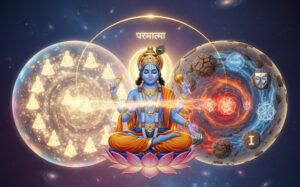
- Firstly, I am sacrifice (adiyajna), the offering to ancestors (pitrus), medicine, ghrta (clarified butter), sacrificial fire (agni) and the offering (huta). Also, I am father and mother of this universe, dispenser of fruits of action, grandfather, OM, the pure Vedas – Rig, Yajur and Sama.
- For all, I am the goal, supporter, resident and witness. Also, I am the shelter, friend, origin, dissolution, locus, balance and imperishable seed. Moreover, I give heat, withhold and send rain. In fact, I am immortality as well as death, existence and well as non-existence.
- Those drinkers of soma (soma is a drink which was used in ancient sacrifices. The ingredients of soma have been lost, but are thought to contain mild intoxicants) who have attained the three knowledge, purified from sin by sacrifice, go come to me where they stay until they have exhausted merits of their actions after which they return.
- Anyone, practicing any other forms of worship will be endowed with similar benefits provided it is done with shraddhā (sincerity and devotion) because all sacrifice comes to me (Shri Krishna).
Shri Krishna explains the benefits of sacrifice (yajna) in rajavidya rajaguhya yoga.
- Firstly, all sacrifices yield merit of the target of sacrifice. Also, those sacrificing to Gods, go to Gods. Similarly, those sacrificing to ancestors (pitris), reach the ancestors, just as those worshipping elements, go to elements. Finally, those that dedicate their sacrifice to me (Shri Krishna) will come to me.
- Importantly, the scale of sacrifice is not important. However, quality, devotion and sincerity (shraddha) are of principle value. In fact, even a flower, leaf, fruit or even water is accepted if it is done with shraddha.
- Remember, one does not have to prepare a special occasion for sacrifice. Sacrifice whatever you are doing; the food before you eat, gift before you give away, any action before acting, all austerities your words or even the fruits of your efforts.
- Without a doubt, I (Shri Krishna) regard everyone equally and am partial to none. However, those who perform sacrifice, I am in them and they are in me.
- Furthermore, your worldliness does not get affected provided you sacrifice unto me. In fact, with sacrifice, your background, birth, education, status becomes irrelevant. So, focus your awareness on the Brahman and sacrifice unto me and you will merge with me (Shri Krishna).
Sacrifice and Shri Krishna in rajavidya rajaguhya yoga.
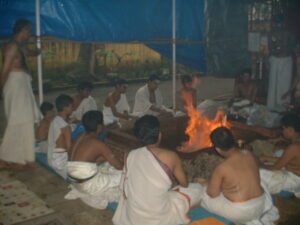 So, when one sacrifices his or her action (karma) to Shri Krishna, who is adiyajna (primordial sacrifice), one is actually sacrificing into sacrifice, mathematically, this is like adding null to null or infinity to infinity
Finally, another critical concept that Shri Krishna clarifies is that the ability to perform is not relevant. In fact, it is the quality of dedication, sincerity and desire for perfection (shraddha) that matters.
- Hence, Shri Krishna detaches quality of outcome from quality of input and clearly establishes the ascendency of effort and contribution over outcome.
- Shri Krishna also states that ability to focus on the task at hand with all attention, without excessive worry about the outcome is the crucible of sacrifice.
School of Yoga explains Srimad-bhagavad-gita, chapter 9, rajavidya-rajaguhya-yoga.
Some contradictions to accepted positions on rajavidya rajaguhya yoga.
- When one reviews the concept, there is a clear point of merger of all knowledge (sankhya), be it philosophical, psychological, physiological, physical or scientific.
- The problem seems to be that there is no foundational theory that supports the unity of all knowledge, such as is proposed above and embedded in the ancient science of yoga.
School of Yoga explains Srimad-bhagavad-gita, chapter 9, rajavidya-rajaguhya-yoga.
Lessons learned in rajavidya rajaguhya yoga.
- Shri Krishna’s position is clarified in this chapter as a state of existence; in verse 11, he states that people confuse his human manifestation as reality, which he is not. Then, from verses 16-19, he asserts that he is sacrifice, the materials of a sacrifice, the reason and objective.
- In verse 20-21, he obliquely refers to rebirth and how it functions, while at the same time dissociating himself from the individual’s state.
- So, we can deduce that Shri Krishna is the framework and operation but not the participant.
- Anyone who sacrifices to him specifically, gets rewarded appropriately. This means that while there are different paths, those that sacrifice unto him get direct benefits of surrender. This is little difficult to accept because the deity should not make a difference, it is the input quality that matters.
The transliteration and translation of Śrīmad-bhagavad-gītā, (rajavidya rajaguhya yoga) chapter 9 follows,
The Sanskrit words are in red italics.
Śrī Kṛṣṇa said – (1) Firstly, to you who bears no ill-will I shall declare this truly great secret, (idaṃ tu te guhyatamaṃ pravakṣyāmyanasūyave ।), knowledge of the Self along with knowledge of the Whole, which when cognised results in emancipation from misfortune (jñānaṃ vijñānasahitaṃ yajjñātvā mokṣyase’śubhāt ॥ 9-1॥).
(2-3) Sovereign science, sovereign secret is highly sacred recognisable by direct experience for the righteous very easy to perform and imperishable (rājavidyā rājaguhyaṃ pavitramidamuttamam । pratyakṣāvagamaṃ dharmyaṃ susukhaṃ kartumavyayam ॥ 9-2॥). People without devotion or righteousness of this do not attain me and return to live and die in saṃsāra (aśraddadhānāḥ puruṣā dharmasyāsya parantapa । aprāpya māṃ nivartante mṛtyusaṃsāravartmani ॥ 9-3॥).
(4-5) All in this world are pervaded by me in the unmanifested form (mayā tatamidaṃ sarvaṃ jagadavyaktamūrtinā ।), all beings exist in me undifferentiated and not I in them (matsthāni sarvabhūtāni na cāhaṃ teṣvavasthitaḥ ॥ 9-4॥). The embodied living me cannot cognise my sublime sovereignty (na ca matsthāni bhūtāni paśya me yogamaiśvaram ।). Supporting the embodied and living in them my Soul enables them to express themselves (bhūtabhṛnna ca bhūtastho mamātmā bhūtabhāvanaḥ ॥ 9-5॥).
(6-7) Just as air rests in space perennially which exists everywhere, similarly comprehend this that all creation rest in me (yathākāśasthito nityaṃ vāyuḥ sarvatrago mahān । tathā sarvāṇi bhūtāni matsthānītyupadhāraya ॥ 9-6॥). All beings created out of prakṛti merge with me at the end of a kalpa (sarvabhūtāni kaunteya prakṛtiṃ yānti māmikām । kalpakṣaye). At the beginning of a kalpa I generate them again (punastāni kalpādau visṛjāmyaham ॥ 9-7॥). Prakṛti being my own creation, is generated again and again (prakṛtiṃ svāmavaṣṭabhya visṛjāmi punaḥ punaḥ ।). All these myrial beings are helpless in the force of prakṛti (bhūtagrāmamimaṃ kṛtsnam avaśaṃ prakṛtervaśāt ॥ 9-8॥).
(8-10) Having controlled prakṛti (prakṛtiṃ svāmavaṣṭabhya) I send out again and again (visṛjāmi punaḥ punaḥ ।) all these myriad creations (bhūtagrāmamimaṃ kṛtsnam) who are helpless before the impact of prakṛti (avaśaṃ prakṛtervaśāt ॥ 9-8॥). These acts do not bind me (na ca māṃ tāni karmāṇi nibadhnanti dhanañjaya ।), I reside indifferent and unattached in those that act (udāsīnavadāsīnamasaktaṃ teṣu karmasu ॥ 9-9॥). The static and dynamic components (sacarācaram) of prakṛti operate under my supervision (mayādhyakṣeṇa prakṛtiḥ sūyate), this is the causal (hetunānena) factor for transformation or change in the cosmos (kaunteya jagadviparivartate ॥ 9-10॥).
(11-12) Disregard this delusional human form that I have taken refuge in know my higher state of being my Lordship over all creation (avajānanti māṃ mūḍhā mānuṣīṃ tanumāśritam । paraṃ bhāvamajānanto mama bhūtamaheśvaram ॥ 9-11॥). Vain expectations, futile actions, deluded understanding of knowledge (moghāśā moghakarmāṇo moghajñānā vicetasaḥ ।), truly these deluded qualities of prakṛti are manifested in the demonic and those of aasuric qualities (rākṣasīmāsurīṃ caiva prakṛtiṃ mohinīṃ śritāḥ ॥ 9-12॥),
(13-14) However, souls of exceptional cognition, with divine nature take refuge in me (mahātmānastu māṃ pārtha daivīṃ prakṛtimāśritāḥ ।), worship with a cognition that does not deviate having recognised meas the imperishable motility of beings (bhajantyananyamanaso jñātvā bhūtādimavyayam ॥ 9-13॥). They are always trying to glorify me with effort and firm in their vows and prostrations of me (satataṃ kīrtayanto māṃ yatantaśca dṛḍhavratāḥ ।), worshipping and doing homage with continual steadfastness (namasyantaśca māṃ bhaktyā nityayuktā upāsate ॥ 9-14॥).
(15) Sacrificing all knowledge and sacrificing everything else also, worship me (jñānayajñena cāpyanye yajanto māmupāsate ।), my universal face exists as one, as different, and as multiplicity (ekatvena pṛthaktvena bahudhā viśvatomukham ॥ 9-15॥).
(16-19) I am the purpose (ahaṃ kratu), I am sacrifice (ahaṃ yajñaḥ), I am the oblation (svadhāham), I am medicine (ahamauṣadham), I am mantra (mantro’ham), I am also ghee (ahamevājyam), I am fire (ahamagni), I am that which is sacrificed or the offering (ahaṃ hutam). I am the father of the world (pitāhamasya jagato) as also the mother, the elemental substance, grandfather (mātā dhātā pitāmahaḥ), sacred vedam, OM and also Rik, Sama, Yajur (vedyaṃ pavitramoṅkāra ṛksāma yajureva ca ॥ 9-17॥). Enabler of goals, the Lord, witness, resident, refuge, friend (gatirbhartā prabhuḥ sākṣī nivāsaḥ śaraṇaṃ suhṛt ।), the origin, dissolution, position, the hoard, seed imperishable (prabhavaḥ pralayaḥ sthānaṃ nidhānaṃ bījamavyayam ॥ 9-18॥). I am the source of heat (tapāmyaham), I withold and send forth rain (varṣaṃ nigṛhṇāmyutsṛjāmi ca ।), I am nectar of immortality (amṛtaṃ caiva), I am death and existence, non-existence and I am Arjuna (mṛtyuśca sadasaccāhamarjuna ॥ 9-19॥).
(20-21) The knowers of three Vedas and drinkers of Soma by me are purified of impurities by help of sacrifices pray to go to heaven (traividyā māṃ somapāḥ pūtapāpā- yajñairiṣṭvā svargatiṃ prārthayante ।). They, having become purified reach the world of Indira and enjoy divinity and divine pleasures in divine world (te puṇyamāsādya surendraloka- maśnanti divyāndivi devabhogān ॥ 9-20॥). They that have enjoyed the vast celestial places enter the mortal world when they exhaust their merits (te taṃ bhuktvā svargalokaṃ viśālaṃ- kṣīṇe puṇye martyalokaṃ viśanti ।), thus abiding by the three Vedas, they come and go and seek the world of desires (evaṃ trayīdharmamanuprapannā- gatāgataṃ kāmakāmā labhante ॥ 9-21॥).
(22-24) Those people who worship me exclusively without worrying about others, them I ensure complete and assiduous prosperity (ananyāścintayanto māṃ ye janāḥ paryupāsate । teṣāṃ nityābhiyuktānāṃ yogakṣemaṃ vahāmyaham ॥ 9-22॥). Even those devotees who worship other deities with complete devotion (ye’pyanyadevatā bhaktā yajante śraddhayānvitāḥ ।), they also worship me alone using an unapproved process (te’pi māmeva kaunteya yajantyavidhipūrvakam ॥ 9-23॥). Truly, I am the enjoyer and sole owner of all sacrifices and those who do not cognise this truth, they fall (ahaṃ hi sarvayajñānāṃ bhoktā ca prabhureva ca । na tu māmabhijānanti tattvenātaścyavanti te ॥ 9-24॥).
(25) Worshippers of deivas, go to deivas; worshippers of ancestors, go to the ancestors; worshippers of beings go to the world of creation; my worshippers come to me (yānti devavratā devānpitṝnyānti pitṛvratāḥ । bhūtāni yānti bhūtejyā yānti madyājino’pi mām ॥ 9-25॥).
(26-28) Leaf, flower, fruit, water, those that offer me with devotion (patraṃ puṣpaṃ phalaṃ toyaṃ yo me bhaktyā prayacchati ।), those offered with devotion I accept of the pious souls (tadahaṃ bhaktyupahṛtamaśnāmi prayatātmanaḥ ॥ 9-26॥). Whatever you do, whatever you eat, whatever you offer as sacrifice, whatever you donate (yatkaroṣi yadaśnāsi yajjuhoṣi dadāsi yat ।) all your austerities you do, consign it to me (yattapasyasi kaunteya tatkuruṣva madarpaṇam ॥ 9-27॥). Thus, you will be freed from good and bad fruits that create bonds of karma (śubhāśubhaphalairevaṃ mokṣyase karmabandhanaiḥ ।) when your soul is steadfast in seeking harmony through renunciation (saṃnyāsayogayuktātmā), you shall be liberated and come to me (vimukto māmupaiṣyasi ॥ 9-28॥).
(29-31) I treat all creation equally, I do not repel them nor are they dear to me (samo’haṃ sarvabhūteṣu na me dveṣyo’sti na priyaḥ ।) but those who worship me with devotion, they are in me and also, I am in them (ye bhajanti tu māṃ bhaktyā mayi te teṣu cāpyaham ॥ 9-29॥). Even if a wicked person worships me, thinking of no other (api cetsudurācāro bhajate māmananyabhāk ।), truly, he should accurately be regarded as saintly, for emancipated is he (sādhureva sa mantavyaḥ samyagvyavasito hi saḥ ॥ 9-30॥). Soon he becomes a righteous soul and attains eternal peace (kṣipraṃ bhavati dharmātmā śaśvacchāntiṃ nigacchati ।), know that none of my devotees is destroyed (kaunteya pratijānīhi na me bhaktaḥ praṇaśyati ॥ 9-31॥).
(32-33) Indeed, even those who may me of wretched origin who take refuge in me (māṃ hi pārtha vyapāśritya ye’pi syuḥ pāpayonayaḥ ।), also women, business people and workers, they also attain supreme salvation (striyo vaiśyāstathā śūdrāste’pi yānti parāṃ gatim ॥ 9-32॥). How many more brahmins, pious devotees, royal seers also impermanent and unhappy in the world have obtained this, worship me (kiṃ punarbrāhmaṇāḥ puṇyā bhaktā rājarṣayastathā । anityamasukhaṃ lokamimaṃ prāpya bhajasva mām ॥ 9-33॥).
(34) With your cognition on me, my devotee, sacrifice unto me, propitiate me alone, strive steadfastly with your soul thus devoted to me (manmanā bhava madbhakto madyājī māṃ namaskuru । māmevaiṣyasi yuktvaivamātmānaṃ matparāyaṇaḥ ॥ 9-34॥).
The complete text is available in my book, A Seeker’s Śrīmad-Bhagavadgītā. Buy your copy today – Notion Press home / Flipkart / Amazon / Amazon India / Amazon UK / Amazon US / Amazon Australia
Acknowledgement –
School of Yoga is profoundly grateful to Saṃskṛta scholars and academics Pijus Kanti Pal (pal.pijuskanti@gmail.com) and Dolon Chanpa Mondal for their support in Saṃskṛta transliteration and quality control.