School of Yoga explains internal awareness in Srimad-bhagavad-gita, chapter 13, Kshetra kshetrajna vibhaga yoga (verse 13-28).
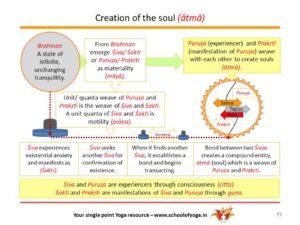 Internal awareness of the Individual or kshetra is kshetrajna. It is a layered evolution from current physical and cognitive state to the core of existence.
Shri Krishna explains internal awareness of prakriti and purusha.
- Both, prakriti and purusha emerge from the Brahman. From purusha emerges consciousness (citta) and attributes (guna) are created by prakriti.
- Purusha experiences the actions that are caused by prakriti, this is done through the medium of consciousness (citta). So, experience of pleasure and pain are caused by purusha who, seated in prakriti experiences the guna born of prakriti.
School of Yoga explains internal awareness in Srimad-bhagavad-gītā, chapter 13, Kshetra kshetrajna vibhaga yoga (verse 22).
पुरुष: प्रकृतिस्थो हि भुङक्ते प्रकृतिजान्गुणान् |
कारणं गुणसङ्गोऽस्य सदसद्योनिजन्मसु|| 22||
puruṣaḥ prakṛtistho hi bhuṅkte prakṛtijānguṇān ।
kāraṇaṃ guṇasaṅgo’sya sadasadyonijanmasu ॥ 13-22॥
puruṣa, seated in prakṛti experiences the guṇa-s born of prakṛti.
School of Yoga explains internal awareness in Srimad-bhagavad-gita, chapter 13, Kshetra kshetrajna vibhaga yoga.
Example – You are strolling down a street and suddenly meet an acquaintance. Happily, you smile but the other person ignores you and walks away.
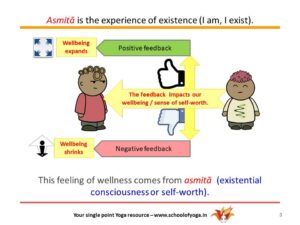 Let us review the above transaction.
- When you are walking down the road with no specific purpose, your mind is generally empty. This is the state of Brahman, a state of peace without any disturbance. While, the actual Brahman is infinite sublime peace, this allusion is for the purpose of explaining the situation.
- You meet a friend – Your consciousness (citta) recognises another purusha (identity). So, you manifest. Here, your purusha and prakriti weave and energising the citta (consciousness) to reach out to the other purusha. As a result of the weave, prana flows in the various channels or nadis, increasing your prana-vayu (incoming energy) and vyana-vayu (personality projection energy/ aura).
- The acquaintance ignores you – The feedback comes through the citta (consciousness) to the purusha. Consequently, purusha experiences loss of existence/ self-worth (shrinking asmita or self-esteem) and it shrinks. This changes the guna (attribute) balance to predominantly tamas (inertia/ delusion, despondence, melancholy or shrinkage).
Here, purusha is the experiencer, prakriti is the manifestation of purusha and their weave is svatantra or individuality. Prakriti and purusha manifest from Brahman. Citta is the cognitive transmitter of idenitity which enables both identities (purusha) to transact. The atma (Self or that unit which represents the weave of purusha with prakriti as svatantra) experiences the situation through the citta (consciousness). Prana is the motility that flows from the transaction of the two entities and the foundation of materiality.
School of Yoga explains internal awareness in Srimad-bhagavad-gita, chapter 13, Kshetra kshetrajna vibhaga yoga.
Shri Krishna explains internal awareness of kshetra and kshetrajna.
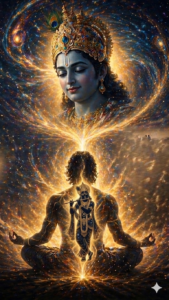 All that is created, comes from the union of the kshetra (region) with the kshetrajna (awareness of the identity of the region). Thus, the jnani (one who has experienced the truth) sees the Brahman in everything – those that perish and those that don’t. Also, such a person recognises that the atma (Self) is actionless and all activity is performed by prakrti. Consequently, such a person merges with the Brahman and becomes that.
- This atma (Identity / Self), has no beginning, possesses no guṇa (attributes), is imperishable, though dwelling in the body, neither acts nor is tainted just as the all-pervading space.
- Just as the Sun illuminates the world, the Lord of the kshetra illuminates the kshetra. So, those that can perceive the distinction between kshetra (region) and kshetrajna (controller of the ksetra), thus they get liberated from prakriti, and merge with the Brahman.
How internal awareness connects purusha and prakriti to life, living and awareness.
- We can see that Brahman is an integral part in every aspect of the experience, but it is not the experiencer.
- Purusha is the experiencer that uses consciousness (citta) to transmit and receive information.
- Prakriti manifests as the expression of purusha and their weave changes according to the feedback as attributes (guna).
- Next, prana is the motility that results from the weave of Shiva (quanta identity) and Shakti (quanta manifestation) which is the building block of purusha and prakrti, but it is inert.
- Also, consciousness (citta) participates like a postman, transmitting purusha’s message to the object and receiving feedback which it passes on to purusha. It is also inert, not experiencing anything!
- Importantly, purusha the experiencer cannot express its experience without prakriti.
- The weave of purusha and prakriti gives rise to creation and existence of a primary self-sustaining unit called atma (soul, Identity or Self).
- Also, atma (soul) by virtue of being the primary unit of Identity is the repository of debt (rinn), but it cannot act without the motility factor (prana).
- With prana, the atma expands by integrating many more atma-s to form a body (ksetra) and interacts with its environment. Importantly, each of these new entities is also an identity/ experiencer (purusha).
- The repository of all karma of a kshetra resides in the atma. So, when prana-vayu leaves, the body (kshetra) loses its ability to perform karma and the atma has to reconcile its debts (rinn) and get another body (kshetra).
- The experiencer, YOU, are acting on the foundation of Brahman, but not engaging with Brahman (That). That is in YOU, but YOU are not in That. This distinction must be understood.
- Since Brahman is an unchanging, infinite cognitive state of peace, it is called the absolute truth (paramarth-sathya). Everything else is conditional Truth or maya or samvritti-sathya.
- So, all of us are an infinite, inexhaustible, unrelenting, continuous field of a weave of purusha and prakriti. This infinite creation of individual expressiveness is is called svatantra (sva = self + tantra = weave of purusha and prakriti) or individuality.
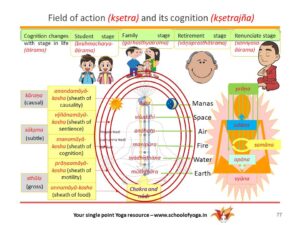 All entities, prāṇa (motility) moves in the form of an energy-stream or vāyu. These are
- prana-vayu (incoming/ life generation motility),
- apana-vayu (outgoing / excretion motility),
- vyana-vayu (ethereal or aural energy motility),
- udana-vayu (upward moving / communication or expression motility),
- samana-vayu (digestion or circulatory motility).
- The above five motilities (prana) combine with the five primordial elements (panca-bhuta) to form five sheaths (koshas) around the body. These are;
- Sheath made by food (annamaya-kosha),
- Sheath of prāṇa (pranamaya-kosha),
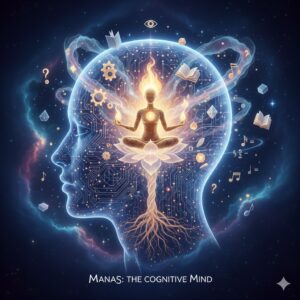
- Sheath of cognition (manomaya-kosha),
- Sheath of awareness of the system (vijnanamaya-kosha),
- Sheath of merger (anandamaya-kosha).
- Whenever, one tries to cognise any region, one must recognise each of the factors and be aware of the state of the Self (atma) of the region/ field (kshetra). This awareness (prajna) is called kshetrajna (awareness of the region).
- Anyone who is constantly in this state of awareness is called sthitaprajna (person of steady awareness).
We can dissect internal awareness (prajna) further into three levels…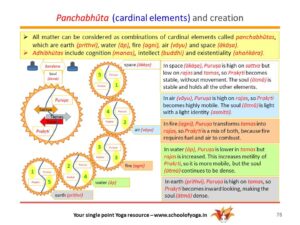
- Gross (sthula) – For example: the world we see around us is made of the primordial elements such as earth, water, fire, air and space (pancabhuta). When we shop for vegetables, we look at the gross aspects of the vegetable – its colour, texture and feel to ascertain its health through our sensory apparatus and this is decoded by our cognitive and logical apparatus.
- Subtle (sukshma) – The awareness of gross elements is driven by an underlying principle, which is the consciousness (citta). For instance, when you read this sentence, the primary information you see is derived through its physical attributes (sthula-sharira), of alphabets and words that are transmitted through a device. However, your experience of the underlying principles (sukshma-sharira) comes from the quality of your awareness as you decipher the information (manomaya) relating to the subject (vijnanamaya).
- Causal (karana) – this is the state from which all materiality (maya) is caused.
- While the base is the Brahman, it is the launch point of purusha and prakriti and the point where joy of cognitive infinity is experienced. So, this is called the sheath of joy (anandamaya-kosha).
For example – we know that Archimedes was bathing (sthula) in a bathtub in a state of null (Brahman) watching the waters sloshing over the tub and his body bobbing. Suddenly, an inspiration occurred (anandamaya), and he cracked the problem of buoyancy (sukshma). The same can be applied to Newton sitting under a tree watching the apple fall down or August Kekule imagining the Benzene ring to be a snake chasing its own tail or Watson to discover the ATGC (adenine-thyamine-guanine-cystocine) model of DNA. This can roughly be approximated as a close application of the causal state (karaṇa-sharira).
School of Yoga explains internal awareness in Srimad-bhagavad-gita, chapter 13, Kshetra kshetrajna vibhaga yoga
Union of the kshetra (region/ field) and kshetrajna (Internal awareness of the region/ field).
Field or region can also refer to an entity such as a building, society, office, company, country, region, world, solar system and even the Universe. How would it work?
Let us look at a company and country.
- A company or country is just an idea… first, there is nothing! This is the Brahman.
- In the case of a company, someone gets an idea or desire to start one. Similarly, in the case of a country people unite in a desire for a country! This is iccha-shakti.
- Next, people make sacrifices necessary for creation of their country. In the case of a company, the promoter sacrifices time, resources and energy to get the requisite technology, funding, people, systems. This is adiyajna.
- From the sacrifice emerges a national identity (purusha). When it weaves with its own manifestation (prakriti), a national soul (atma) is formed and this is represented by the Government, National Flag and Constitution. In the case of a company, the identity (purusha) is established by the articles of association and brand. Purusha and prakriti weave to form and market a product. Vijnana is market feedback.
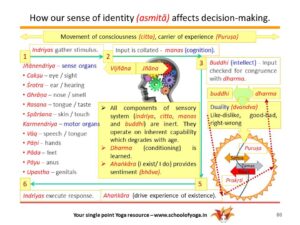 Prakriti manifests as guna (attributes). Legislature, which represents the people, hence their identity, fears, aspirations and delusions, is predominantly Judiciary, which represents equality is predominantly sattika and Executive, which runs the country is rajasika, since effort and energy are required to keep all systems functioning. In the case of the company, these guna-s are embedded in each department and the way each department functions. For example, a well-run manufacturing department will have quality systems, low wastage and rejection, optimised use of manpower etc. Thus, a good manufacturing department should be low on tamas, but high on rajas and sattva. However, a branding department would need to understand Identity, which is intrinsically tamasika but must be balanced by sattva so that the brand doesn’t become narcissistic! Quality department would have a mix of rajas and sattva, while accounts would need to be a mix of tamas and sattva owing to the intrinsic need for integrity, ability to say no and accuracy.
- Kshetra is defined by the borders of the country. In a company, this depends on the product line and markets as can be seen in the case of Amazon, Microsoft, Indian Railways or Ford!
- The Head of the country is kshetrajna (soul of the kshetra). So, the ability of any Head to understand and define the country’s goals determines how the guna-s will mix in its operation. The board, in a company would ideally be the kshetrajna, but often, it might be the department heads if functions are compartmentalised.
- If the Head of Government were to be delusional, then all actions by the Government will be predominantly tamasika. Also, if the Head were to be ambitious, then the Governments actions will be rajasika and aggressive. Finally, a sattvika Government will adopt a balanced and harmonic approach to all issues mixing reconciliation, aggression and passivity appropriately. This applies to companies as well.
- The country’s awareness of its position in the external environment is vijnana and its understanding of itself, its strengths and weaknesses is jnana. In the case of a company, it would be the strategic as well as competitive environment.
- Also, the energy that flows through the country which makes the guna-s function is prana and encompassing foundation of all experience within the kshetra (country) is an undefinable state of nothing. Indeed, this applies to companies as well.
- Finally, the degree to which the leader and people of a company or country are yoked to their country’s identity will determine the seamlessness with which their actions will mirror the requirements of their country.
- The yoking of people to their company or country is Yoga and the outcome is determined by the mix of situational awareness (prajna), conditioning/ order and harmony (dharma), sincerity and dedication (shraddha), knowledge (jnana) and sacrifice (yajna), which includes effort (karma).
- It’s amazing, how this ancient philosophy is so universally applicable (sanatana) in every situation as a manual of life and living.
School of Yoga explains internal awareness in Srimad-bhagavad-gita, chapter 13, Kshetra kshetrajna vibhaga yoga
Some contradictions to accepted positions on internal awareness.
Are Brahman and God one and the same? We pray to God, which means that we adopt a subordinate attitude when dealing with God. However, since the Self and Brahman are the same, we adopt an attitude of equalness with the Brahman. Hence, equating Brahman with God, may not be appropriate.
School of Yoga explains internal awareness in Srimad-bhagavad-gita, chapter 13, Kshetra kshetrajna vibhaga yoga
Lessons learned in Chapter 13 on internal awareness.
- Cognition of the kshetra in its gross (sthula) and subtle (sūkṣma) aspects is kshetrajna. Brahman is the causal state (karana).
- Purusha is the spectator, that which experiences the Self. Consequently, those with knowledge of the purusha and prakriti along with the guna-s are able to isolate experience from the Self and are never born again.
- So, anyone who is attached to these material outcomes will be unable to move from the gross state to the subtle and finally causal state. To achieve this, one needs to move beyond the material by avoiding duality of like/dislike, discrimination between permanent and impermanent (vivekam), dispassion to all objects (vairagyam) and adopt an equal gaze (sama-drishti) to everything.
The transliteration and translation of Srimad-bhagavad-gita, chapter 13 kshetra kshetrajna vibhaga yoga (verse 15-35) follows.
15-16) Bringing clarity to all senses driven by attributes, all senses removed and unattached, supporting all and even devoid of attributes and still the user of attributes (sarvendriyaguṇābhāsaṃ sarvendriyavivarjitam । asaktaṃ sarvabhṛccaiva nirguṇaṃ guṇabhoktṛ ca ॥ 13-15॥). Outside and within creation, unmoving yet moving also and because of its subtlety, that incognisable is far and near (bahirantaśca bhūtānāmacaraṃ carameva ca । sūkṣmatvāttadavijñeyaṃ dūrasthaṃ cāntike ca tat ॥ 13-16॥).
(17-18) Undivided and in creation existing as if divided, existing as well as supporting creation and know that to be devouring and generating (avibhaktaṃ ca bhūteṣu vibhaktamiva ca sthitam । bhūtabhartṛ ca tajjñeyaṃ grasiṣṇu prabhaviṣṇu ca ॥ 13-17॥). That which is the light that lights complete darkness it is said, wisdom that is cognised, the goal of wisdom, seated in the heart of all (jyotiṣāmapi tajjyotistamasaḥ paramucyate । jñānaṃ jñeyaṃ jñānagamyaṃ hṛdi sarvasya viṣṭhitam ॥ 13-18॥).
(19-20) Thus, the field as well as wisdom as well as the knowable have been stated briefly. Knowing this, my devotee merges with my essence (iti kṣetraṃ tathā jñānaṃ jñeyaṃ coktaṃ samāsataḥ । madbhakta etadvijñāya madbhāvāyopapadyate ॥ 13-19॥). Know that both prakṛti and puruṣa are also without beginning, know that all changes and guṇa-s are born out of prakṛti (prakṛtiṃ puruṣaṃ caiva viddhyanādī ubhāvapi । vikārāṃśca guṇāṃścaiva viddhi prakṛtisambhavān ॥ 13-20॥).
(21-22) The act, reason for the act, the actor is caused by prakṛti, it is said. Puruṣa is the cause of the experience of pleasure and pain, it is said (kāryakāraṇakartṛtve hetuḥ prakṛtirucyate । puruṣaḥ sukhaduḥkhānāṃ bhoktṛtve heturucyate ॥ 13-21॥). Indeed, puruṣa embedded in prakṛti experiences guṇa that emerge from prakṛti, which include cause, attachment to the attributes, of one’s value, lack of value, of birth from various wombs (puruṣaḥ prakṛtistho hi bhuṅkte prakṛtijānguṇān । kāraṇaṃ guṇasaṅgo’sya sadasadyonijanmasu ॥ 13-22॥).
(23-24) The spectator, permitter and husband, the experiencer is the great īśvara, who is the supreme Soul, and so the body is also called supreme puruṣa (upadraṣṭānumantā ca bhartā bhoktā maheśvaraḥ । paramātmeti cāpyukto dehe’sminpuruṣaḥ paraḥ ॥ 13-23॥). He who this cognises puruṣa, prakṛti and guṇa-s in all combinations in the state of the present, also he is not born again (ya evaṃ vetti puruṣaṃ prakṛtiṃ ca guṇaiḥ saha । sarvathā vartamāno’pi na sa bhūyo’bhijāyate ॥ 13-24॥).
(25-26) By meditating into the Self, some can cognise the Self in the Self, others use yoga of knowledge and yet others karma-yoga (dhyānenātmani paśyanti kecidātmānamātmanā । anye sāṅkhyena yogena karmayogena cāpare ॥ 13-25॥). Others, even though not knowing, worship as they have heard from others, and even they also cross beyond death due to their devotion to what they have heard (anye tvevamajānantaḥ śrutvānyebhya upāsate । te’pi cātitarantyeva mṛtyuṃ śrutiparāyaṇāḥ ॥ 13-26॥).
(27-28) Anything that comes into existence, the static and mobile, the confluence of the field and knowledge of the field must be cognised (yāvatsañjāyate kiñcitsattvaṃ sthāvarajaṅgamam । kṣetrakṣetrajñasaṃyogāttadviddhi bharatarṣabha ॥ 13-27॥). Equally in all creation exists the supreme Being, he that sees among the perishable the non-perishable is one that actually sees (samaṃ sarveṣu bhūteṣu tiṣṭhantaṃ parameśvaram । vinaśyatsvavinaśyantaṃ yaḥ paśyati sa paśyati ॥ 13-28॥).
(29-30) Indeed, he that sees equally everywhere, as the baseline the Being, that Self is not destroyed, the self then goes to the supreme goal (samaṃ paśyanhi sarvatra samavasthitamīśvaram । na hinastyātmanātmānaṃ tato yāti parāṃ gatim ॥ 13-29॥). He who cognises that all actions are performed by prakṛti alone, that seer also is a Self which becomes actionless (prakṛtyaiva ca karmāṇi kriyamāṇāni sarvaśaḥ । yaḥ paśyati tathātmānamakartāraṃ sa paśyati ॥ 13-30॥).
(31-32) When one sees all creation is as the same entity, from that development onward he becomes Brahman (yadā bhūtapṛthagbhāvamekasthamanupaśyati । tata eva ca vistāraṃ brahma sampadyate tadā ॥ 13-31॥). Without beginning, without attributes, this imperishable supreme Self, though in the body, does not act nor is it tainted (anāditvānnirguṇatvātparamātmāyamavyayaḥ । śarīrastho’pi kaunteya na karoti na lipyate ॥ 13-32॥).
(33-35) Just as ether exists everywhere in a subtle manner but does not get tainted, the Self exists everywhere in the body but is not tainted (yathā sarvagataṃ saukṣmyādākāśaṃ nopalipyate । sarvatrāvasthito dehe tathātmā nopalipyate ॥ 13-33॥). Just as this one Sun lights the whole field, similarly the Brahman illuminates everything (yathā prakāśayatyekaḥ kṛtsnaṃ lokamimaṃ raviḥ । kṣetraṃ kṣetrī tathā kṛtsnaṃ prakāśayati bhārata ॥ 13-34॥). So, the distinction between the field and knower of the field is by cognition of wisdom that liberation of creation from prakṛti and those that know go to the Supreme (kṣetrakṣetrajñayorevamantaraṃ jñānacakṣuṣā । bhūtaprakṛtimokṣaṃ ca ye viduryānti te param ॥ 13-35॥).
The complete text is available in my book, A Seeker’s Śrīmad-Bhagavadgītā.

Buy your copy today – Notion Press home / Flipkart / Amazon / Amazon India / Amazon UK / Amazon US / Amazon Australia
Acknowledgement –
School of Yoga is profoundly grateful to Saṃskṛta scholars and academics Pijus Kanti Pal (pal.pijuskanti@gmail.com) and Dolon Chanpa Mondal for their support in Saṃskṛta transliteration and quality control.