
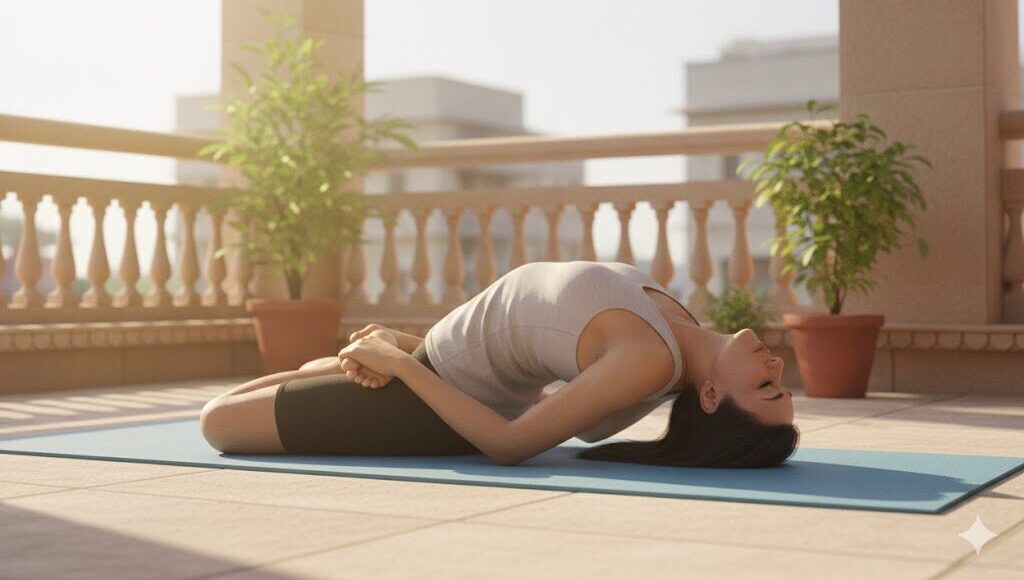
What is matsyāsana (fish pose)?
Matsyāsana is a mandatory āsana that is performed after halāsana and sarvangāsana to reverse the spinal pressure on the neck. Matsyāsana is an advanced āsana and must be learned under the guidance of an expert.
How does one perform matsyāsana ? (should be learned under supervision)
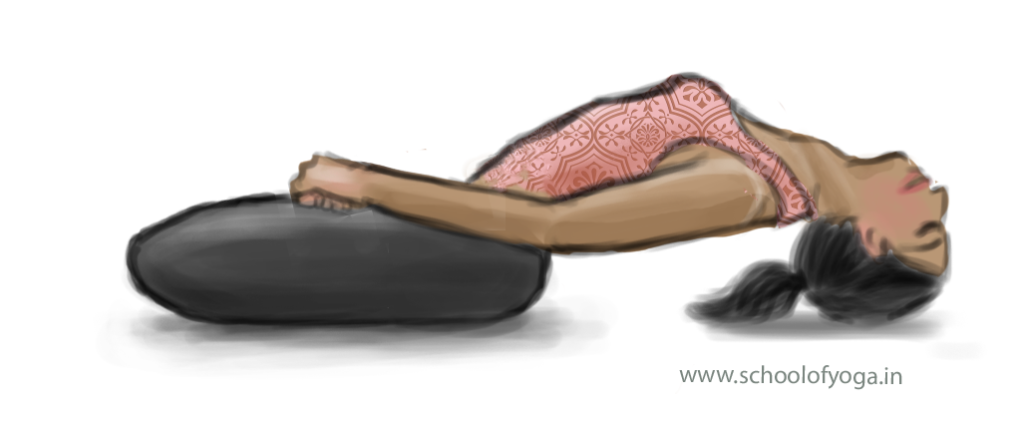
- Sthithi (starting) position: First, sit in padmāsana.
- Second, using elbows as support, slowly fall backwards on the back until you are completely on the ground.
- Third, take hands rearward and place them under the shoulder.
- Then, using your hands, lift your shoulders off the ground while bending your head backwards towards the body, till the neck stretches completely and the body balances on the top of the head.
- Slowly, release the load on the hands and transfer the weight of the torso onto the head. Ensure that the body is in balance, and there is no strain on the head or neck.
- Now, take your hands forward to grip the toes. Importantly, pull on the toes so that the legs, back, and neck are in tension. This is a reverse neck lock or matsya-banda.
- Maintain position for around 10 seconds. Remember to maintain shallow breathing.
- Next, release the hands and bring them to either side. Slowly, straighten legs, stretch body, and relax.
- The dṛṣṭi (gaze) recommended is ūrdhva-dṛṣṭi (open sky gaze).
What are the benefits of the fish pose?
- Firstly, the reverse neck lock in matsyāsana reverses and compensates for the pressure created by the neck lock during sarvangāsana and halāsana. Therefore, halāsana should always be followed by sarvangāsana and finally by matsyāsana.
- Importantly, this exercise is good for toning the neck, shoulder muscles, upper, middle, and lower back. Additionally, this exercise stretches the chest and abdominal muscles, thereby toning them.
- Also, matsyāsana increases blood supply to the brain stem, and the movement increases its suppleness. The complex and sensitive muscles of the neck and head feel rejuvenated with this exercise.
- Lastly, this āsana is good for stabilising irregularities in periods for women.
What are the possible contraindications for the fish pose?
- Firstly, if you have any form of backache, do not attempt this āsana without expert supervision and support.
- Importantly, people with neck ailments like cervical spondylitis should not try the matsyāsana.
- Also, those with cardiac problems such as high blood pressure should start this exercise only after getting proficiency in other āsana, and that too, increase the intensity of practice gradually, under the guidance of a doctor.
- Additionally, do not perform this āsana if you have cervical spondylosis, hernia, or arthritis.
- Finally, people with kidney ailments, hernia, etc., should avoid this āsana.
- Lastly, this āsana should not be practiced during menstruation and pregnancy.
Some noteworthy points on matsyāsana :
Internal Links: Dharma (conditioning), Stress and Situational Awareness, Prana, Asana sequence, Asana schedule, Asana Focus or gazing, Pranayama, Hatha Yoga Pradeepika
External Links: Prana, Chakra, Pancha Tattva, Pancha Prana, Pancha Kosha, Nadi,
- Importantly, the pulling of the feet increases the lumbar arch and rejuvenates the spine as well as the sympathetic and para-sympathetic nervous system.
- The pulling of the feet also increases the flexibility of the knees and improves the ability to perform padmāsana.
- However, be very careful when increasing pressure on the neck muscles. In fact, a jerk or an improperly balanced pull could easily result in muscle or ligament damage in the neck, and this can be very painful.