What is mayurasana (peacock pose)?
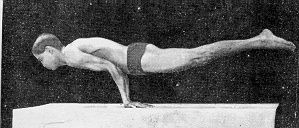
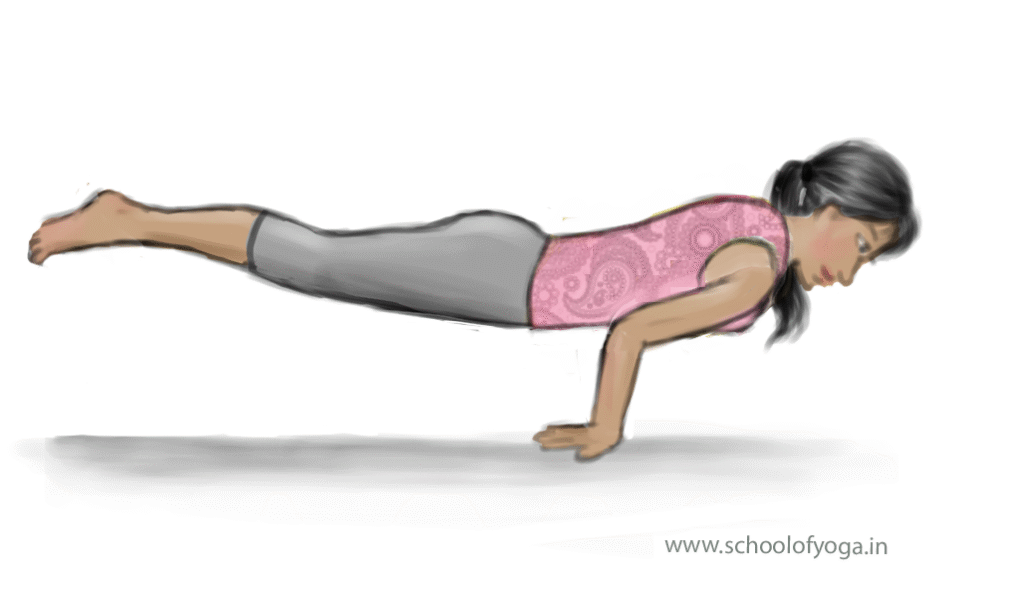
Mayurasana or peacock pose in yoga is an asana where one holds the entire body straight horizontally, by balancing it on the hands, and with the elbows against the abdomen. Mayurasana is an advanced asana which must be learned under the instructions of an advanced yoga expert.
How does one practice mayurasana yoga pose ? (should be learned under supervision)
- Sthithi (starting) position: First, kneel on the ground.
- Second, bring the forearms together such that the little fingers of both your hands are touching.
- Third, plant your palm firmly on the ground near the knees, with fingers facing the knee, and the insides of the forearms facing out.
- Now, inhale partially and stiffen the abdominal muscles.
- Following this, let the abdomen fall gently on the back of your joined elbows, such that the elbows are in the region of the navel. Do not relax the abdominal muscles.
- Lean your torso forward until your forehead touches the ground.
- Slowly, stretch your legs back one at a time and stiffen them.
- Next, slowly raise your torso until it is parallel to the ground.
- Lift one leg and then the next, until they are parallel to the ground.
- Retaining the breath, rock your body forward slightly such that your legs lift, and your body balances evenly on your hands, and is parallel to the ground.
- Importantly, your legs should remain straight as well as stretched, and the buttocks should be contracted.
- Retain for 5 counts.
- Slowly, come back to sthithi position.
- The yoga drishti (gaze) recommended is manipura-cakra.
What are the benefits of mayurasana (peacock pose)?

- Firstly, while performing this exercise, there is pressure on the organs within the abdominal cavity. The increase in intra-abdominal pressure induces peristalsis. As a result, there is very good evacuation of the bowels.
- Additionally, the intra-abdominal massage also ensures good blood supply to all muscles within the abdomen, ensuring optimum functioning of all abdominal organs.
- Mayurasana is very good for removing flatulence, constipation, and piles.
- This exercise also improves the functioning of the liver, pancreas, and kidneys, thus removing digestive ailments.
- Mayurasana is also very good for ensuring better abdominal inter-organ orientation.
- Also, the action of lifting legs and balancing the body on the wrists strengthens the muscles of the wrist, forearms, and lower back.
- Lastly, this asana is good for stabilising irregularities in periods for women.
What are the mayurasana contraindications?
- Firstly, if you have any form of backache, do not attempt mayurasana without adequate expert supervision and support.
- Importantly, people having neck ailments or lower back ailments like cervical or lumbar spondylitis should not try this asana.
- Also, those with cardiac problems like high blood pressure should start this exercise only after getting proficiency in other asana, and that too, increase the intensity of practice gradually, under the guidance of a doctor.
- Additionally, people with kidney or liver ailments, hernia, etc., should avoid this asana.
- Also, practitioners suffering from wrist problems like carpal tunnel will find this exercise difficult to perform. There will be severe pain in the wrist. Hence, one should first perform wrist movement and strengthening exercises before slowly increasing the load on the wrists. If the pain continues, stop.
- Lastly, women must avoid this asana during menstruation and pregnancy.
Mayurasana according to Hatha Yoga Pradeepika:
Chapter 1 v (30) mayurasana – Placing both hands on the ground, rest the navel on the elbows and balancing thus, raise the body in the air like a rod. This position is called mayura.
Chapter 1 v (31) mayura cures all diseases like gulma (enlargement of glands in the abdomen like spleen), udara (stomach), removes irregularities arising from imbalance of phlegm, bile, and wind. It enables the digestion of food taken in excess and restores appetite, even having ability to digest poison.
Some noteworthy points on mayurasana :
Internal Links: Dharma (conditioning), Stress and Situational Awareness, Prana, Asana sequence, Asana schedule, Asana Focus or gazing, Pranayama, Hatha Yoga Pradeepika
External Links: Prana, Chakra, Pancha Tattva, Pancha Prana, Pancha Kosha, Nadi,
- Importantly, since there is a danger of toppling when there is an imbalance, fall to the side so as not to fall and injure your face.
- Additionally, it is advisable to keep a soft pillow in front to prevent damage to the face. If falling sideways, use the deltoids to break the fall.
- Also, one of the problems in performing this asana is maintaining both axial (along the length of the body) and lateral (balance between hands) balance. Keep your hands slightly apart such that the elbows sit on either side of the abdominal muscle (abs). This increases lateral balance.
- If you do not feel confident about maintaining balance along the length of your body, you can get similar benefits by practicing a variation of this asana. This is called hamsasana (swan pose) and is performed without lifting the feet off the ground. Later, as confidence increases, one could first lift one foot and then the other.
- Lastly, the reason one is asked to take a half breath, just as in shalabhasana, is to ensure that the abdomen is not unduly stressed. In complete exhalation, the abdominal viscera would be loosely packed in the abdomen, while after complete inhalation, the abdomen would be tight, leading to stomach cramps. By taking a half breath, there is no undue stress to the abdomen, and this helps avoid cramps.