What is sannyasa-yoga (yoga of renunciation) – Srimad-bhagavad-gita, chapter 5,
Introduction to sannyasa-yoga or yoga of renunciation.
- In chapters 2, 3 and 4, Shri Krishna guides the student from disillusionment, fear of outcome and grip of illusion (maya) to action and then, renunciation of action.
- In chapter 5, he moves to the next step, what happens after a person has cleaned up his action (karma)? How does one evolve to the next level of personal development?
- Importantly, one must recognise that development in Yoga is experiential and everything that is said in Srimad-bhagavad-gita can only create value when there is introspection and practice.
Jnana-yoga or karma-yoga, which is better? sannyasa-yoga (verse 1-6)
Arjuna starts off by expressing confusion – which is better, performing action or renouncing it? Shri Krishna says, both jnana-yoga (sankhya) and karma-yoga are one (eka) and reach the same goal, Brahman. However, the path of renunciation is very difficult and painful. In any case, even renunciation requires action, so renouncing the outcome of action is an easier method of reaching Brahman.
School of Yoga explains chapter 5, sannyasa-yoga (verse 2-11).
Overview of renunciation.
- First, the yogi should try and smoothen internal turbulence during experience of change. This is called purification of the soul (atmashuddhaye). This is done by discriminating permanent from impermanent (viveka) and approaching all actions with dispassion (vairagyam).
- Next, the yogi attempts to remain in this state at all times and in all situations. This includes seeing, hearing touching, smelling, eating, evacuating, sleeping, breathing or speaking. Consequently, the cognitive apparatus (indriyas) is conditioned one to move among similar sense objects without getting affected by stimulus.
- In fact, the yogi should perform karma (activity) with sentience (awareness of his senses) withdrawn from the environment, viewing all creation as one (sama-darshana).
- Lastly, the yogi should be detached from the surroundings like a lotus leaf in water (water on a lotus leaf slides off without making the leaf wet) and remain in an isolated state. This is done by performing action using the body, cognitive apparatus, logical reasoning and senses with the attitude of not acting nor causing action.
- So, the yogi’s awareness is absorbed in the Brahman, his or her Soul is established in the Brahman and with the Brahman for the goal and nothing else. This is called ekagrata (single-pointed focus).
School of Yoga explains Srimad-bhagavad-gita, chapter 5, sannyasa-yoga (verse 12-19).
What is Brahman? Importance in renunciation.
- Brahman is neutral – it is neither the initiator, creator nor the doer, nor does it get attached to creation – this is because this is its innate nature. Also, Brahman does not accept from anyone their demerits or even merit, this occurs in people on account of illusion (maya) and lack of knowledge (ajnana).
- The reason for this delusion is that the Self (atman) experiences existential doubt (am I alive? do I exist? who am I?) and this insecurity gives rise to the need to form bonds and attachments that reinforce a sense of existence and increase the feeling of self-worth (asmita).
- Consequently, this need for reinforcement of its sense of identity creates a veil of ignorance (maya) over the true nature of the Self (ajnana) which is dispelled by knowledge of the Self (jnana).
- Also, this makes maya (illusion) very difficult to overcome unless the person is able to overcome the need for reinforcement of self-worth as well as distance and detach the Self from impact of the environment on the Self (atman).
A person merges with Brahman when he has advanced in cleansing of the Soul (atmashuddhaye), views everything as one (sama-drishti), has an intellect that is immersed in an unchanging state of peace (Brahman) with complete focus on an unchanging state of peace (Brahman) (verse 18-19).
School of Yoga explains Srimad-bhagavad-gita, chapter 5, sannyasa-yoga .
What is karma-yoga? What is renunciation in action?
- We get stimulus through our senses – sight, sound, touch, taste and smell. Then, we react through our motor organs – legs, hands, tongue, anus and sexual organs.
- Consequently, we get into a cycle of stimulus and response, that is driven by our senses, cognition and intellect. This creates an illusionary world called maya that veils the Brahman.
- So, to merge with Brahman, we need to transcend maya (Illusion or farce).
- One way is to isolate ourselves from the environment so that stimulus is controlled, so that impact of maya is slowly controlled. This is renunciation (sannyasa) and the path is called jnana-yoga.
- The other way is to perform karma (action), but control the senses (indriyas), cognition (manas) and logic (buddhi). Consequently, during the performance of action, we remain calm, unruffled in every experience and look at effort & outcome without fear or favour. This path is called karma-yoga.
- However, both paths are difficult. In fact, isolating ourselves from society requires enormous ability to come to terms with loss of self-worth or self-esteem (asmita).
- Also, the difficult effort of isolating the Self from society itself is action (karma).
- Therefore, whether we practice renunciation (sannyasa) or control of action (karma-yoga), action is required. However, by practicing karma-yoga, we give ourselves the ability to improve continuously without bringing catastrophic damage to our self-esteem (asmita) that sannyasa-yoga could bring.
- Since the risks are lower, this karma-yoga is seen by Shri Krishna as more practical and thus achievable.
School of Yoga explains Śrīmad-bhagavad-gītā, chapter 5, sannyasa-yoga (verse 18-29).
How to increase free-will (svatantra) through renunciation?
- To get jnana (knowledge of the self), one must anchor the seat of cognition (manas) and seat of logic (buddhi) with the Brahman and view everything with sama-darshana (equal gaze), whether it is a learned person, a cow, an elephant, a dog or even an outcast.
- As a result of sama-darshana (equal gaze), the seat of cognition (manas) becomes spotless (nirdosha) and without bias because it allows the yogin to separate the stimulus from the source of the stimulus.
- Consequently, a sense of equality gets established and this ensures that the yogi becomes a detached soul.
- As a result, the yogi recognises all actions are born out of impulses of desire and that happiness or peace comes from removal of duality. So, the yogi reacts with equanimity to pleasant and unpleasant stimuli, being neither too happy at good news nor grieving at unpleasant news.
- Self-controlled ascetics (sannyasin) does this by shutting out external objects, fixing the gaze between the eyebrows (nasikagra-drishti) and equalising their incoming (prana) and outgoing (apana) breath (vayu) and moving it within the nostrils (nasabhyantaracharinau).
What is the impact of renunciation on guṇa, citta, dharma and karma?
- When we are in our natural state (dharma), we experience a cognition of peace, the three attributes (gunas – tamas = delusion / rajas = passion / sattva = harmony) are in balance.
- Then, stimulus coming in through the senses (indriyas) is collated by the centre of cognition (manas). This stimulus is compared with conditioning (dharma) before a response is formulated.
- Citta (consciousness) is the medium that recognises the object, stimulates the senses, collates the data at the cognitive centres (manas), carries the information to the intellect (buddhi) for comparison with conditioning (dharma) and formulates a response.
- If there is congruence, ahankara (I am the doer) pulls the object towards it because it wants continued engagement. If there is dissonance, ahankara pushes the object away to avoid discomfort. As a result, there is give-take or a transaction.
- Any transaction or give-take results in karma (action). When there is congruence / attraction (raga) or dissonance / repulsion (dvesha) with the object, a give-take transaction results in pull-push movement between the subject and object. In like (raga), the subject and object try to come closer to each other and in dislike (dvesha), they try to push each other away.
- However, in give-take transactions karma is always unequal between the giver and taker, this results in an imbalance, since one always gives or takes more from the other. Consequently, this imbalance results in debt (rinn) which has to be repaid, even if it means taking another jnana or rebirth.
What is the citta (consciousness) and renunciation?
- Citta (consciousness) performs the following action:
- It transmits projection of self-worth (asmita) of the subject to other entities and vice-versa,
- Also, it seeks and identifies other entities,
- Then, it relays feedback from other entities as experience,
- Citta carries the stimulus through the senses (indriyas), to the centre of cognition (manas), then to the centre of logic (buddhi).
- Then, it acts as bridge, comparing stimulus with conditioning (dharma),
- The outcome is integrated with the sense of self-worth/ identity (asmita) which takes ownership of the response (ahankara).
- Finally, citta then carries out the response as a projection of identity (asmita).
- In short, citta (consciousness) is the thread (sutra) that runs across the complete transaction spectrum, from identifying another entity, acquisition of information to formulation of response, then response and finally feedback.
- One can experience consciousness (citta) flowing out of the frontal lobe when one is transacting with anyone.
- When citta (consciousness) examines itself, this internal awareness of its own existence is called jnana.
- Next, the awareness of the projection of citta (consciousness) to the environment is called vijnana (macro or system transaction).
- Also, the experience of citta of the Identity’s (purusha) projection perceived by others is called asmita (self-esteem/ self-worth).
- Additionally, the experience of being a doer by purusha is called ahankara (I am the doer).
- Lastly, awareness of consciousness (citta) and its movements is called prajna (awareness). This awareness is primordial and can be experienced with practice, when a person steps back from any situation and watches his own actions as if he or she were a different person.
- When a person focuses on the action and not the experience, there is no experience of like (raga) or dislike (dvesha), which results in the effort of purusha to project itself being nullified.
- This effort is yajna or sacrifice.
How should we perform karma when we aspire renunciation?
Maya (illusion) is driven by guna (attitude) which drives conditioning (dharma). Guna comprises tamas (delusion), rajas (passion) and sattva (harmony). So, we can transcend maya and experience the nature of Self by taking the following actions:
- First, avoid hatred (tamas) and anger (rajas). Then, try to stay balanced (sattva) with sama-darshana (equal gaze).
- Next, bring the senses under control.
- Start by physically avoiding sensory stimuli.
- Also, try controlling flow of stimuli where they are collated at the cognition (manas). This area corresponds to the area around the amygdala where “flight or fight” responses are processed. One may increase one’s ability by practicing pranayama and meditation.
- Finally, practice control of conversion of stimulus to response by separating the intellect (buddhi) from conditioning (dharma) as well as logically try to redirect response to a sāttvika (harmonic or balanced) one to preventing rise of tamas or rajas.
- Also, avoid duality such as like/dislike, happy/ sad etc as these result in tāmasika and rajasika experiences which can hijack the intellect (buddhi).
- Additionally, view everything with sama-drishti (sama = equal + drishti = gaze), this way tamas and rajas are brought under control.
- Finally, do not get attached to action, its experience, efforts or outcome. Step back and recognise it as maya. For example, perform action as a duty as sincerely as possible without expecting any return, avoid attachment to the action (ahankara) or outcome (phala).
As a result, senses become controlled and Self is isolated from the actions. Also, this allows clarity in cognition (viveka) and dispassion (vairagya), the two key requirements for betterment in Yoga which allow the Soul to transcend maya and merge with the Truth (Brahman).
The transliteration and translation of Srimad-bhagavad-gita, chapter 5 – sannyasa-yoga (renunciation) follows.
The Saṃskṛtaṃ words are in red italics.
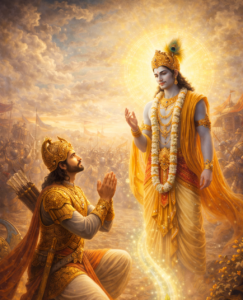
Arjuna said (1) On the one hand you praise renunciation of action and at the same time recommend its performance. So, tell me conclusively, between these, which is better? (saṃnyāsaṃ karmaṇāṃ kṛṣṇa punaryogaṃ ca śaṃsasi । yacchreya etayorekaṃ tanme brūhi suniścitam ॥ 5-1॥).
Śrī Kṛṣṇa said (2-3) Both renunciation and performance of action lead to the highest bliss but of the two, renunciation of action is superior to merger with action (saṃnyāsaḥ karmayogaśca niḥśreyasakarāvubhau । tayostu karmasaṃnyāsātkarmayogo viśiṣyate ॥ 5-2॥). Know this that he is a complete ascetic who neither hates nor desires, is free from opposites, truly that person becomes free from bondage easily (jñeyaḥ sa nityasaṃnyāsī yo na dveṣṭi na kāṅkṣati । nirdvandvo hi mahābāho sukhaṃ bandhātpramucyate ॥ 5-3॥).
(4-6) The harmonisation of knowledge philosophy is distinct and only the childish speak of them not the learned even though when one is established then truly fruits of both are obtained (sāṅkhyayogau pṛthagbālāḥ pravadanti na paṇḍitāḥ । ekamapyāsthitaḥ samyagubhayorvindate phalam ॥ 5-4॥). The philosophical state obtained by yogīs is also reached when one that sees knowledge also sees action (yatsāṅkhyaiḥ prāpyate sthānaṃ tadyogairapi gamyate । ekaṃ sāṅkhyaṃ ca yogaṃ ca yaḥ paśyati sa paśyati ॥ 5-5॥). Renunciation is painful to obtain without implementation of yoga but when harmonised in yoga, the ascetic quickly goes to Brahman (saṃnyāsastu mahābāho duḥkhamāptumayogataḥ । yogayukto munirbrahma nacireṇādhigacchati ॥ 5-6॥).
(7-9) A purified soul is harmoniously merged and becomes a victorious soul when it has subdued the senses (yogayukto viśuddhātmā vijitātmā jitendriyaḥ ।), that soul which sees sentient souls in all souls when acting is also not tainted (sarvabhūtātmabhūtātmā kurvannapi na lipyate ॥ 5-7॥). I do not do anything is what the yogī who knows the Truth should cognise even when he is seeing, hearing, touching, smelling, eating, sleeping, breathing, speaking, evacuating, holding, opening the eyes, closing the eyes also. (naiva kiñcitkaromīti yukto manyeta tattvavit । paśyañśaṛṇvanspṛśañjighrannaśnangacchansvapañśvasan ॥ 5-8॥ pralapanvisṛjangṛhṇannunmiṣannimiṣannapi ।). In fact, his senses move separated from sense objects (indriyāṇīndriyārtheṣu vartanta iti dhārayan ॥ 5-9॥).
(10-11) He who has based his actions in the Brahman and who acts after abandoning all attachment (brahmaṇyādhāya karmāṇi saṅgaṃ tyaktvā karoti yaḥ ।), he is not tainted by consequences and is like a lotus leaf in water (lipyate na sa pāpena padmapatramivāmbhasā ॥ 5-10॥). The yogī performs action using the body, cognitive apparatus, logical reasoning, senses; abandoning attachment and acting for purification of the Soul (kāyena manasā buddhyā kevalairindriyairapi । yoginaḥ karma kurvanti saṅgaṃ tyaktvātmaśuddhaye ॥ 5-11॥).
(12-13) Having merged with abandonment of fruits of action he obtains highest peace (yuktaḥ karmaphalaṃ tyaktvā śāntimāpnoti naiṣṭhikīm ।). However, he that is driven by desire and clings to outcome is bound to karma (ayuktaḥ kāmakāreṇa phale sakto nibadhyate ॥ 5-12॥). So, he that has detached cognition from all action controls happiness (sarvakarmāṇi manasā saṃnyasyāste sukhaṃ vaśī ।), resting in the ramparts of his nine-gated city, not acting, nor causing action (navadvāre pure dehī naiva kurvanna kārayan ॥ 5-13॥).
Acknowledgement –
School of Yoga is profoundly grateful to Saṃskṛta scholars and academics Pijus Kanti Pal (pal.pijuskanti@gmail.com) and Dolon Chanpa Mondal for their support in Saṃskṛta transliteration and quality control.
The complete text is available in my book, A Seeker’s Śrīmad-Bhagavadgītā. Buy your copy today – Notion Press home / Flipkart / Amazon / Amazon India / Amazon UK / Amazon US / Amazon Australia