School of Yoga explains Srimad-bhagavad-gita, chapter 5, sannyasa yoga.
Recap of Sannyasa Yoga
In sannyasa yoga, Arjuna asks Shri Krishna to conclusively prove whether (sannyasa) renunciation of action is better than performance of action, to which Shri Krishna says that though both lead to perfection, but sannyasa or renunciation of action is superior because it leads to complete merger of the sense of Identity with the Brahman.
When a person has subdued his senses, neither hates nor desires, is neither happy nor sad, of steady intellect, and is free from opposites, then that person becomes purified and free of bondage of māyā, and in this state, the yogi achieves mokṣa quickly.
Such a yogi, who has abandoned the fruits of his actions, is the unchanged and without attachment, like a lotus in water, on which no water stick. What this means is that, no matter what the situation, the yogi is unaffected by its impact or the resulting change.
It is important to remember that the Brahman is a cognitive state of null. Only a detached Soul can cognise this state.
Going into an example of the samosa, when we are attached to our senses, we will eat many hot, delicious samosas, but as we begin to let go our attachment, we will treat all samosas and their variations as merely food.
In fact, Shri Krishna gives us a practical method of reaching this state. First detach yourself and ignore the external environment. Then ignore external stimulus of desire, fear, anger, and focus on cleaning the Soul and try to reach a state of contentment. Avoid all dualities such as like-dislike, good-bad, right-wrong, all of this. Then, find internal pleasure in internal silence and rejoice in the welfare of all.
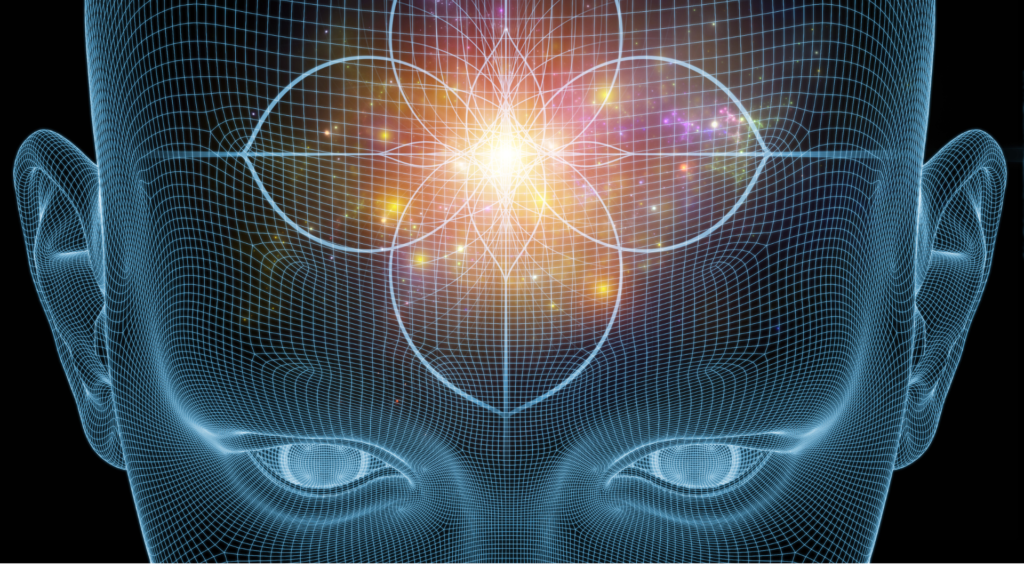
Finally, gaze between the eyebrows from inside in a peaceful manner, and equalise inhalation and exhalation of the breath. Through practice, we will find turbulence subsiding, and our consciousness or citta will become still, and we will merge with the Brahman, and become free from the shackles of karma.
The physiology and awareness in verse 27 of sannyasa yoga
The sanyasin does this by shutting out external objects, fixing the gaze between the eyebrows (nasikagre-drishti) and equalising their incoming (prana) and outgoing (apana) breath (vayu) and moving it within the nostrils (nasabhyantaracarinau) (verse 27).
It is important for any student of Yoga to understand the physiology and prana movements that occur in this practice.
Breathing physiology (sannyasa yoga) – part 1 – How does air flow into the nasal passage?
First, air is sucked into the respiratory system through the nostril. How does this occur?
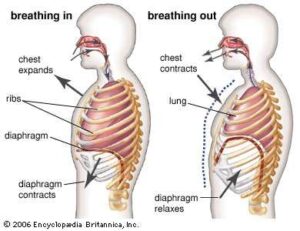
- The diaphragm is a muscle which separates the abdominal cavity from the thoracic cavity. In fact, it is anchored on the lower ribs. So, during inhalation, the diaphragm moves down, creating a negative pressure in the thoracic cavity. Consequently, this draws in air from the atmosphere.
- Next, the movement of the diaphragm is against the movement of the rib cage and abdomen. So, both systems expand to allow the downward movement of the diaphragm. As a result, a reverse pressure is created within the abdomen and rib which forces the diaphragm to move upwards again. Consequently, there is an upward movement of the diaphragm which changes the intra-thoracic pressure from negative to positive, resulting in air being forced out of the lungs.
- Importantly, breathing is a reflex action. Also, it is a parasympathetic process which is controlled by the medulla oblongata. In fact, the rate of breathing is dependent on the concentration of O2 / CO2 and blood ph. Additionally, the pons controls the speed of inhalation (speed of the movement of the diaphragm).
Breathing physiology (sannyasa yoga) – part 2 – How does the flow of air impact awareness (prajna)?
- Initially, when breathing in, air crosses the sinuses. Uniquely, sinuses are pockets of air which secrete mucous into the nasal cavity through orifice called ostia. These open into small recesses called meati and are protected by shelf like projections called turbinates.
- Next, the incoming air is compressed at the bridge of the nose, called septum. This is a venturi like structure which results in the air getting compressed when entering the nose. Therefore, due to the venturi effect in the septum, the air exits the septum into the nasal cavity under pressure which is lower than atmospheric pressure. Consequently, this causes the air to swirl within the nasal cavity.
- Meanwhile, the fins of the turbinator direct the swirl and split the incoming air.
- One part of the incoming air is guided by the nasal concha over the olfactory epithelium and activates the olfactory bulb.
- Next, the inferior concha guides air over the nasopharynx. This results in a resonating column effect within the auditory tube, which activates the middle ear.
- Importantly, the sinuses are air-pockets, so they resonate to the flow of air and differential pressure between the nasal passage and sinus.
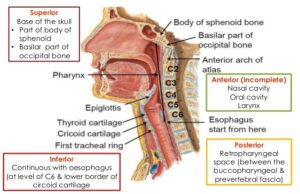
Upper Respiratory Tract (URT) physiology
Breathing physiology (sannyasa yoga) – part 3 – How does air flow impact upper respiratory tract dynamics?
The result of the above movement of air is,
- First, there is a creation of a resonance at the sphenoidal sinuses due to turbulence in the incoming swirling air flow.
- Next, the rush of air across the olfactory bulb energises the olfactory nerves and amygdala as well as the hypothalamus-pituitary-adrenalin (HPA axis) and the immune system.
- Finally, the flow of air across the nasopharynx creates a vibrating column effect in the auditory canal.
All this results in an awareness of being alive.
There is a slight drop in temperature of the incoming air due to the venture effect, which is compensated by the warm air in the nasal cavity and sinuses. This is why, there is often condensate over the bridge of the nose and, also the reason for the nose being the coldest part of the face.
When the yogi equalises the incoming and outgoing breath at the nasal cavity, the air flow gets regulated to one where turbulence is slowly minimised and then made insignificant. As a result, the main senses of touch, smell and hearing are shut down. When the yogī focuses his awareness by gazing between the eyebrows, sight is also brought under control. This is why the above verse 27 is so important.
Sannyasa yoga – School of Yoga posits some contradictions to accepted positions.
- Availability of free-will is critical for renunciation.
- The ability to control free-will in action is limited in action (karma) because our response is controlled by conditioning (dharma).
- Increase of free-will is only possible when there is control over the movement of consciousness (citta).
- All efforts to control consciousness will be opposed by the sense of Self (puruṣa or śiva) because of fear of loss of Identity. This results in increased internal conflict, pain and a sense of dissociation from society.
- However, this effort also increases awareness of the Self (prajna), discrimination between permanent and impermanent (viveka) and dispassion (vairagya).
- Consequently, free-will increases.
School of Yoga explains Srimad-bhagavad-gita, chapter 5, sannyasa yoga.
What is the important lessons learned on sannyasa yoga?
Sannyasa yoga is easier said than done. It requires effort, sacrifice and ability to endure pain and grief.
The transliteration and translation of Srimad-bhagavad-gita, chapter 5 – sannyasa yoga follows.
The Saṃskṛtaṃ words are in red italics.
(14-15) Brahman is neither the initiator nor the doer in the created world, also not driven by the embrace of the union of desire for fruits with inherent personality (na kartṛtvaṃ na karmāṇi lokasya sṛjati prabhuḥ । na karmaphalasaṃyogaṃ svabhāvastu pravartate ॥ 5-14॥). Brahman does not accept of anyone their demerits or even merit (nādatte kasyacitpāpaṃ na caiva sukṛtaṃ vibhuḥ ।), this occurs on account of ignorance shrouding knowledge in deluded people (ajñānenāvṛtaṃ jñānaṃ tena muhyanti jantavaḥ ॥ 5-15॥).
(16-17) Wisdom destroys ignorance of anyone the Soul shines like the Sun with highest knowledge (jñānena tu tadajñānaṃ yeṣāṃ nāśitamātmanaḥ । teṣāmādityavajjñānaṃ prakāśayati tatparam ॥ 5-16॥). Those with intellect absorbed in that, Soul established in that, with focus on that, with that for the goal go without return when wisdom removes all impurities (tadbuddhayastadātmānastanniṣṭhāstatparāyaṇāḥ । gacchantyapunarāvṛttiṃ jñānanirdhūtakalmaṣāḥ ॥ 5-17॥).
(18-19) Those endowed with knowledge and humility will view a Brahmana, cow, elephant, dog, and even an outcast, and learned people with equal gaze, (vidyāvinayasampanne brāhmaṇe gavi hastini । śuni caiva śvapāke ca paṇḍitāḥ samadarśinaḥ ॥ 5-18॥). Thus, even they conquer creation by which inequality is established, the cognition remains spotless, consequently the equal Brahman is therefore established in Brahman (ihaiva tairjitaḥ sargo yeṣāṃ sāmye sthitaṃ manaḥ । nirdoṣaṃ hi samaṃ brahma tasmād brahmaṇi te sthitāḥ ॥ 5-19॥).
(20-21) Importantly, one should not rejoice at obtaining a favourable outcome, nor grieve when an unfavourable outcome (na prahṛṣyetpriyaṃ prāpya nodvijetprāpya cāpriyam ।), with steady intellect that is undeluded, one that has knowledge of Brahman get established in the Brahman (sthirabuddhirasammūḍho brahmavid brahmaṇi sthitaḥ ॥ 5-20॥). The detached soul, when dealing with external contacts, finds within the Self, that infinite happiness as one that has merged with the Brahman enjoys (bāhyasparśeṣvasaktātmā vindatyātmani yatsukham । sa brahmayogayuktātmā sukhamakṣayamaśnute ॥ 5-21॥).
(22-23) In fact, all outcomes born from external contact, they cause suffering only (ye hi saṃsparśajā bhogā duḥkhayonaya eva te ।) they have a beginning as well as an end, so wise people do not find delight in them (ādyantavantaḥ kaunteya na teṣu ramate budhaḥ ॥ 5-22॥). Anyone who can withstand before liberation from the body, impulses born of desire and anger, he becomes united with Brahman, he is a happy man (śaknotīhaiva yaḥ soḍhuṃ prākśarīravimokṣaṇāt । kāmakrodhodbhavaṃ vegaṃ sa yuktaḥ sa sukhī naraḥ ॥ 5-23॥).
(24-26) Who finds happiness within, even who has internal pleasure from illumination from Brahman, that yogī attains absolute freedom and merges with Brahman (yo’ntaḥsukho’ntarārāmastathāntarjyotireva yaḥ । sa yogī brahmanirvāṇaṃ brahmabhūto’dhigacchati ॥ 5-24॥). ṛṣis (seers) achieve absolute freedom due to cleaning of impurities, cutting of duality, rejoicing in the welfare of all beings (labhante brahmanirvāṇamṛṣayaḥ kṣīṇakalmaṣāḥ । chinnadvaidhā yatātmānaḥ sarvabhūtahite ratāḥ ॥ 5-25॥). Detached from desire and anger ascetics control their consciousness in all situations (abhitaḥ = on all sides), are evolved souls who exist in absolute freedom (kāmakrodhaviyuktānāṃ yatīnāṃ yatacetasām । abhito brahmanirvāṇaṃ vartate viditātmanām ॥ 5-26॥).
(27-29) Excluding external stimuli outside bring gaze inside between the eyebrows (sparśānkṛtvā bahirbāhyāṃścakṣuścaivāntare bhruvoḥ ।). Then, equalise inhalation and exhalation, moving it within the nostrils (prāṇāpānau samau kṛtvā nāsābhyantaracāriṇau ॥ 5-27॥). With the senses, cognition and logical apparatus of the sage are focused on liberation, desire, fear, anger leave and he forever and truly becomes free (yatendriyamanobuddhirmunirmokṣaparāyaṇaḥ । vigatecchābhayakrodho yaḥ sadā mukta eva saḥ ॥ 5-28॥). He enjoys fruits of his austerity and becomes Lord of all worlds who is affectionate to all creation and comes to me in peace (bhoktāraṃ yajñatapasāṃ sarvalokamaheśvaram । suhṛdaṃ sarvabhūtānāṃ jñātvā māṃ śāntimṛcchati ॥ 5-29॥).
The complete text is available in my book, A Seeker’s Śrīmad-Bhagavadgītā. Buy your copy today – Notion Press home / Flipkart / Amazon / Amazon India / Amazon UK / Amazon US / Amazon Australia
Acknowledgement
School of Yoga is profoundly grateful to Saṃskṛta scholars and academics Pijus Kanti Pal (pal.pijuskanti@gmail.com) and Dolon Chanpa Mondal for their support in Saṃskṛta transliteration and quality control.