

What is jnana yoga ?
The fundamental premise in jnana yoga is that all of us are trapped in the material world by our bonds and our need for relevance. Also, our bonds and need for identity/ self-worth (asmita), ensnare us to keep acting (performing karma). This results in creation of debt (rna), which needs to be reconciled in this life or next, and traps us into a never ending cycle of birth and death, called samsara.
Importantly, our identification of ourselves and the need for relevance in this material world comes from our erroneous belief that the world and our situation, is real. Also, this inability to cognise the world as transient, stems from the ignorance of the true nature of Brahman (the source). Jnana yoga is that branch of yoga where we try to transcend materiality through introspection and examination of the true nature of the Self.
Significantly, in jnana yoga, the opposite of jnana (knowledge of the Self) is not falsehood, but ajnana (ignorance). Ignorance is the veil that covers the true state of the Brahman (source/ Truth). This veil, which induces us to accept the perception of our senses as the true representation of itself (asmita) is called maya or farce. Consequently, when maya is dispelled, the true state of one’s identity is revealed.
What are some of the skills, tools, and goalposts in jnana yoga practice?
- Vivekam (discrimination) – This is the ability to distinguish truth/ real from unreal, fact from fiction, or perception from reality. It can be seen that this is a critical capability that we need to develop because it enables us to consciously reject the material world while functioning in it.
- Vairagyam (detachment) – Decision making is always clouded by sentiment and attachment. In fact, the sense of self-worth (asmita) feels threatened by criticism which clouds and affects decision making. So, learn to step back without losing empathy!
- Satsanga (discussion with similar minded people) – In fact, seeking the truth is a terribly lonely business and there is failure, there are mistakes, and heart-breaks. However, the journey becomes easier when it is shared.
- Mumukshutva (extreme desire for liberation) – Since almost all the effort and change is internal, there is no visible measure of success. Therefore, our internal motivation and desire to succeed is critical to success.
In addition to the above skills, the following tools can help one in peeling away the layers of ignorance:
- Shravana (hearing) – Discrimination and detachment don’t come easily. It is important to share our experiences and learning with others. Also, we must learn from others and draw inspiration from them, on how to manage failure and build capability.
- Manana (controlling cognition) – All stimuli come in through the senses (indriya). These are collated in the brain before a response is formulated. The imaginary place where this collation is done is manas. Thus, manana is neutralising the impact of stimulus at the stage of cognition.
- Nididhyasana (reflecting) – When we receive stimuli, we react. In order to move our awareness from reflex to conscious, we need to reflect on the stimulus and its impact on the awareness of the Self (asmita).
How can we make jnana yoga work?
Jnana yoga is possibly the simplest yoga to implement, with the number of variables to control.
The concept requires us to isolate impermanent stimulus. Consequently, this isolation will slowly bring out the more permanent aspect of reality.
Obviously, many of these negations will require adjustments to our conditioning (dharma), resulting in strong physical and emotional backlash. Also, we will need to build capability and an emotional reservoir to manage internal change. Additionally, we will need to develop a strong drive to continue despite the pain of loss of closely held views.
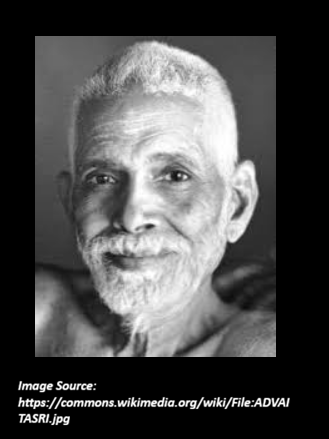
The best role model of a modern day jnana yoga aspirant is Bhagawan Ramana Maharishi. Bhagawan Ramana Maharishi lived in Bharat and was a personification of jnana yoga. He has also left an enormous amount of usable information on how jnana yoga may be practiced.
To build up the ability to discriminate and weed out impermanent stimuli while simultaneously strengthening emotional intelligence, one needs to maintain relationships with like-minded people – getting motivated by their experiences and feeding off their enthusiasm, reading, reflecting, and putting into practice the changes to our conditioning, which strengthens our ability to say “Not this” or “neti” in Sanskrit.
For more on how to practice jnana yoga, read the next blog.
Points to ponder on jnana yoga :
Internal Tags: Dharma (conditioning), Stress and Situational Awareness, Stress and prana, Awareness measures, Hatha Yoga Pradeepika, Patanjali Yoga Sutra, Jnana Yoga, Bhakti Yoga, Karma Yoga, Hatha Yoga and Raja Yoga..
- What is jnana yoga?
- What are the fundamentals of jnana yoga?
- How does on integrate jnana yoga into daily life?
- How does one cope with the stress of negation?
- What are the tools you would use to implement jnana yoga?


Pingback: Review - Jnana Yoga by Swami Vivekananda - School of Yoga
Sorry for the delayed response,
Thank you for youe support,
Please do suggest ways to make the site more useful