What is vrikshasana?
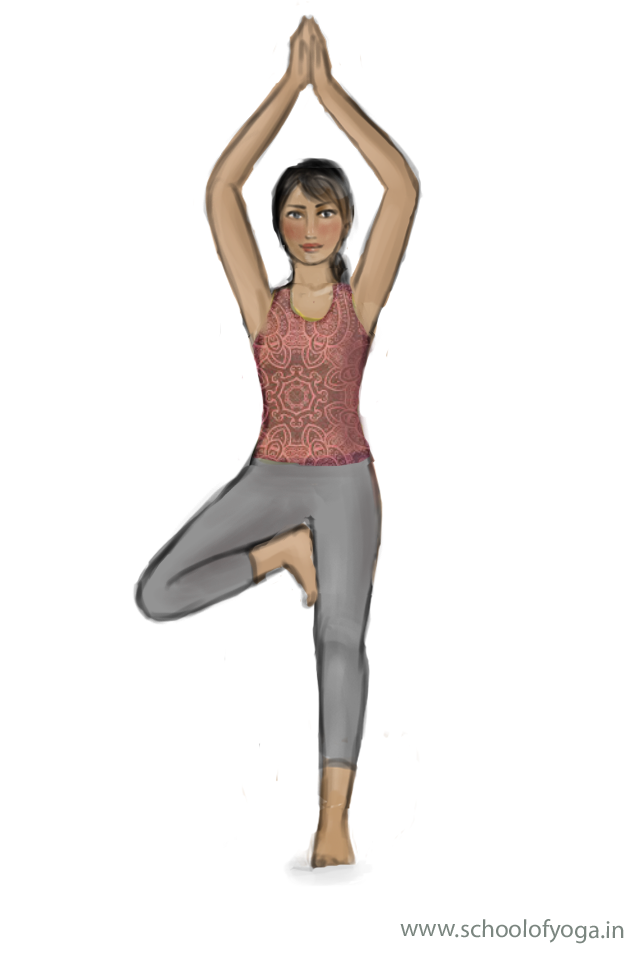
Vrikshasana, known as the tree pose, is a classic standing pose in yoga wherein the practitioner balances the torso while standing on one foot, with both hands raised above the head, thus creating the silhouette of a strong tree and its branches.
What is the technique to practice vrikshasana?
- Sthithi (starting) position: First, stand erect with both legs together. Keep your hands to the sides.
- Keep your head aligned with the body and look straight ahead.
- Next, bending one leg at the knee, lift one foot such that the heel touches the perineum and the foot is firmly rested on the inside of the thigh. Use the hands to place the feet correctly.
- Take the hands above the head and join them in anjali mudra.
- Alternatively, the hands can be joined in anjali mudra at the chest level.
- Balance the body on one foot and try to remain steady.
- Maintain shallow breathing. Hold for 10 – 30 counts.
- The recommended drishti (gaze) is urdhva drishti (open sky gaze).
- Come back to straight position. Bring your hands back to the sides.
- Repeat with the other leg.
What are the benefits of practicing vrikshasana ?
- The action of holding the heel against the perineum results in activation of mooladhara chakra.
- Therefore, this asana increases the innate sense of balance and awareness of the body in the individual.
What are the contraindications of vrikshasana ?
- People with arthritis must perform this asana only under supervision of a physician.
- Women should not perform this asana during menstruation or pregnancy.
Some noteworthy points on the tree pose:
Internal Links: Dharma (conditioning), Stress and Situational Awareness, Prana, Asana overview 1, Asana Overview 2, Asana Focus or gazing, Pranayama, Yama, Niyama
External Links: Prana, Chakra, Pancha Tattva, Pancha Prana, Pancha Kosha, Nadi,
- Initially, one may have difficulty in achieving balance, so this exercise could be performed close to a wall for support until competence is reached.
- Closing the eyes could lead to imbalance, so the awareness of the body will need to be achieved with open eyes.