What is veerasana (virasana)?
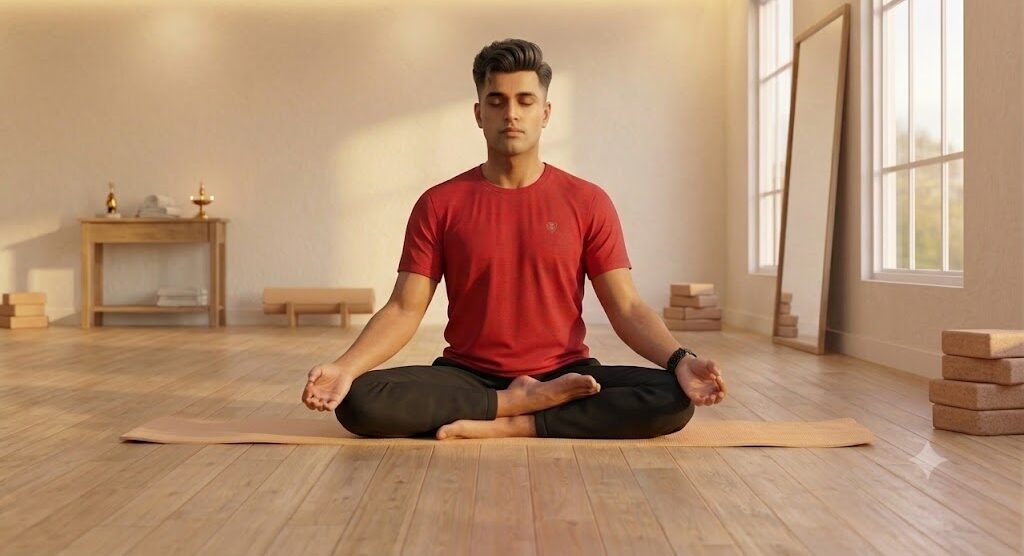
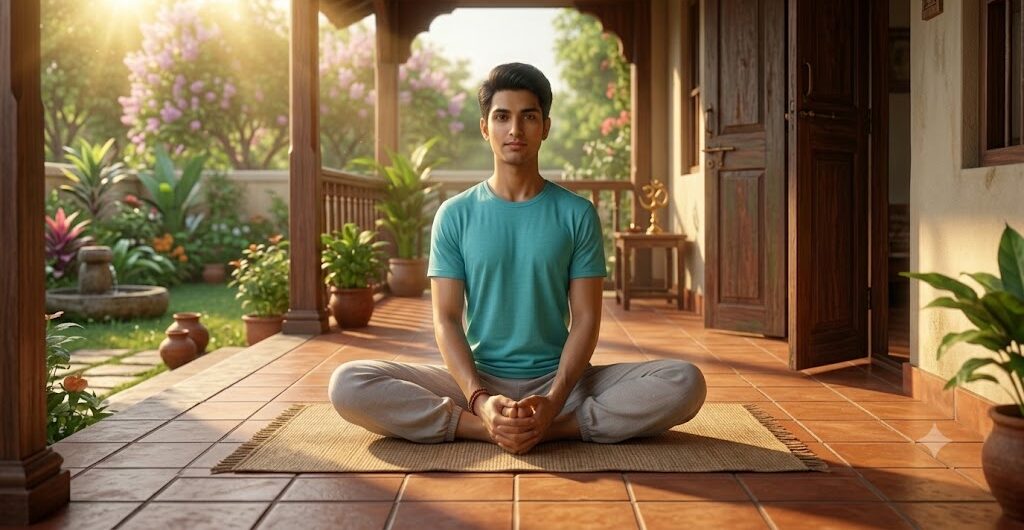
Veerasana (virasana) is a seated yoga posture in which the practitioners sit in a kneeling position, and slowly lower their hips to settle between their feet, sitting directly on the floor or on their yoga mat.
It is important not to confuse this with vajrasana – although both the poses may appear similar, please note that while practicing the vajrasana pose, the practitioner sits on his heels.
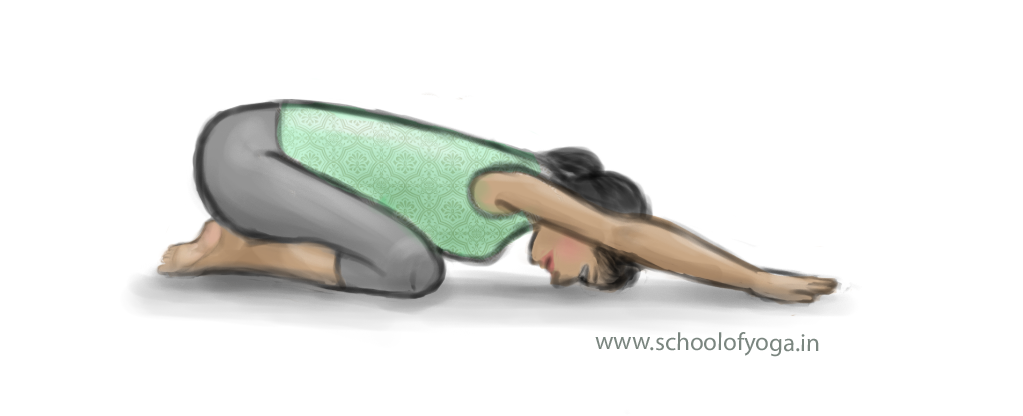
Variation 1 – The adhomukha veerasana (adhomukha virasana) or the downward-facing dog virility pose technique :
- Sthithi (starting) position: Firstly, sit in vajrasana. Ensure that the hip, knee, and ankle joints are aligned.
- Place your hand on your knees, such that your palms are covering the knees.
- Ensure that the genitals are comfortably placed between the thighs and not pressurised.
- Slowly increase the pressure of the buttocks on the ankles till the ankles are completely stretched, but not uncomfortable. However, final position could take time and practice. So, be patient.
- Raise your hand over your head. Breathe in.
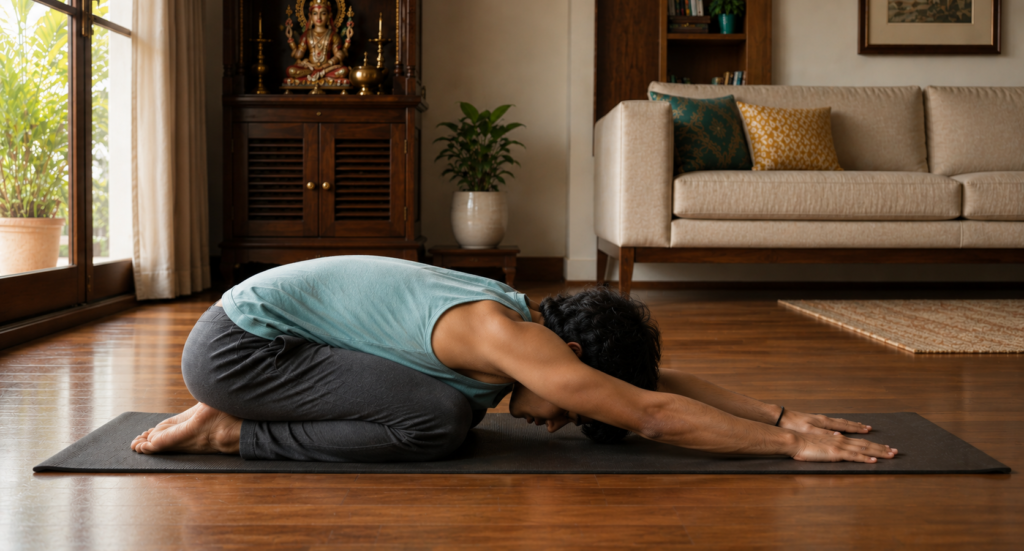
- Breathing out, slowly fold your torso over your thighs till your face touches the ground, while ensuring that your hands also touch the ground.
- Stretch the hands as far forward as possible and hold for 5-10 counts.
- Breathing in, rise up to keep your back erect.
- While breathing out, bring your hands over your knees.
- Breathe normally. Once is enough. Increase the count to increase efficacy of the pose.
- The recommended drishti (gaze) is focus on the svadhisthana cakra.
- For best results, it is important that there is minimal gap at the knee and hip joints.
What are the benefits of adhomukha veerasana pose?
- The total benefit of this asana can be derived only if there is complete stretching of the lower back, shoulders, hips, thighs, hamstrings, and calves. Consequently, this energises and strengthens all the posterior lower torso, lumbar region and muscles. Also, there is an enormous increase in flexibility in the lower region.
- Importantly, this exercise strengthens the back muscles of the thigh, the hamstring muscles, the quadriceps, as well as the calf muscles. Therefore, it is beneficial for treating all forms of early knee and hip arthritis issues.
- Furthermore, there is enormous stretching, compression and tension at the knee and hip joints. However, to get maximum benefit, one should attempt to reach a tight knee and hip joint lock.
- Moreover, the bending forward brings a 3-way compression of the genitals and generates heat. This is supposed to increase brahmacharyam (celibacy), the quality of the seminal fluid and consequently virility (veeryam).
- Veerasana is also helpful in stabilising menstrual issues.
- The compression of the abdominal viscera on the thighs improves digestion and evacuation.
Variation 2: The supta veerasana (supta virasana) or the supine virility asana technique:
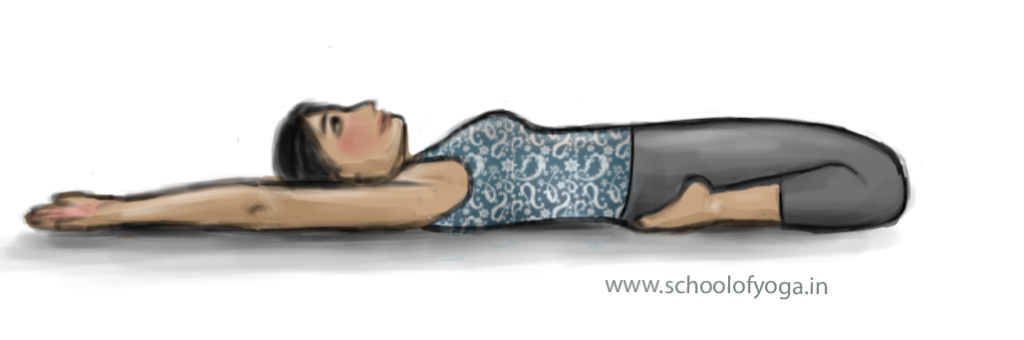
- Sthithi (starting) position: Firstly, sit in vajrasana. Ensure that the hip joint, knee joint and ankle are in the same line. Place your hand on your knees, covering your knees with your palms.
- Importantly, ensure that the genitals are comfortably placed between the thighs and not pressurised.
- Next, slowly increase pressure of the buttocks on the ankles, till the ankles feel completely stretched, but not uncomfortable. This could take time and practice. Breathe in.
- While breathing out, using the hands as support, slowly go backwards till the torso touches the ground.
- Take your hand over your head and join together in anjali mudra.
- Stretch the hand as far forward as possible and hold for about 10 counts.
- Breathing in, rise up erect.
- While breathing out, bring your hands over your knees.
- Breathe normally. Once is enough if the count held is between 5 and 10.
- The drishti (gaze) recommended is focus on svadisthana chakra.
- For best results, it is important that there is minimal gap at the knee and hip joints.
What are the benefits of supta veerasana?
- The total benefit of this asana can be derived only if there is complete stretching of the lower back, shoulders, hips, thighs, hamstrings, and calves. Consequently, this energises and strengthens all the posterior lower torso, lumbar region and muscles. Also, there is an enormous increase in flexibility in the lower region.
- Importantly, this exercise strengthens the back muscles of the thigh, the hamstring muscles, the quadriceps, as well as the calf muscles. Therefore, it is beneficial for treating all forms of early knee and hip arthritis issues.
- Furthermore, there is enormous stretching, compression and tension at the knee and hip joints. However, to get maximum benefit, one should attempt to reach a tight knee and hip joint lock.
Variation 3: The eka pada supta veerasana (one leg stretched) technique:
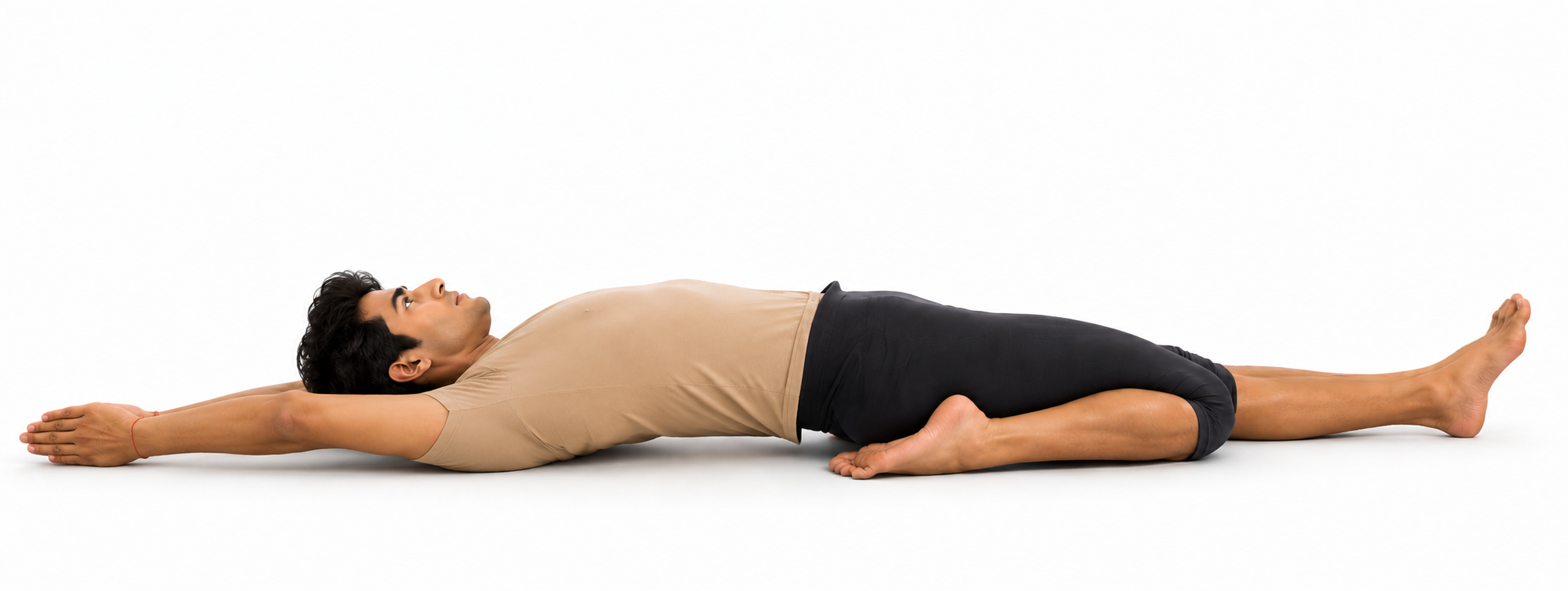
- Sthithi (starting) position: Firstly, sit in vajrasana. Ensure that the hip joint, knee joint and ankle are in the same line. Place your hand on your knees, with your palms covering the knees.
- Next, ensure that the genitals are comfortably placed between the thighs and not pressurised.
- Slowly increase the pressure of the buttocks on the ankles, till the ankles are completely stretched but not uncomfortable. This could take time and practice. Breathe in.
- Remove one foot from under the buttock and stretch it forward.
- While breathing out, using your hands as support, slowly go backwards till the torso touches the ground.
- Take your hands over your head and join them together in anjali mudra.
- Stretch the hand as far forward as possible and hold for about 10 counts.
- Breathing in, come erect.
- While breathing out, bring your hands over your knees.
- Breathe normally. Once is enough.
- The drishti (gaze) recommended is focus on svadisthana chakra.
What are the benefits of eka pada supta veerasana ?
- This asana increases flexibility at the knees and ankles. However, it is important to realise that the pressure on the ankles by the descending torso could result in pain.
- Importantly, if there is pain, stop immediately, and move the feet outwards to reduce the direct pressure on the ankles.
What are the contraindications for veerasana :
- Do not perform this asana if you are suffering from extreme arthritis.
- Also, do not perform this asana during menstruation or pregnancy.
Some noteworthy points on veerasana:
Internal Links: Dharma (conditioning), Stress and Situational Awareness, Prana, Asana overview 1, Asana Overview 2, Asana Focus or gazing, Pranayama,
External Links: Prana, Chakra, Pancha Tattva, Pancha Prana, Pancha Kosha, Nadi,
- It may be difficult to sink down vertically, hence one could bend slightly forward to relieve the pressure on the knee.
- Also, it is important to remember that the primary objective of this asana is conservation of seminal fluid and secretions.
- The subsidiary benefits are increased flexibility of the ankles, knees, hips, as well as the lower back.