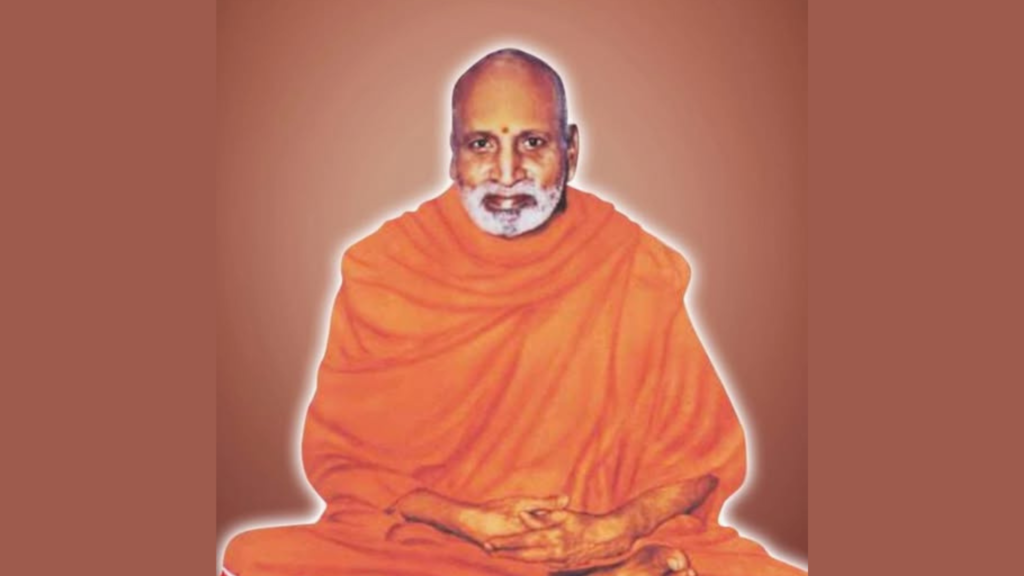
Review by Vishwanath Iyer
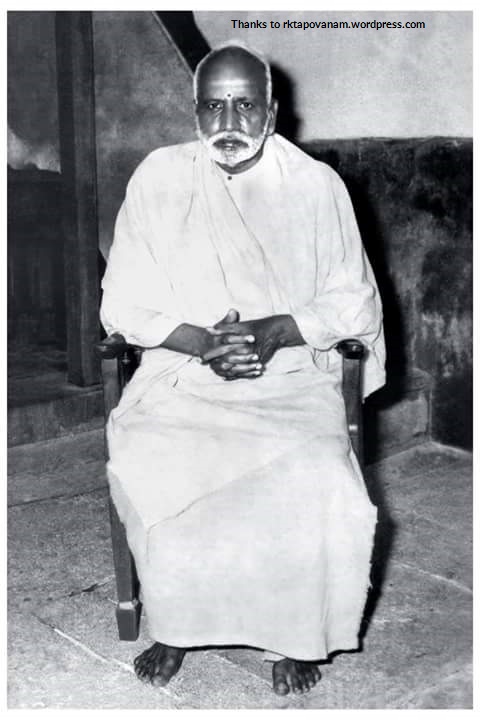
About the author – Swami Chidbhavananda (11 March 1898 – 16 November 1985)
“The Bhagavad Gita” by Swami Chidbhavananda is a scholarly work on the Srimad Bhagavad Gita. Swami Chidbhavananda was born as Chinnu, near Coimbatore, India. Importantly, he was influenced by Swami Vivekananda at an early age, and he joined the Ramakrishna Mission at Belur, Kolkata. Additionally, his Guru was Swami Shivananda, a direct disciple of Sri Ramakrishna Paramahansa. Furthermore, obeying his Guru, he established an ashram and educational institution at Ooty, in South India. Lastly, Swami Chidbhavanada was also an author, writing in English and Tamil.
“The Bhagavad Gita” by Chidbhavananda is possibly the most secular translation of the Srimad Bhagavad Gita available so far. Importantly, it is certainly one of the most comprehensive books on the subject.
Significantly, the book’s index is very complete, detailing the topics that follow in each chapter. Additionally, the index also provides cross-referencing to various parts of the book.
Introduction to “The Bhagavad Gita” by Swami Chidbhavananda.
In this section, Swami Chidbhavananda introduces the reader to the Bhagavad Gita in a unique way. He cross-references the Gita with other sacred texts, so as to make the reading appeal to a wider, secular audience.
Then, he brings the reader’s attention to the relevance of the Bhagavad Gita in the Hindu frame of existence, as prasthaanatrayam (that which answers 3 questions).
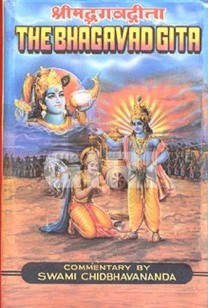
Importantly, the setting of the Srimad Bhagavad Gita is the battlefield at Kurukshetra, as depicted in the epic Mahabharata. Importantly, the Srimad Bhagavad Gita is a dialogue between Sri Krishna, the charioteer, and Arjuna, the warrior. In fact, Sri Krishna, using a question and answer method, explains the difficult logic of yoga, and this has been enunciated by Swami Chidbhavananda. Significantly, Swami Chidbhavananda tries to retain the divinity in the existence and message of Sri Krishna in his translation.
Importantly, this part of the book is followed by the relevance of the workbook to normal living and problem-solving. Most noteworthy is the effort to link the various concepts that make Sanatana Dharma a cohesive platform for spiritual development.
Review of The Bhagavad Gita by Swami Chidbhavananda
The Bhagavad Gita may be described as a book of intertwined dialogues – there are 2 dialogues: one between Sanjaya and Dhritarashtra, the blind Kaurava king, and the other dialogue, a subset of the first dialogue, is between Sri Krishna and Arjuna. So, the Bhagavad Gita is a dialogue between Sri Krishna and Arjuna, recounted to the blind king Dhritarashtra by Sanjaya.
Importantly, the book is divided into 18 chapters and each is a form of Yoga. Additionally, Swami Chidbhavananda has structured his work with the Shloka or verse coming first, followed by the literal translation, and then his interpretation of the verse along with a commentary, followed finally by a recount of Swami Ramakrishna or Vivekananda’s views on the subject. So, this makes the translation very comprehensive. The book ends with the greatness of the Gita and an index.
Significantly, the book is voluminous. Therefore, reading this book will require patience, persistence and time. Also, the text is slightly old-fashioned and there are repetitions of concepts and practices. However, the book is clear in its translation and allows the reader to flex in his thinking, to suit current approaches and practices. Therefore, anyone wishing to develop spiritually will find this book useful, as it is universal in approach and simple to understand.
Conclusion: This book is recommended for anyone who has passed the first flush of youth and now wishes to find direction in life.