Printed by The Adyar Library and Research Centre. Review by Vishwanath Iyer
About the author of The Hatha Yoga Pradipika: Svatmarama (15th or 16th century Yoga Master):
Hatha Yoga Pradipika was written by Svatmarama, a disciple of Gorakshanath, in turn, a disciple of Matsendranath. The lineage is rooted in the Siddha tradition, an esoteric and ancient branch of Shaivism.
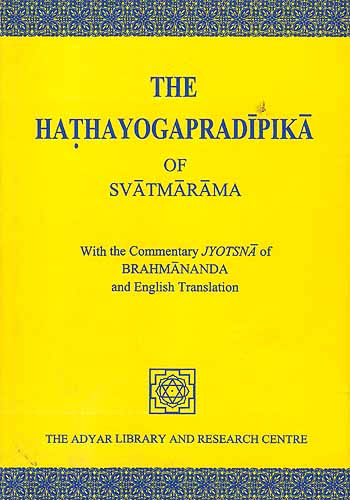
Review of The Hatha Yoga Pradipika book:
The Hatha Yoga Pradeepika is a very lucid textbook on Hatha Yoga. Furthermore, it is split into 4 chapters: asana, pranayama, mudras, and samadhi, respectively. Significantly, the reader is immediately struck by the clarity of approach in dealing with the subject. Additionally, the document is very clear on its objectives and the path a practitioner should take to reach liberation.
Finally, after reading the Hatha Yoga Pradipika, one will conclude that liberation is a straightforward action. For example, one does not need to know many asanas, pranayama techniques, etc., to attain liberation. It only requires focus, discipline, and regular effort. Additionally, Svatmarama constantly espouses the precedence of practice and experience over theory or discussion.
Hatha Yoga Pradipika has also been translated by Vishwanath Iyer of School of Yoga and the links are as follows – the first is on asana, second on pranayama, third on mudras and fourth on samadhi.
The Hatha Yoga Pradipika by Adyar Library:
Adyar Library and Research Centre has done the translation of Hatha Yoga Pradipika in a very interesting manner. The book is a collaboration by many – there is a Jyotsna (Sanskrit explanation) by Brahmananda, an English translation by Srinivasa Iyengar, and editing & publishing by Tukaram Tatya.
Despite the multiple collaborations, the book is excellently compiled and integrated. However, the lack of translation of individual words makes it difficult for a reader to arrive at his own conclusions.
For anyone with an interest in Yoga, this book is mandatory. Indeed, it is well written. Additionally, where required and in certain places, the book explains the socio-cultural background of India, which makes understanding easy.
Conclusion – This book is a “must-read” for all Yoga enthusiasts. However, the book also highlights the deep divide between the ideals of Hatha Yoga and current yoga practices.