School of Yoga explains Srimad-bhagavad-gita, chapter 15 – purushottama yoga (yoga of the supreme purusha or supreme Self).
Arjuna calls Shri Krishna purushottama. Why?
Introduction to purushottama.
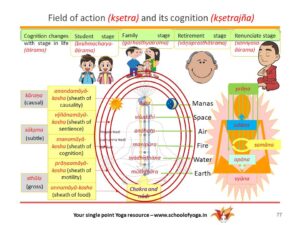 In chapters 13, Shri Krishna speaks about the body being a field and understanding the field as ksetrajna. However, it is evident that the word kshetra denotes greater opportunity for use than being limited to the body.
- In chapter 14, he takes this concept into personal development, speaking about how attributes (guna) drive behaviour.
- In chapter 15, he speaks about how a person of excellence (purushottama) should live, using himself as a role model.
- Excellence has always fascinated us and progress has been made possible because of adherence to perfection and excellence. But what is it? How does science view it and is there any correlation between today’s understanding of excellence and the way ancient cultures of the South Asian sub-continent encouraged it?
- This chapter looks at some of management and manufacturing science’s accepted theories and compares it to that which was practiced in South Asia, the results are quite astonishing.
School of Yoga explains Srimad-bhagavad-gita, chapter 15 – purushottama yoga.
Shri Krishna explains ashvattha (fig tree) – the tree of life.
If one were to compare with the indestructible ashvattha tree with its roots above and branches below, the metering hymns are the leaves and one who knows the Vedas comprehends this. Also, below and above are its branches, nourished by the guna-s; sense-objects are its buds rooted in action and stretching its branches in the world of humans.
Thus, this fig tree (ashvattha) has no beginning, middle or end and needs to be cut with the axe of non-attachment. This goal should be sought, for reaching this condition, one merges with the Supreme Self.
https://youtube.com/shorts/wmlXpTwOBhE
Competency requirement for reaching the state of purushottama.
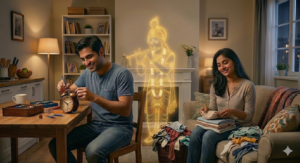 Such people are free from pride and delusion, victorious over attachment, constant in the Supreme Self, passion under control, freed from opposites, such as peace or pain.
- A part of me (Shri Krishna) is embedded in the world of beings as a being driving the six senses which abide in prakriti, enabling the person to be sentient.
- When the person dies, he leaves the body but this part of me (Shri Krishna) stays with the soul and moves to another body.
- The departure of the soul cannot be seen if one is mired in the activities of the guna, but if a person is able to transcend this, then one can see the soul depart.
- To reach this stage, one should strive, endured by yoga to cognise the Supreme Identity within the soul. It is this Identity which drives motivation to relate to the world.
- I am the light in the Sun, Moon and the fire. Also, I am the vaishvanara-agni (the warmth of the body), residing in prana and apana where I digest food.
- Finally, I am memory, knowledge of the identity and well as lack of it; the author of Vedanta and the knower of the Vedas.
- There are two purusha-s – those that perish and those that are imperishable. All creation is perishable, the Supreme Identity (kutastha) is imperishable and it supports everything. Since, I transcend the perishable as well as the imperishable, I am called purushottama.
- Know this, that when a man becomes enlightened, all his duties are accomplished.
Purushottama-yoga – How does cognition function?
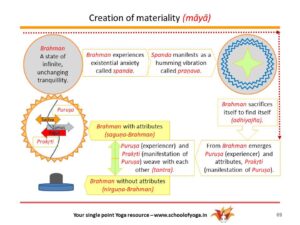
- Brahman experiences existential crisis and a desire to express/ project itself (iccha-shakti or strength of desire).
- Effort to manifest requires sacrifice to overcome inhibition or fear of loss of Identity (adhiyajna or primordial sacrifice).
- From this sacrifice arises purusha (primordial Soul, experiencer or identity) and prakriti (primordial manifestation) of purusha.
- Prakriti manifests as attributes (guna).
- The motility interface between purusha and prakriti is prana (primordial motility).
- The unit of the weave of prakriti and purusha is the Soul (atma).
- Citta (consciousness) emerges from puruṣa and becomes the medium of transmitting the expression of the Soul (atma), which is seen by all as asmita (self-esteem or self-worth).
- Impressions carried by the consciousness (citta) enter through the senses (indriyas). First, they go to the centre of cognition (manas) for collation of stimulus. Then, the collated information is carried by the consciousness (citta) to the centres of logic (buddhi). Here, the incoming stimulus is compared with conditioning (dharma) and a response is formulated. Since conditioning (dharma) is the foundation of self-worth (asmita), the response is called ahankara (I am the doer).
- If there is congruence between the incoming stimulus and dharma, asmita (self-worth) pulls the entity towards itself because it wants continued engagement. If there is dissonance, asmita pushes the object away to avoid discomfort. Consequently, there is a transaction which results in give or take which is called action (karma).
- Since all give-take transactions are always unequal, there is an imbalance between giver and taker.
- This imbalance creates debt (rinn) which has to be repaid, even if it means taking another birth (janma).
- The ensuing cycle of birth and death is called samsara.
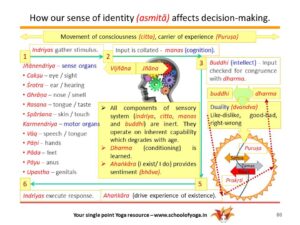
- Consequently, the objective of life is to break this cycle of birth and death (samsara) and merge with the Brahman.
School of Yoga explains Srimad-bhagavad-gita, chapter 15 – purushottama yoga.
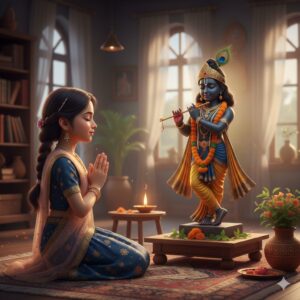
What are the qualities of a purushottama?
Purushottama is a compound word of purusha (experiencer or identity) + uttama (supreme). This word can be rearranged as uttama-purusha or a person who has complete control of the experience or response to stimuli in any situation. This means that the person has an awareness that does not change under any circumstances. Consequently, this person can be called a “sthitaprajna” or a person with steady situational awareness as described in Srimad-bhagavad-gita Chapter 2 (śaṅkha-yoga).
What are the qualities of a purushottama?
- We know that purusha (person, primordial Self or experiencer) weaves with prakriti which manifests as guna (attribute).
- There are two types of purusha-s, one that perishes and one that is imperishable. The imperishable purusha is Shri Krishna and the role model. All creation is perishable purusha that needs to be optimised and brought to a state of congruence that is close to that of Shri Krishna.
- This means that when prakriti is in a nirguna state (nir = without + guna = attributes), purusha will not experience anything. But, is that the only way?
- We know that when purusha projects its consciousness (citta) into the environment for confirmation of existence. So, when consciousness (citta) is not allowed to project itself, purusha remains steady is its own awareness.
- This can also happen, if purusha engages and acts without any attachment to the outcome. When this happens, there is no feedback, hence purusha has no experience.
School of Yoga explains Srimad-bhagavad-gita, chapter 15 – purushottama yoga.
Purushottama yoga – Concept of individuality (sva-tantra) over the ages.
Up until now, mankind has always enquired into the meaning of existence. This has mainly taken the form of trying to understand the Universe and a hierarchy for everything that exists within the Self (kshetrajna). This enquiry can be broadly split into Western thought which is based on Greek logic as well as Abrahamic thought and Oriental thought, which has two major branches, the South Asian philosophy of Sanatana-dharma, Buddhism, Jainism and Sikhism along with the Chinese philosophy of Tao and Confucianism and Japanese Shinto. There are other schools of thought, but most of today’s peoples are covered by the above schools.
An important difference between the two streams of thought is that while the base of Western thought has been moulded heavily by shifting power and conquests, the fundamentals of Oriental thought have largely remained unaffected by conquest and remained unchanged over the centuries with some modification dictated by societal development.
Though Srimad-bhagavad-gita is very lucid in its explanation of concept and clarity of personal goals, it is a high-level document and not an easy starter kit! So, some DIY (do it yourself) solutions are required while the person works out the larger goals espoused by Śrī Kṛṣṇa.
So, it seems appropriate that one seeks an intermediate solution which can act as springboard to higher development. One place that one could search is the developments that became popular post World War 2 because the current world is largely shaped by that period and all of us subscribe to it directly or indirectly.
Purushottama yoga – some convergence of concepts.
Ivan Pavlov (1849-1936) –
The journey into conditioning (dharma) is incomplete without Pavlov and his work on classical conditioning and reflex. Almost all conclusions of Pavlov reinforce the sanatana-dharma hypothesis that conditioning (dharma) determines personality (svabhava).
However, dharma takes the concept further in two areas,
- Dharma says that all creation, sentient or insentient have a natural state and
- The natural state of an individual entity is svadharma and this translates to conditioning.
Sigmund Freud (1856-1939) –
Freud is often considered the father of psychoanalysis, using concepts such as free-association, transference, sexuality and id-ego-super ego etc. in the framework of psychoanalysis. The interesting aspect of psychoanalysis is its congruence with ancient Yoga concepts.
- Id is considered to be the random desires that drives behaviour. In Yoga, these impulses are called vasana-s which are considered to be indelible-impressions arising from unpaid debts (prarabdha-karma), so even though people seem to be acting out of control, they are actually driven by unpaid debts.
- The super-ego is considered to be the moral and critical side of the individual that acts like a conscience, constantly struggling to counteract the Id. In yoga-vidya, this is dharma (conditioning). Dharma is also considered to be a product of debt that has come up for resolution (prarabdha-karma) and determines where a person is born as well as how he or she will be conditioned. Our incomplete and unfulfilled desires (vasana-s) are constantly struggling with our conditioning (dharma).
- The ego is the one that plays mediator between Id and Super-ego to moderate behaviour. In yoga-vidya, this is called asmita (I am this or self-worth). While in psychoanalytic theory, the ego is a completely internal function, in yoga-vidya, the self-worth (asmita) is entirely dependent on feedback that the Self receives to its manifestation as well as stimulus through the consciousness (citta) which carries the impression of the situation through the senses (indriyas) to the cognitive apparatus (manas), after which intellect (buddhi) compares the information with conditioning/ super-ego (dharma). However, in some situations, even self-worth (asmita) gets hijacked by unfulfilled desires (vasana-s), this is the power of unfulfilled impressions of unresolved debts (prarabdha-karma).
- Also, while in psychoanalysis free-will is considered available to the individual, in Yoga, this is considered a product of awareness (prajna) and increases only with experience (anubhava).
Abraham Maslow (1908-1970) –
in 1943, Abraham Maslow published his paper “Theory of Human Motivation” where he postulated that humans have a hierarchy with which they approach any need. He said that there are five stages of Motivation. It’s a hierarchy because a person will need to be complete in one need to be able to go to the next need. The hierarchy is;
- Physiological – Food, safety, rest and shelter,
- Safety – The feeling of not being threatened,
- Social needs – relationships and social validation,
- Esteem Needs – need for accomplishment and prestige,
- Self-actualisation – the ability to achieve complete potential.
Interestingly, it is possible to correlate the psychological state as propounded by Abraham Maslow in his 1943 paper “Theory of Motivation” with energy vortices (chakra) in yoga-vidya. It is known in yoga-vidya and other forms of Oriental healing that rate of energy flow through these centres affects the behaviour of the person. As a matter of fact, ancient Oriental texts on this subject from India, China, Korea, and Japan speak of multiple energy vortices (chakra), but all agree that there are six major wheel locations in the human body which control all major organs.
· Base cakra (muladhara) – (mula = base + adhara = foundation or source).
The first of the energy vortices aligns itself with the perineum, a flat region above the coccyx and between the anus and genitals. This centre affects the physiological aspects of the individual, that is, the overall energy levels, feeling of safety and health.
Example: People in difficult situations squirm in their seats. When fears for personal safety overwhelm us, there is acute discomfort at the region of the anus. There is an urge to shift in the seat, and the need to relieve ourselves when fear is very great. The rocking action energises the muladhara-chakra.
· Self-evolution cakra (svadhishthana) – (sva = self + adhishthana = evolved place).
This energy vortex corresponds to the sacral region around the genital area. It affects sexuality, social and communications skills of the individual. Control of this centre results in strong response control and emotional stability.
Example: After a heated argument, often there is an ache in the lower back. This occurs on account of our need to communicate effectively and to be able to convince the other person about our point of view and reinforce our sense of self-worth (asmita). This strains the lumbar arch and often results in stress.
· Stomach cakra (manipura) – (manipura = navel).
This energy vortex is placed around the navel and corresponds to the lumbar area of the spine. This is a centre that controls situational and management skills.
Example: Often, we hear about the gut feel or taking a decision from the gut! How is that possible? After all, it is the brain that decides. Or is it? The stomach does have a role, for the manipura with its acids & bile is affected by blood flow in case of fight or flight stimulus. Consequently, this impacts the maṇipūra energy vortex and comfort in a social environment.
· Heart cakra (anahata) – (ana= not + ahat = touched).
Placed at the centre of the chest at the sternum, this responds to the thoracic region on the spine. This is also the centre of emotional energy. A balanced anahata is essential for emotional stability.
Example: Blood pressure is directly related to anger and speech. Generally, doctors advise a person to reduce speaking after a heart attack. Why? Because a person gets excited, the release of adrenaline has a direct impact on the heart & lungs.
· Throat cakra (vishuddha) – (vishuddha = extraordinarily pure).
This energy vortex is placed around the Adam’s apple and corresponds to the cervical region in the spine. The thyroid, parathyroid and lymphatic systems, which control metabolic activity reside here. Since metabolism is the ability of the body to convert food into usable energy and rebuilding of tissue, seamless energy flow here is critical.
This is also the area which controls breathing and food intake, so any disruption in our stress levels will immediately impact the quality of our breathing and digestion.
Example: When we are afraid, we often feel choked! Why? Because the prana flow at the vishuddha is congested. The chocking action impacts the thyroid & parathyroid. Consequently, disruption of this centre can lead to various illnesses.
· Forehead cakra (ajna) – (ajna = that which commands)
This energy vortex is placed between the eyebrows in the front of the cranium. It controls the functioning of the other energy vortices. It energizes the amygdala, pituitary and endocrine glands etc. and controls both, primary and secondary response. Consequently, this energy vortex is the primary input point for “fight or flight” stimulus.
One can see that the chakra system of yoga-vidya is highly evolved and can be used in therapy. Another important aspect is that yoga-vidya recognises that each of these vortices may be activated, depleted or congested to varying degrees and that this is an actively changing parameter. This makes the Yoga system subtle and sophisticated.
The only problem is that this system is not completely understood and its subtlety makes it hard to quantify or systematise. However, at an individual level, it is possible for a practitioner to cognise this science.
Hans Seyle (1907-1982) –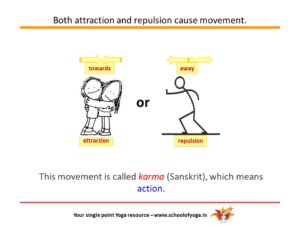
Hans Seyle, an endocrinologist propounded the theory of stress where he described stress as “the non-specific response of the body to any demand made upon it”. He postulated that when there is stimulus which moves the person away from homeostasis (natural state of peace/ order/ harmony or dharma), the PTA axis (pituitary-hypothalamus-adrenal axis) is activated depending on the impact to the person’s self-worth (asmita). As a result, the person experiences eustress / motivation (raga) or distress / misery (dvesha) and this triggers an internal as well as external (fight or flight) response (karma).
It is clear that there are many theories which are evolving in modern scientific space and that many of these “discoveries” are reinforcing concepts already embedded in sanatana-dharma and Yoga.
School of Yoga explains Śrīmad-bhagavad-gītā, chapter 15 – purushottama yoga.
Lessons learned in Chapter 15 – purushottama yoga.
There is a discernible degree of confluence between the concepts embedded in yoga-vidya and science as it unfolds. However, what is most important is that a person chooses those values from the many schools of thought that exist today (sat) that help in increasing awareness and help in becoming a perfect person (purushottama).
The transliteration and translation of Srimad-bhagavad-gita, chapter 15 – purushottama yoga follows.
The Sanskrit diacritic words are in red italics.
Śrī Kṛṣṇa said (1-2) Rooted above, branches below, the fig tree, they say is indestructible. Its leaves are the Vedas and he that knows this knows the Vedas (ūrdhvamūlamadhaḥśākhamaśvatthaṃ prāhuravyayam । chandāṃsi yasya parṇāni yastaṃ veda sa vedavit ॥ 15-1॥). Below and above spread its branches, nourished by attributes, objects are its new shoots, below and roots continue the binding of action in the world (adhaścordhvaṃ prasṛtāstasya śākhā guṇapravṛddhā viṣayapravālāḥ । adhaśca mūlānyanusantatāni karmānubandhīni manuṣyaloke ॥ 15-2॥).
(3-4) This has no form as such, as such cannot be perceived, It has no end or origin, nor foundation. This ashvattam is cut by well-rooted people with the strong axe of non-attachment (na rūpamasyeha tathopalabhyate nānto na cādirna ca sampratiṣṭhā । aśvatthamenaṃ suvirūḍhamūlaṃ asaṅgaśastreṇa dṛḍhena chittvā ॥ 15-3॥). Then the goal that should be sought to go forth and not return again is by seeking refuge in the ancient primordial puruṣa when performing activity (tataḥ padaṃ tatparimārgitavyaṃ yasmingatā na nivartanti bhūyaḥ । tameva cādyaṃ puruṣaṃ prapadye yataḥ pravṛttiḥ prasṛtā purāṇī ॥ 15-4॥).
(5-6) Free from pride and delusion, victorious over the affliction of attachment, dwelling constantly in the Self, turned away from passion and pairs of opposites, freed from what is known as pleasure and pain reach that undeluded eternal goal (nirmānamohā jitasaṅgadoṣā adhyātmanityā vinivṛttakāmāḥ । dvandvairvimuktāḥ sukhaduḥkhasaṃjñai rgacchantyamūḍhāḥ padamavyayaṃ tat ॥ 15-5॥). Sun does not illuminate it, nor does the Moon, nor fire. Once they reach, they do not return, that is my Supreme abode (na tadbhāsayate sūryo na śaśāṅko na pāvakaḥ । yadgatvā na nivartante taddhāma paramaṃ mama ॥ 15-6॥).
(7-8) Even my Eternal aspect that has become a material Soul and participates in this world with the sixth aspect of cognition and sensory apparatus due to the engagement with prakṛti (mamaivāṃśo jīvaloke jīvabhūtaḥ sanātanaḥ । manaḥṣaṣṭhānīndriyāṇi prakṛtisthāni karṣati ॥ 15-7॥). When Īśvara obtains or leaves a body, it takes these just as a wind takes scent from its source (śarīraṃ yadavāpnoti yaccāpyutkrāmatīśvaraḥ । gṛhītvaitāni saṃyāti vāyurgandhānivāśayāt ॥ 15-8॥).
(9-10) With ear, eye, touch, taste and smell and even presiding over the cognition he experiences materiality (śrotraṃ cakṣuḥ sparśanaṃ ca rasanaṃ ghrāṇameva ca । adhiṣṭhāya manaścāyaṃ viṣayānupasevate ॥ 15-9॥). Whether leaving, staying or also enjoying, everything is based on the attribute. However, those that are deluded do not cognise this, only those of wisdom cognise (utkrāmantaṃ sthitaṃ vāpi bhuñjānaṃ vā guṇānvitam । vimūḍhā nānupaśyanti paśyanti jñānacakṣuṣaḥ ॥ 15-10॥).
(11-12) Yogis who strive see this dwelling in the Self, however immature Souls and those with low consciousness cannot cognise even with effort (yatanto yoginaścainaṃ paśyantyātmanyavasthitam । yatanto’pyakṛtātmāno nainaṃ paśyantyacetasaḥ ॥ 15-11॥). That light residing in the Sun which illuminates the whole world, which is also there in the Moon and Fire, know that light to come from my state (yadādityagataṃ tejo jagadbhāsayate’khilam । yaccandramasi yaccāgnau tattejo viddhi māmakam ॥ 15-12॥).
(13-14) Permeating the Earth, I support all beings with my vitality and nourish all herbs by becoming the watery Moon (gāmāviśya ca bhūtāni dhārayāmyahamojasā । puṣṇāmi cauṣadhīḥ sarvāḥ somo bhūtvā rasātmakaḥ ॥ 15-13॥). Having become fire in the body I abide as prāna and apāna and digest the four kinds of food (sweet, salt, astringent and sour) (ahaṃ vaiśvānaro bhūtvā prāṇināṃ dehamāśritaḥ । prāṇāpānasamāyuktaḥ pacāmyannaṃ caturvidham ॥ 15-14॥).
(15) And I am seated in the heart of all and from me comes memory and wisdom as well as their absence. And I am the wisdom of all the Vedas, even author of Vedānta and I am the knower of the Vedas (sarvasya cāhaṃ hṛdi sanniviṣṭo mattaḥ smṛtirjñānamapohanañca । vedaiśca sarvairahameva vedyo vedāntakṛdvedavideva cāham ॥ 15-15॥).
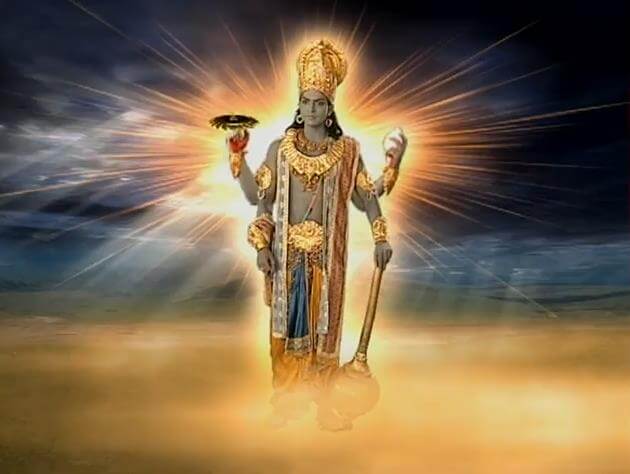
(16-18) There are two puruṣa-s in the world, the perishable and imperishable. All beings are perishable and the imperishable is called kūṭastha (supreme soul) (dvāvimau puruṣau loke kṣaraścākṣara eva ca । kṣaraḥ sarvāṇi bhūtāni kūṭastho’kṣara ucyate ॥ 15-16॥). The supreme puruṣa is another name for supreme Soul, the indestructible, Īśvara who pervades and sustains the three worlds (uttamaḥ puruṣastvanyaḥ paramātmetyudāhṛtaḥ । yo lokatrayamāviśya bibhartyavyaya īśvaraḥ ॥ 15-17॥). Since I transcend the perishable, am above the imperishable also and I am the highest, therefore in the world and the Vedas I am declared as the Supreme puruṣa (yasmātkṣaramatīto’hamakṣarādapi cottamaḥ । ato’smi loke vede ca prathitaḥ puruṣottamaḥ ॥ 15-18॥).
(19-20) He who is undeluded and knows me to be the Supreme Soul, he is completely wise and worships me with all sentiment (yo māmevamasammūḍho jānāti puruṣottamam । sa sarvavidbhajati māṃ sarvabhāvena bhārata ॥ 15-19॥). Thus, this most secret sciencific treatise has been taught by me and knowing this, the wise become accomplished in all activities (iti guhyatamaṃ śāstramidamuktaṃ mayānagha । etadbuddhvā buddhimānsyātkṛtakṛtyaśca bhārata ॥ 15-20॥).
The complete text is available in my book, A Seeker’s Śrīmad-Bhagavadgītā.
Buy your copy today – Notion Press home / Flipkart / Amazon / Amazon India / Amazon UK / Amazon US / Amazon Australia
Acknowledgement –
School of Yoga is profoundly grateful to Saṃskṛta scholars and academics Pijus Kanti Pal (pal.pijuskanti@gmail.com) and Dolon Chanpa Mondal for their support in Saṃskṛta transliteration and quality control.