
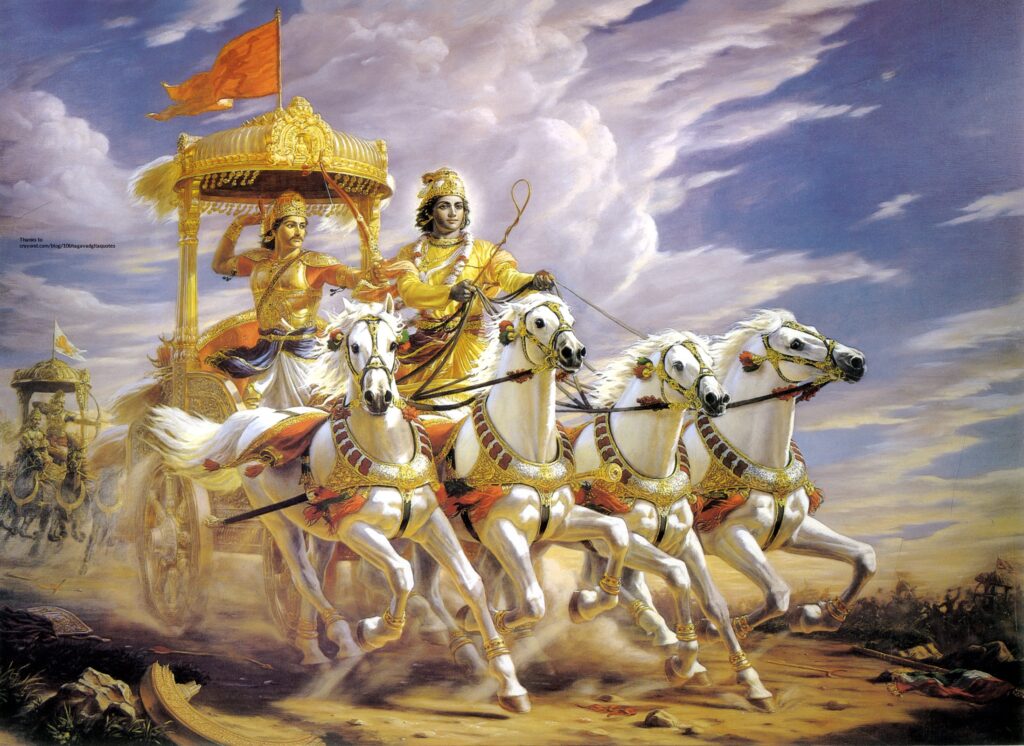
School of Yoga explains Srimad-bhagavad-gita, chapter 14 – gunatraya vibhaga yoga (Yoga of differentiation of the three guna-s).
What is gunatraya vibhaga yoga? Let’s find out… 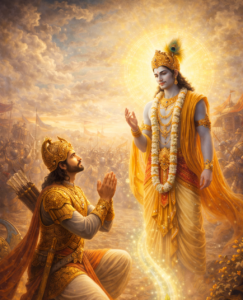
Introduction to gunatraya vibhaga yoga.
- Starting with chapter 9, Shri Krishna moves from explaining the basics to implementation of concepts. To do this, he speaks about his Absolute (virat) Self in chapter 9 and finally shows him his Universal form (vishvarupa) in chapter 10. This obviously confuses as well as amazes and scares Arjuna.
- In chapter 13, he moves to the next step and explains cognition of the body and environment. In terms of daily living, it is all about vijnana or cognition of the body and environment in the visible or gross (sthula), subtle (sukshma) state as well as the causal (karana) state.
- In chapter 14, though he seems to repeat a lot of the same concepts, actually he is applying the concept to various situations, so that one understands the myriad opportunities for implementation of Srimad-bhagavad-gita, and Yoga in real life.
- In this chapter, Shri Krishna speaks about how attributes affect behaviour. School of Yoga expands the subject to examine how this concept affects every aspect of living.
School of Yoga explains Srimad-bhagavad-gita, chapter 14 – gunatraya vibhaga yoga, verse 1-20.
Shri Krishna explains the three attributes (triguna-s) in gunatraya vibhaga yoga.
Shri Krishna said: I will now teach you that knowledge of the Self (jnana) which will enable you to merge with the source (Brahman).
- I am the seed, the womb and the placer of the seed of all creation.
- From me is born the (three guna-s) triguna-s – sattva, rajas and tamas, the qualities which are common to all entities.
- Of these, sattva is spotless, luminescent and free from faults. Also, it binds one to the knowledge of the self which is sourced from contentment.
- Rajas is the embodiment of passion, the source of thirst and attachment. Consequently, it binds one to action.
- Finally, tamas is born out of ignorance and delusion. As a result, it binds one to heedlessness, indolence and sleep.
- Sattva binds one to peace, rajas to action and by shrouding one from the knowledge of oneself, tamas binds one to heedlessness.
- There is a constant struggle for ascendancy, with sattva, rajas and tamas competing to overpower the other two. Consequently, when every sense is filled with awareness, this is the state of sattva. Likewise, when greed drives any undertaking and there is restlessness and longing, rajas predominates. Lastly, when darkness, inertness, heedlessness and delusion predominate, then tamas is predominant.
- In fact, if one dies when sattva is predominant, then he goes to the world of the pure. Next, if he dies in rajas, then he is born again attached to action. Finally, if one dies when tamas is predominant, then he is born into a deluded home.
- Sattva is born out of good action, rajas results in pain and tamas results in ignorance. From sattva emerges knowledge of the Self, from rajas arises greed and from tamas arises heedlessness, ignorance and error. Those whose awareness of the Self is fixed in sattva rise. In rajas, there is stagnation and in tamas, there is deterioration of one’s progress.
- When a practitioner recognises all action as arising out of gunas, and transcends it, he will merge with the Brahman.
School of Yoga explains Srimad-bhagavad-gita, chapter 14 – gunatraya vibhaga yoga.
Qualities of the guna (attributes).
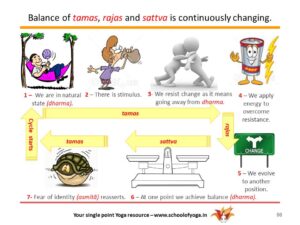
Tamas (Inertia): This aspect is characterised by fear, laziness, indolence, confusion, delusion etc. A person with a predominance of this state is generally vacillatory, lethargic, prone to giving excuses and, indecisive.
Rajas (Passion): This state governs nearly all forms of passion and is driven primarily by desire. As a result, a person in this state would typically focus on personal achievement and gratification, be result oriented, dominating, aggressive, impatient etc.
Sattva (Harmony): This state is characterised by harmony. It is demonstrated when a person tries to balance result with resource or process, task with quality and relationships etc. A person in this state avoids confrontation, but in a conflict situation, is calm, absorbs emotional outburst and remains objective.
Obviously, no one is endowed with one attribute only. The mix of attributes changes according to the situation, desires, perception of threat and this changes continuously as the situation unfolds. This means that the three attributes constantly change in composition with each other, with each attribute trying to gain ascendancy over the other, depending on the quality of change and its impact on one’s self-worth (asmita).
School of Yoga explains Srimad-bhagavad-gita, chapter 14 – gunatraya vibhaga yoga, verse 21 onwards.
How does one rise above the guna-s?
Arjuna said in gunatraya vibhaga yoga: What are the characteristics of him who has transcended the guna-s? How does one rise above the guna-s?
Shri Krishna said: The qualities of a person who has transcended the guna-s are;
- He who does not hate light, activity or delusion when it occurs, nor longs for them when they are absent (is free from opposites such as like-dislike, good-bad, right-wrong).
- Also, he who is unaffected by the guṇa-s, for he knows how they operate. Therefore, this person is centred in the Self and does not get swerved by the actions of the guṇa-s.
- Balanced in peace, centred in the Self, viewing earth, stone and gold alike, treating loved ones and strangers in the same manner, firm in all situations and treating censure and praise with equal value.
- Same in honour or dishonour, treating friend or foe equally, and abandoning all undertakings.
- He who is devoted to me, merges with me reaches the
School of Yoga explains Srimad-bhagavad-gita, chapter 14 – gunatraya vibhaga yoga.
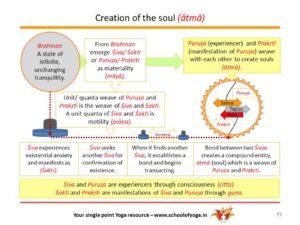
Concept of samadhi (transcending of the Self) in gunatraya vibhaga yoga.
From first principles on gunatraya vibhaga yoga, we know that;
- Guna rises from the weave of purusha and prakriti.
- Purusha is the experiencer and prakriti is the manifestation of purusha.
- Purusha and prakriti combine to form the Self (atma)
- Hence, when the purusha ceases to experience, prakriti has no impact on the atma (Self).
How does purusha stop experiencing?
- Stop dealing in dualities such as like-dislike, love-hate. That stops purusha from experiencing
- Be even-handed. Treat everything and every situation without bias.
- Stop living in the past and don’t dream about the future. Be aware of the present. Become a sthithaprajna (one of steady awareness)
School of Yoga explains Srimad-bhagavad-gita, chapter 14 – gunatraya vibhaga yoga.
Concept of sva-tantra (personality) using India as an example.
Since Yoga is from India, it seems appropriate that one should explore the possibility of applying Shri Krishna’s advice in all the above chapters to India. Obviously, once this is done, the litmus test for Srimad-bhagavad-gita would be its applicability to humanity as sanātana-dharma.
Ancient texts from the sub-continent talk about purushartha-s (purusha = person + artha = reason for existence) which means reason-for-living or raison-d’etre of human existence.
Purushartha principle states that people live for artha = material gain, kama = sensual pleasure, dharma = harmony/ order and moksha = freedom from seeking. Importantly, for balanced living, dharma must be resident in artha = material gain and kama = sensual pleasure.
The question that needs answering is, does freedom-from-seeking (moksha) fit into this equation?
Absolutely! After people have achieved material (artha) enjoyment and sensual pleasure (kama) in harmony (dharma), they begin to look for an answer to the question, “What is life?”, “Why am I alive?”, “Does life have a purpose?” etc. This takes them into an esoteric world that culminates with absolute freedom from materiality (maya). This freedom comes when the person has cognised the Self and results in the person having no further desire-to-seek (moksha).
Therefore, any country that wishes to exist as a balanced individual (satvika-sva-tantra) must be able to create for its citizens, circumstances for them to comprehend their Self, the reason thei are alive. Not encouraging people to seek freedom from materiality (moksha) would condition people into viewing materiality as life’s sole objective. Also, practice of moksha brings with it, finer altruistic sentiments (bhava) of charity (dana), tolerance (kshama), non-violence (ahimsa) etc.
So, any society that wishes to develop its personality must develop the finer qualities of behaviour control (yama) and self-restraint (niyama) of its people, as detailed in raja-yoga (check Śrīmad-bhagavad-gītā, chapter 17 for more on yama and niyama).
Obviously, behaviour control (yama) and self-restraint (niyama) cannot be taught overnight, so they need to be inculcated in children when they are young. This means that the education system of the country must systematically teach yama (behaviour control) and niyama (self-restraint) and encourage its citizens to discuss its values as well as practice the concept in civic life. This will condition people to live a life of natural peace (dharma) while they are enjoying material (artha) and sensual (kama) pleasures and prepare them for absolute freedom (moksha) later.
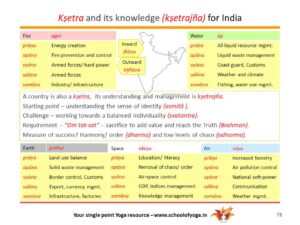 How can the principles of purushartha-s (reason for human existence) be applied to the management of the country? Artha is obviously material well-being, availability of food, shelter, clothing and infrastructure such as transport, electricity, availability water etc., kama is the softer aspects of artha.
For example, while shelter might be available, if it is designed and constructed in a haphazard manner, badly designed or dilapidated, there can be no positivity about the place and residents would be unhappy. If food is spoiled, cold, unappetising or lacking in nutrition, then there is no pleasure derived in eating. This means that both hardware (artha) and software (kama) are required for a society to be a functional and happy place. So, we can see that material aspects (artha) and sensual aspect (kama) of a country cannot function independently.
Additionally, material aspects (artha) and sensual aspect (kama) cannot be independent of order and harmony (dharma).
For example, even if food and shelter were to be made available in a country, if there is no order, harmony or peace, then material aspects (artha) and sensual aspect (kama) become irrelevant.
So, we can also see that for a country (kshetra) to experience it individuality (sva-tantra) with complete awareness (prajna), its society (kshetra) must be conditioned for a life of harmony (dharma) which must be a weave of its material (artha) and sensual (kama) aspects in the gross/ visible/ overt (sthula) as well as subtle (sukshma) states. This knowledge of how to manage a country is called (kshetrajna) and is completely dependent on sincere and diligent application (shraddha) of the policies, systems, processes and rules (dharma) by its rulers as well as citizens.
School of Yoga explains Srimad-bhagavad-gita, chapter 14 – gunatraya vibhaga yoga.
Relationship between Prana (motility) and gunatraya vibhaga yoga for a country.
Prana moves in entities in the form of five vital airs (vayus),
- Prana-vayu which controls all incoming value,
- Apana-vayu which controls all excretory value,
- Vyana-vayu which determines the quality of energy or aura that governs the projection of individuality (sva-tantra) of the country.
- Udana-vayu which determines how the country communicates with the outside world and
- Samana-vayu which determines how it digests all the resources that it ingests.
Let us detail this further.
-
Prana-vayu is incoming motility, which includes material, ideas, energy and resources. The key discriminator is rinn (debt). When a country is not in debt and adds value in all its actions, it can enjoy material (artha) and sensual (kama) prosperity, but when it borrows beyond its means of repayment and lives without adding value, there is loss of dharma, and the country lapses into delusion and depression (tamas).
- Apana-vayu can be viewed in the light of the primordial elements (pancha-bhuta). For as long as solid (prithvi) and liquid (jala) waste management ensures betterment of the community, when air (vayu) and space (akasha) are pure and energy/ fire (agni) used is adequate to transform raw materials into products of value (sat), apana-vayu will not become destructive (tamasika) but ensure that the country is harmonised, clean and in peace (sattvika).
- Vyana-vayu – when people of a land (kshetra) use their energies in constructive development of themselves and their neighbourhood, the overall aura of the country becomes one of a people that can be called civilised and developed. Example – both Germany and Japan ended World War II with a terrible reputation and in servitude. However, over the years they used their energies to transform themselves in a holistic manner (increased dharma), so much so that today, their World War II reputation has become insignificant.
- Udana-vāyu is how the country communicates and represents itself. Some countries punch above their weight, some become bullies, some struggle to keep their composure, others turn docile while a few become rebellious. We can see examples of all these countries in the neighbourhood of Bharat, in Asia itself. The quality of attributes (guna) is evident in the manifestation of self-worth (asmita) in the individuality (sva-tantra).
- Samana-vayu is the energy that circulates within a country. For example – Germany and Japan were able to acquire reputations as countries that add value (sat) on account of their hard work and harmonious societal ethics.
School of Yoga explains Srimad-bhagavad-gita, chapter 14 – gunatraya vibhaga yoga.
Some situations of countries with differring gunatraya vibhaga yoga.
- When indolence, delusion and laziness (tamas) are the predominant attributes of the people, then the country is likely to remain poor, living on hand-outs / aid and blaming others for its situation.
- Next, when the people of a country are full of passion (rajas), then one will see a high level of energy, passion and ambition. If this rajasika energy is tempered by indolence (tamas), then growth will be haphazard with frequent conflicts. In many countries, there will be a disconnect between the people and their governments.
- However, when rajasika energy is tempered by balance and harmony (sattva), then one will see an attempt by the government to make each person stand on his or her own feet and be independent.
For example – when passion (rajas) is tempered with indolence (tamas) every citizen will be given fish to eat. However, when passion (rajas) is tempered by balance (sattva), citizens will be taught and encouraged to fish so that they stop being dependent on others for free fish, as this makes them vulnerable to power, pressure and influence and weakens their individuality (svatantra). The latter method is harder and more painful, but leads to a self-reliant and stronger country.
- The difference between the above two situations is the quantum of sacrifice (yajna) that is required.
- In the former, the citizen merely needs to convince his leaders that giving fish freely, will lead to harmony and easier governing of the country (kshetra). However, in the latter case it becomes incumbent on the leader to convince citizen that free fish is not in their interest and they must learn to fish.
- There is a big difference in the input required to condition (dharma) the citizens in the latter situation and the way the citizens (jana) and leaders (rajana) relate will determine whether the country comes out with a strong and resilient personality (sva-tantra).
Prana and the four ashrama (stages of existence) in gunatraya vibhaga yoga.
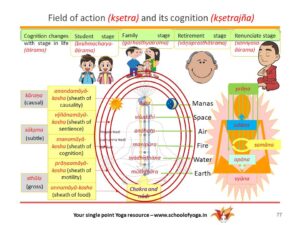 How does the movement of prana affect people in various stages of their existence (ashrama)?
- There are four stages of existence (ashramas) and their relevance to a country.
- Brahmacaryashrama (stage of youth),
- Grahasthashrama (stage of a house-holder),
- Vanaprasthashrama (stage of retirement),
- Sannyasashrama (stage of renunciation).
- Brahmacaryashrama (stage of youth) is a phase of learning and formation of conditioning (dharma). This is the most critical stage of a country and effort that society invests in teaching its youth to work with dedication (shraddha), to sacrifice (yajna), act (karma-yoga) and align sacrifice (yajna) with Truth (satya) will determine the country’s conditioning (dharma) and consequently, its personality (svatantra).
- Grahasthashrama (stage of a householder) is that stage where maximum consumption occurs. Here, awareness (prajna) is the quality that needs to be developed. The householder (grahastha) implements everything that was learned in brahmacaryashrama and begin to understand the value or shortcoming of everything that was taught. They become alert to income, expenses, waste and its disposal. They learn discrimination (viveka) and dispassion (vairagyam). Only then do householders understand and contribute to all aspects of the country’s development (kshetrajna).
- Vanaprasthashrama (stage of retirement) is a stage when the person steps back from activity and reflect on the learnings of his or her grahasthashrama. The key requirement of this stage is having enough resources to face the remainder of life and not be dependent on anyone as well as the ability to view the Self dispassionately (vairagyam).
- Sannyasashrama (stage of renunciation) is the last stage, where a person is expected to focus on the nature of the Soul (atma-vichara), absolute freedom (moksha) and nature of death. Unfortunately, people often baulk at any suggestion that they should reflect on the nature of death and after-life. However, the result of ignoring this major life-event is having to face anxiety and fear of death when one is least prepared.
The transliteration and translation of Srimad-bhagavad-gita, chapter 14 gunatraya vibhaga yoga follows,
The Sanskrit diacritic words are in red italics.
Śrī Kṛṣṇa said (1-2) Again I will declare the supreme of all wisdom, the knowledge of the highest degree, which after cognising, all sages have attained supreme perfection after leaving life (paraṃ bhūyaḥ pravakṣyāmi jñānānāṃ jñānamuttamam । yajjñātvā munayaḥ sarve parāṃ siddhimito gatāḥ ॥ 14-1॥). Having taken refuge in this wisdom and having attained one-ness with me, one is not born at creation, nor disturbed at dissolution (idaṃ jñānamupāśritya mama sādharmyamāgatāḥ । sarge’pi nopajāyante pralaye na vyathanti ca ॥ 14-2॥).
(3-4) In my womb is the great Brahma in whose womb, I place at his birth creation of all beings thereafter (mama yonirmahad brahma tasmingarbhaṃ dadhāmyaham । sambhavaḥ sarvabhūtānāṃ tato bhavati bhārata ॥ 14-3॥). In all wombs where creation occurs embedded in the womb of great Brahma, I am the seed-giving father (sarvayoniṣu kaunteya mūrtayaḥ sambhavanti yāḥ । tāsāṃ brahma mahadyonirahaṃ bījapradaḥ pitā ॥ 14-4॥).
(5-6) Satva, rajas, tamas, these attributes which are born out of prakriti bind within the body, the indestructible embodiment (sattvaṃ rajastama iti guṇāḥ prakṛtisambhavāḥ । nibadhnanti mahābāho dehe dehinamavyayam ॥ 14-5॥). Of these, sattva displays stainlessness, luminosity, health, bias towards happiness and binding to wisdom (tatra sattvaṃ nirmalatvātprakāśakamanāmayam । sukhasaṅgena badhnāti jñānasaṅgena cānagha ॥ 14-6॥).
(7-8) Cognise rajas to be the nature of passion, the source of attachment, which binds the embodied to action (rajo rāgātmakaṃ viddhi tṛṣṇāsaṅgasamudbhavam । tannibadhnāti kaunteya karmasaṅgena dehinam ॥ 14-7॥). But cognise tamas to be born out of ignorance, with stronghold of being confused when dealing with others, negligent, lazy and somnolent (tamastvajñānajaṃ viddhi mohanaṃ sarvadehinām । pramādālasyanidrābhistannibadhnāti bhārata ॥ 14-8॥).
(9-10) Sattva attaches one to happiness, rajas to action by truly shrouding wisdom but tamas attaches one to heedlessness (sattvaṃ sukhe sañjayati rajaḥ karmaṇi bhārata । jñānamāvṛtya tu tamaḥ pramāde sañjayatyuta ॥ 14-9॥). Overpowering rajas and tamas, sattva rises; similarly rajas rises over sattva and tamas; and tamas over rajas and sattva (rajastamaścābhibhūya sattvaṃ bhavati bhārata । rajaḥ sattvaṃ tamaścaiva tamaḥ sattvaṃ rajastathā ॥ 14-10॥).
(11-12) When every sensory aperture in the body shines with the light of wisdom then this wisdom is predominantly sattva indeed (sarvadvāreṣu dehe’sminprakāśa upajāyate । jñānaṃ yadā tadā vidyādvivṛddhaṃ sattvamityuta ॥ 14-11॥). When greed, restlessness and longing predominate in any undertaking of action, these arise from rajas (lobhaḥ pravṛttirārambhaḥ karmaṇāmaśamaḥ spṛhā । rajasyetāni jāyante vivṛddhe bharatarṣabha ॥ 14-12॥).
(13-14) No clarity, inertness and heedlessness, even delusion, these arise when tamas becomes prominent (aprakāśo’pravṛttiśca pramādo moha eva ca । tamasyetāni jāyante vivṛddhe kurunandana ॥ 14-13॥). In fact, if sattva becomes prominent at time of dissolution, the spotless embodied then attains the highest world (yadā sattve pravṛddhe tu pralayaṃ yāti dehabhṛt । tadottamavidāṃ lokānamalānpratipadyate ॥ 14-14॥).
(15-16) At dissolution in rajas, the person is born among those attached to action, those dying in tamas are born in the womb of the deluded (rajasi pralayaṃ gatvā karmasaṅgiṣu jāyate । tathā pralīnastamasi mūḍhayoniṣu jāyate ॥ 14-15॥). The outcome of sāttvika action is pure, the fruit of rājasika action is pain and ignorance is the fruit of tāmasika action (karmaṇaḥ sukṛtasyāhuḥ sāttvikaṃ nirmalaṃ phalam । rajasastu phalaṃ duḥkhamajñānaṃ tamasaḥ phalam ॥ 14-16॥).
(17-18) From sattva rises wisdom, from rajas it’s surely greed, heedlessness and delusion rise from tamas and also gives rise to ignorance (sattvātsañjāyate jñānaṃ rajaso lobha eva ca । pramādamohau tamaso bhavato’jñānameva ca ॥ 14-17॥). Upward go those seated in sattva, those of rajas remain in the middle, those abiding in the lowest of attributes which is tamas, go downward (ūrdhvaṃ gacchanti sattvasthā madhye tiṣṭhanti rājasāḥ । jaghanyaguṇavṛttisthā adho gacchanti tāmasāḥ ॥ 14-18॥).
(19-20) When the seer beholds no agent higher than the attributes, and goes beyond the qualities of the attributes, he attains my state (nānyaṃ guṇebhyaḥ kartāraṃ yadā draṣṭānupaśyati । guṇebhyaśca paraṃ vetti madbhāvaṃ so’dhigacchati ॥ 14-19॥). The embodied that has transcended the three attributes out of which the body is evolved is freed from birth, death, ageing and pain, and attains immortality (guṇānetānatītya trīndehī dehasamudbhavān । janmamṛtyujarāduḥkhairvimukto’mṛtamaśnute ॥ 14-20॥).
Arjuna asked (21) what are the indicators of one who has transcended these three attributes? what is the conduct and how can one go beyond the three attributes (kairliṅgaistrīnguṇānetānatīto bhavati prabho । kimācāraḥ kathaṃ caitāṃstrīnguṇānativartate ॥ 14-21॥).
Śrī Kṛṣṇa replied (22-23)- He neither hates nor longs for light or activity or even delusion. He does not dislike it when it is available or long for it when it is absent (prakāśaṃ ca pravṛttiṃ ca mohameva ca pāṇḍava । na dveṣṭi sampravṛttāni na nivṛttāni kāṅkṣati ॥ 14-22॥). Sitting indifferent among attributes, who operates unmoved by attributes, who is centred within and not shaky (udāsīnavadāsīno guṇairyo na vicālyate । guṇā vartanta ityevaṃ yo’vatiṣṭhati neṅgate ॥ 14-23॥).
(24-25) Alike in pain and pleasure, secured in the Self, regarding mud, stone and gold alike, balanced with liked and disliked, steadily balanced Self in censure and praise (samaduḥkhasukhaḥ svasthaḥ samaloṣṭāśmakāñcanaḥ । tulyapriyāpriyo dhīrastulyanindātmasaṃstutiḥ ॥ 14-24॥). Balanced in honour and dishonour, balanced with friend and foe, abandoning motivation of starting anything, such a person is said to have transcended attributes (mānāpamānayostulyastulyo mitrāripakṣayoḥ । sarvārambhaparityāgī guṇātītaḥ sa ucyate ॥ 14-25॥).
(26-27) He that unswervingly practices yoga of dedication and serves me, he crosses beyond the attributes and becomes fit to become Brahman (māṃ ca yo’vyabhicāreṇa bhaktiyogena sevate । sa guṇānsamatītyaitānbrahmabhūyāya kalpate ॥ 14-26॥). Indeed, Brahman is the abode, I exist in immortal, immutable and everlasting natural state of absolute bliss (brahmaṇo hi pratiṣṭhāhamamṛtasyāvyayasya ca । śāśvatasya ca dharmasya sukhasyaikāntikasya ca ॥ 14-27॥).
The complete text is available in my book, A Seeker’s Śrīmad-Bhagavadgītā.
Buy your copy today – Notion Press home / Flipkart / Amazon / Amazon India / Amazon UK / Amazon US / Amazon Australia
Acknowledgement –
School of Yoga is profoundly grateful to Saṃskṛta scholars and academics Pijus Kanti Pal (pal.pijuskanti@gmail.com) and Dolon Chanpa Mondal for their support in Saṃskṛta transliteration and quality control.
This is so different from the usual read! Very connected to the world around us today. The examples of individuals, community, processes, nation state, governance and the attitude of individuals and the nation are so so relevant. It does explain the conflicts within and between nations so beautifully..
As engineered by the individuals within and the government that leads. A fascinating read. WishI had these examples too hand when I used to teach children Gita for their bhagavat Gita chanting contests. I used to make for with various stories from our itihasas to bring home gunas, stitapragnya,karma etc. Including of course good food and junk food as captured in the Gita! I thoroughly enjoyed reading this and look forward to hearing other chapters too through your chakshu!
Thank you for your feedback, especially as you have been a Gita teacher. I would be very grateful if you could suggest more improvements to make this critical document more relevant to daily life. Thanks again. Vishwanath, School of Yoga.