Why is pranayama important?
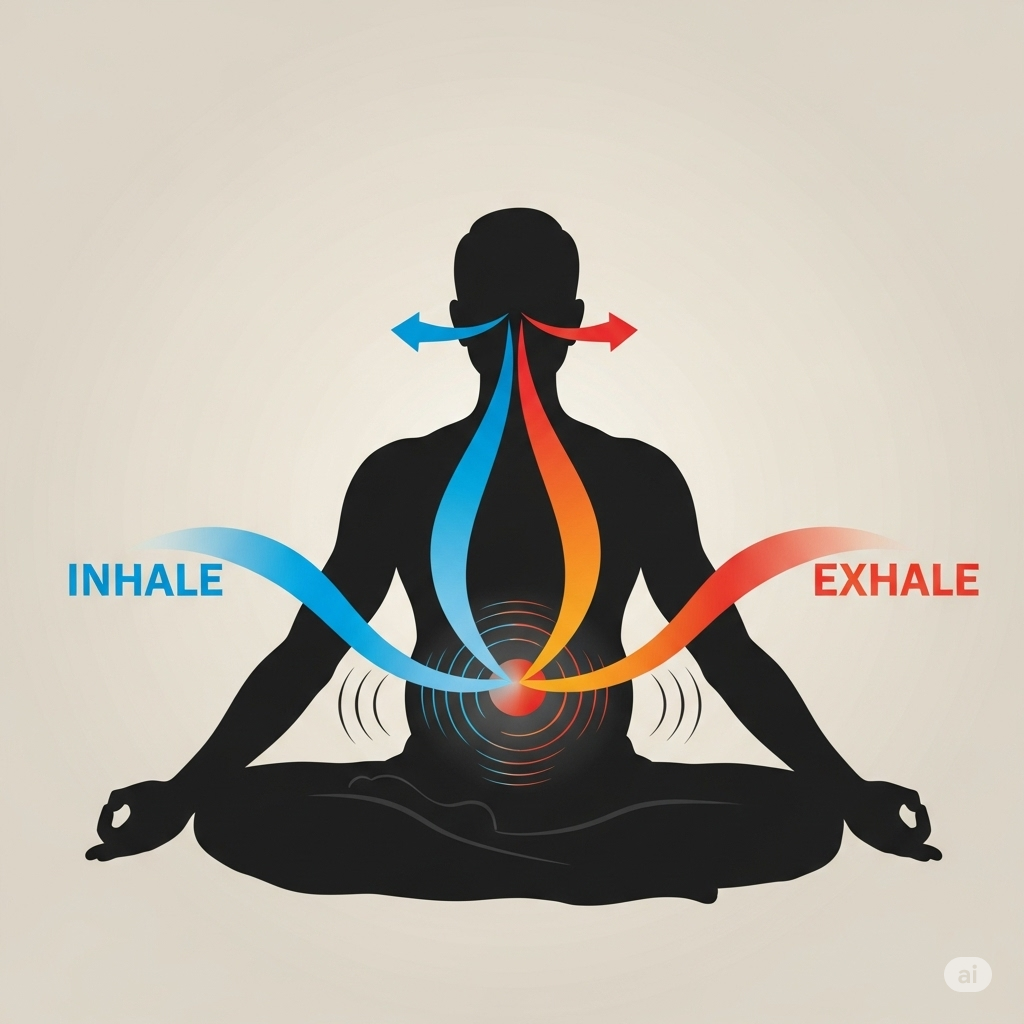
The process – Oxygen-filled air goes into the lungs during inhalation and the oxygen moves to the bloodstream. The process of exhalation expels carbon dioxide and water vapour. Breathing is an involuntary process, which means that it occurs without us being aware of it. Pranayama is the technique of making our breathing a conscious and controlled process. The concept of pranayama is vast and deep. It has its own science, as well as its own vocabulary. Hence, before we learn about the techniques of this yogic breathing practice in depth, it is quintessential to understand the basic and important terminologies of pranayama breathing exercise.
What are the benefits of pranayama?
- Stress surely affects our breathing (click for stress and breathing). Therefore, proper breathing can alleviate stress and thus increase situational awareness (prajna).
- Since oxygen is critical for the conversion of food into energy, proper breathing also impacts all oxidation processes that occur in the body, thereby directly affecting the quality of health.
- Finally, pranayama is one of the most critical aspects of Hatha-Yoga and Raja-Yoga.
Let us now understand the important terminologies of pranayama, in separate sections or parts. Each part covers a specific aspect of yogic breathing – such as the energy channels, the pranayama breathing cycle, etc., and explains the related terminologies of pranayama.
The terminologies of pranayama – The energy channels or nadi :
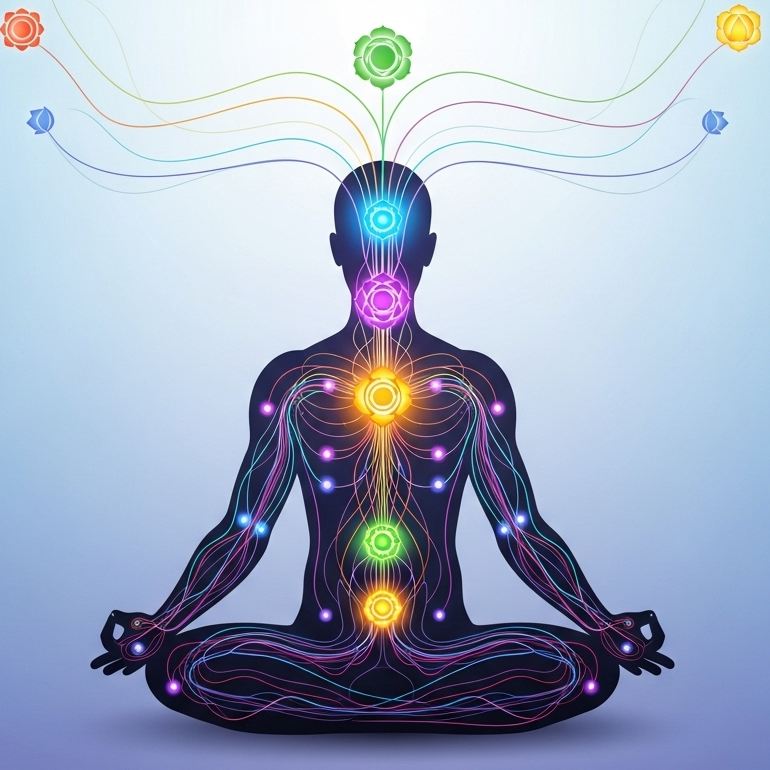
Conscious breathing ensures psychosomatic equilibrium. It channels motility (prana) through channels called nadi, ensuring health and wellness. It is important to understand nadi when practicing pranayama. Subtle energy channels (nadi) and vortices (cakras) within the body act as conduits of motility (prana) and impact the physical, emotional, and intellectual well-being of the practitioner.
Shiva Samhita designates 14 important nadis, and the most important ones are:
- Ida-nadi (comfort in Sanskrit): The ida-nadi channel runs to the left of the sushumna-nadi and it is pale in colour. Ida-nadi is associated with Lunar energy, and thus it is associated with cooler energy. It moves from the left testicle to the left nostril and is associated with the right hemisphere of the brain.
- Pingala-nadi (orange-brown in Sanskrit): This channel runs to the right of the sushumna-nadi. Pingala-nadi is light brown in colour. It is associated with solar energy, and therefore, with hot energy. It moves from the right testicle to the right nostril and is associated with the left hemisphere of the brain.
- Sushumna-nadi (which runs in the backbone) – is the central nadi, running along the backbone. It comprises 3 subsidiary nadis called vajra, chitrini, and brahma which act as the channels through which the kundalini moves upwards from the muladhara to the sahasrara.
The junction of the ida, pingala, and the sushumna-nadi at the muladhara, is called yukta-triveni (yukta = combines + tri = three + veni = streams). When the ida, pingala and the sushumna-nadi meet again at the ajna-cakra, they are called mukta-triveni (mukta = liberated + triveni = three streams).

The terminologies of pranayama – The stages in the pranayama cycle
A – Puraka (inhalation): A single inhalation is termed puraka. It is a process of drawing in air or inhalation. Also, it should be smooth and continuous. With practice, one can eliminate the breaks in puraka.
B – Abhyantara-kumbhaka (hold after inhaling): The kumbhaka consists of deliberate stoppage of breathing and retention of the air in the lungs after inhalation.
C – Recaka (exhalation): The Recaka is the third stage. It should be smooth and continuous, just like inhalation, though often the speed of exhaling is different from that of inhaling. However, one must always attempt to keep the pace, quality, and flow of exhalation equal to inhalation.
Normally, when inhaling, the abdominal wall descends, drawing down the viscera and stretching it. During kumbhaka, the breath is held, and this exerts a strain on the abdominal wall. The abdominal wall relaxes and collapses inward during recaka (rechaka). The viscera pushes against the diaphragm, thus emptying the lungs.
D – Bahya-kumbhaka (hold after exhaling): The fourth stage is bahya-kumbhaka. It is the stage of holding the breath after the exhalation is complete.
The fourth stage thus completes the pranayama cycle when the retention ends and a new inhalation begins.
The terminologies of pranayama – Stages of development in pranayama
A – Arambha-avastha (starting state) – In this stage, the prana is stabilized within the body, balancing the various vayus (airstreams) – such as (prana-vayu / apana-vayu / vyana-vayu / udana-vayu / samana-vayu). When a person practices pranayama sincerely, the following changes occur;
- He/she begins to perspire profusely. He/she should rub the sweat into the body.
- Also, there is involuntary trembling.
- Sometimes, the body jumps and jerks like a frog.
B – Ghata-avastha (pot state or gathering state)– This is the second stage of pranayama. This occurs when there is constant suppression of breath. Then, there is a perfect union of prana-vayu and apana-vayu, manas (cognition) and buddhi (logic). Here, the yogi experiences sama-drishti (viewing all creation equally). Also, the yogi experiences clairvoyance, telekinesis, erudition, ability to become invisible and take up any form he desires.
C – Parichaya-avastha (acquaintance state) – Vayu or breath-flow, pierces the kundalini, which along with agni, enters the sushumna and merges with it. This stage destroys the yogi’s karma. The yogi is thus able to see and manipulate prana.
D – Nispatti-avastha (consummation stage) – Here, the yogi’s identity merges with the universal identity and this stage burns away all cycles of birth and death. This is samadhi, moksha, the final state.
How should one practice pranayama daily?
There are several commonly used important terminologies of pranayama. There are many techniques such as sama-vritti (even condition), visama-vritti (uneven condition), sitali (tongue curled between the lips), sitkari (tongue curled between the teeth), udgeeth (pranayama with chanting). However, the following schedule is adequate to meet daily requirements :
| Pranayama | Cycles | Benefits |
| Nadi-shuddhi with kumbhaka | 5-20 | Overall lung functioning, balancing of left/ right brain, balancing of ida and pingala-nadi. |
| Bhastrika | 5-20 | Increases lung capacity, transfer capacity, activates dead alveoli, increases lung elasticity, and also strengthens diaphragm. |
| Kapalabhati | 25-100 | Increases volumetric efficiency of the lungs, strengthens the trachea and also the pulmonary vessels. Strengthens the abdominal walls as well. |
| Ujjayi | 3-6 | Improves the autonomous nervous system, the heart, and also clears ears and sinuses. |
| Bhramari | 3-6 | Opens the nasal passages, clears all the sinuses, and thus removes mucous. |
| Nadi-shuddhi | 5-10 | Close with nadi-shuddhi to reset the system. |
Finally, it is important to practice breathing on an empty stomach and in a clean room with the windows open.
Thus, doing the pranayama after asana increases its effectiveness, as the entire body is rejuvenated.
Points to ponder on pranayama
Internal Links: Dharma (conditioning), Stress and Situational Awareness, Prana, Asana overview 1, Asana Overview 2, Asana Focus or gazing, Hatha Yoga Pradeepika
External Links: Prana, Chakra, Pancha Tattva, Pancha Prana, Pancha Kosha, Nadi, respiration
- How does pranayama impact stress situations?
- How can we enhance our pranayama capability?
- Therapy and pranayama.
- Patience and pranayama.
- The right time to do pranayama breathing exercise.
- Pranayama and its impact on Situational Awareness.
- Diet and pranayama.
- Can one practice controlled breathing at a bus stop, when waiting at a signal etc. without a conventional setting?