School of Yoga explains Srimad-bhagavad-gita, chapter 18 – moksha sannyasa-yoga (yoga of liberation by renunciation).
Introduction to moksha sannyasa-yoga.
Much of moksha sannyasa-yoga is a recap of chapters 1-17. Some of the important aspects that are covered are,
- Difference between sannyasa and tyaga.
- Delineation of yajn
 a – sacrifice, dana – donate without expectation of return and tapas, self-restraint.
- Description of attributes (guna) – tamas (attitude of indolence), rajas (attitude of passion) and sattva – (attitude of balance or harmony).
- Constitution of action (samgraha).
- How attributes affect people in action and contribution in society (varna). Importance of understanding that varna does not affect personal development.
- Recap of natural state (dharma) and its impact on excellence in action (karma).
- His own (Shri Krishna’s) ability to affect the outcome of any effort in Yoga.
School of Yoga explains Srimad-bhagavad-gita, chapter 18 – moksha sannyasa-yoga (yoga of liberation by renunciation).
What is moksha sannyasa-yoga?
Arjuna said: I wish to know the truth about sannyasa and tyaga (renunciation).
Shri Krishna replied,

- Sannyasa is renunciation of action motivated by desire (kama).
- Abandonment of fruits of action is called tyaga.
- Difference between sannyasa and tyaga – sannyasa is renunciation of desire (kama) for an outcome in an act. For example – a soldier charging an enemy position does not know whether he will succeed. However, tyaga is the renunciation of all fruits from the action. The soldier charging an enemy position can have 3 possible outcomes; he may die, in which case all further discussion ends; he may succeed in overcoming the enemy or he may be defeated and captured. Tyaga is acceptance of both, success and defeat with same attitude, one of indifference. (Ch 18 verse 12)
- One must treat desire (kama) like an affliction (dosa).
- Relinquish all action except,
- Yajna – sacrifice,
- Dana – donate without expectation of return,
- Tapas – self-restraint,
- Even when performing yajna, dana and tapas, do not expect any return.
- Recognise that behaviour is driven by attributes (guna),
- Tamas (attitude of indolence) – when action is abandoned due to ignorance.
- Rajas (attitude of passion) – when action is abandoned because of fear.
- Sattva – (attitude of balance) – when action is performed because it must be done, not for fruits.
- But any person can free himself from the effects of karma by discarding the attitude of being the doer (ahankāra).
- It is impossible to renounce action entirely. However, it is possible to renounce fruits of one’s action.
School of Yoga explains Srimad-bhagavad-gita, chapter 18 – moksha sannyasa-yoga (yoga of liberation by renunciation).
What is moksha sannyasa-yoga?
Shri Krishna’s explanation on karma in this chapter gives the best understanding on the subject. This chapter is almost completely devoted to action in its various forms. Therefore, one could conclude that Shri Krishna in a subtle manner, indicates that everything related to existence is action (karma).
-

Components of karma In this chapter, Shri Krishna explains the gross components of any act. There are five,
- adhishthana – place or body – this is any place where action is being performed, within or outside the body.
- kartra – the doer. Since multiple entities may be impacted, this can include the person, team members and others as well. Also, when the team is integrated, it is considered a single unit.
- karana – causation or reason – reason for the action (mission, strategy and tactics).
- pathaka-cheshta – discrete aspect – all action can be split into discrete stages, systems or processes.
- deva – presiding deity – all action has a presiding deity that personifies its identity (like a brand).
- Subtle components of action consist of three aspects (samgraha),
- karmacodana – motivators of action comprising of three sub-elements,
- jnana – wisdom – knowledge of the subject, including integration of resources and processes.
- jneya – the unknown aspects of the action such as various assumptions and forecast.
- parijneyata – data, evidence on which decisions are based.
- Action (karma) itself – here it is important to realise that action should be performed as a sacrifice (yajna), the person should perform the sacrifice without expectation and accept any outcome without duality (like-dislike, good-bad, right-wrong etc.).
- kartr – doer and team members.

karanam or drivers of action
- karmacodana – motivators of action comprising of three sub-elements,
- What is the difference between gross (sthula) and subtle (sukshma) aspects of action or karma? We can compare these two aspects to the hardware (gross) and software (subtle) of any action! The gross aspect covers all visible components of action, while the subtle aspect covers logic and the drivers (karana) of action as well as Identity (Śiva). The subtle elements drive both, cognition of the system (vijnana) and cognition of the Self (jnana).
- Another important aspect which Shri Krishna highlights is the difference between prarabdha-karma (action that is occurring on account of previous debt or destiny) and free-will (svatantra). The question which is never clearly answered is to what extent do we control our own actions? Some of the points made by Shri Krishna are,
- No one can stop karma from occurring, prakriti (nature’s own instinct) will force action. (Ch 18 verse 59)
- Next, karma or action manifests as natural instincts (svabhava) but these are driven by conditioning (dharma).
- This means that events occur due to repayment of debt (prarabdha-karma) and response to stimulus occurs in conformance with one’s conditioning (sva-dharma).
- Dharma occurs at various levels.
For example, humans eat food, but unlike other creatures’ humans also eat when they are not hungry, this is conditioning (svadharma). Next, humans eat a variety of foods and in various ways, called cuisines. Animals eat without variation, a cow will eat grass and some vegetation, a lion will eat a cow. Humans wear clothing and follow cultures which they protect very assiduously. This type of existence that exists on earth is unique to Earth because the natural conditioning (dharma) of the earth allows it.

-
- The important aspect of all the above examples is that no entity has a choice of the positions they occupy – not the human, animal, Earth, Solar system, nor the fire, snow or rain, all manifest according to their natural states with no control.
- Then, how does Shri Krishna say, renounce desire and fruit of your action? All this indicates free will! The root and span of control can be found in the citta or consciousness. From first principles,
- Brahman is an infinite, unchanging, immutable sea of peace.
- From brahman emerges purusha and prakriti.
- From the weave of purusha and prakriti comes karma (action).
- The common thread in this process is the consciousness (citta). Citta plays the role of a messenger, carrying the projection of purusha through prakriti to the object, bringing feedback. The mechanical components of the transaction are the senses (indriya), cognition (manas) where the intellect (buddhi) compares data with conditioning (dharma) before initiation of reaction and the action (karma) itself.
- Citta is an outward projection of purusha through prakriti. When it is not projecting, it is in turmoil because the purusha (experiencer) is constantly anxious about losing its Identity.
- The citta can be quietened when one becomes aware of its movement as an agency external to the Self (atman). This awareness is called prajna.
- When awareness (prajna) quietens consciousness (citta), reactions become independent of self-worth (asmita) and free-will or ability to control response increases.
- When prajna is combined with sacrifice (yajna), which requires acting for a selfless purpose, (dana) donating without expectation of return and self-restraint (tapas) which is possible only if the consciousness (citta) has been quietened, self-will is exerted to ensure that the Self is removed from the action.
- This is “Om-tat-sat”. Brahman exists in any sacrifice (yajna) that adds value (sat), and this requires dedication, sincerity and focus on contribution (shraddha).
- To achieve this, one must follow the law of rta (excellence), which has been explained in Ch 16.
School of Yoga explains Srimad-bhagavad-gita, chapter 18 – moksha sannyasa-yoga (yoga of liberation by renunciation).
What is karma-sannyasa?
- First, to achieve karma-sannyāsa, stop applying logic to everything. When acting, sacrifice to add value (Om-tat-sat).
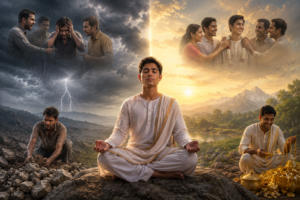
Avoid duality such as like-dislike, or good-bad - Next, ensure that logic is consistently discriminating between permanent-impermanent and dualities such as raga-dvesha (like-dislike). This attitude is called vivekam.
- To reach the above state, live in solitude eat sparingly and control speech, body and cognitive apparatus through meditation.
- Also, practice dispassion (vairagyam) and avoid arrogance, passion, anger and greed. Abandon feelings of being a doer (ahankara).
- Finally, when the yogi has no attachments and has reached a state of sublime peace, that person becomes fit to merge with the Brahman.
- On merging with the Brahman, this serene soul neither grieves nor has expectations.
- Also, the person treats all alike and sees Brahman is all creation (samaḥ-sarveṣu-bhūteṣu). As a result, the yogi realises that “I” and “Truth” are the same and attains indestructible, everlasting bliss.
- So, consciously surrender all actions unto the guru (in this case, Shri Krishna) with complete devotion and follow the Yoga of discrimination. Then, when acting, fix your consciousness on the guru to overcome all obstacles, by his grace.
- However, if anyone retains the attitude of being the doer (ahankara), then they will lose everything.
School of Yoga explains Srimad-bhagavad-gita, chapter 18, verse 20-40 moksha sannyasa-yoga (yoga of liberation by renunciation).
What is the relationship between moksha sannyasa and karma sannyasa.
- No one can escape the power of gunas (attributes).
- Jnana, karma and kartr can be further sub-classified according to the three guṇas (gunabhedatah). Verses 20 to 40 cover this sub-classification.
- Duties of a brahmana, kshatriya, vaishya or shudra can be attributed to their guna.
- However, no matter what varna one is, that person can realise the Self by performing work with an attitude that is in congruence with his personality trait and being consciously aware of the Brahman.
- Importantly, one should act in accordance with one’s own conditioning or dharma, rather than try to satisfy someone else’s. So, one must not convert to another dharma, nor ask anyone to convert from his or her dharma.
Conclusion – There is a clear understanding that jati (community) is different from varna (classification) and neither is an impediment to the yogi who seeks the Truth.
The transliteration and translation of Srimad-bhagavad-gita, chapter 18 moksha sannyasa-yoga (yoga of liberation by renunciation) follows.
The Sanskrit diacritic words are in red italics.
Arjuna said (1) I wish to know the truth about renunciation and abandonment (sannyāsasya mahābāho tattvamicchāmi veditum । tyāgasya ca hṛṣīkeśa pṛthakkeśiniṣūdana ॥ 18-1॥).
Śrī Kṛṣṇa said (2-3) Sages understand sannyāsa as renunciation of actions motivated by desire (kāma). Similarly, abandonment of fruits of all activity is declared abandonment (tyāga) by the wise (kāmyānāṃ karmaṇāṃ nyāsaṃ sannyāsaṃ kavayo viduḥ । sarvakarmaphalatyāgaṃ prāhustyāgaṃ vicakṣaṇāḥ ॥ 18-2॥). Abandon some types of actions as noxious but sacrifice (yajna), gifting without expectation (dāna) and self-restraint (tapas) should not be relinquished (tyājyaṃ doṣavadityeke karma prāhurmanīṣiṇaḥ । yajñadānatapaḥkarma na tyājyamiti cāpare ॥ 18-3॥).
(4-6) With certainty, it has been declared that there are 3 types of abandonment (niścayaṃ śaṛṇu me tatra tyāge bharatasattama । tyāgo hi puruṣavyāghra trividhaḥ samprakīrtitaḥ ॥ 18-4॥). Sacrifice, donation and austerity should not be abandoned when performing action. Indeed, yajnya, dana and tapas are purification acts of the wise (yajñadānatapaḥkarma na tyājyaṃ kāryameva tat । yajño dānaṃ tapaścaiva pāvanāni manīṣiṇām ॥ 18-5॥). Even these, when these actions are performed, it is my best belief that one should abandon the fruits of such actions also (etānyapi tu karmāṇi saṅgaṃ tyaktvā phalāni ca । kartavyānīti me pārtha niścitaṃ matamuttamam ॥ 18-6॥).
(7-10) Importantly, abandoning obligatory duty is not proper. Abandonment arises out of ignorance, and is tāmasika (niyatasya tu sannyāsaḥ karmaṇo nopapadyate । mohāttasya parityāgastāmasaḥ parikīrtitaḥ ॥ 18-7॥). When action is abandoned on account of fear of bodily harm or pain, it is rājasika and when a person abandons it, he does not get the fruits of tyāga (duḥkhamityeva yatkarma kāyakleśabhayāttyajet । sa kṛtvā rājasaṃ tyāgaṃ naiva tyāgaphalaṃ labhet ॥ 18-8॥). Thus, even when obligatory work is performed after abandoning the fruits of such action, such abandonment is known as sāttvika (kāryamityeva yatkarma niyataṃ kriyate’rjuna । saṅgaṃ tyaktvā phalaṃ caiva sa tyāgaḥ sāttviko mataḥ ॥ 18-9॥). Such a person does not loathe disagreeable action, nor gets attached to that which is agreeable duty. Also, a person who is imbibed in sattva is self-contained, wise, with doubts torn asunder (na dveṣṭyakuśalaṃ karma kuśale nānuṣajjate । tyāgī sattvasamāviṣṭo medhāvī chinnasaṃśayaḥ ॥ 18-10॥).
(11-12) Without a doubt, it is impossible to renounce action. But he who renounces the fruits of one’s action, can be regarded as one who has renounced action (na hi dehabhṛtā śakyaṃ tyaktuṃ karmāṇyaśeṣataḥ । yastu karmaphalatyāgī sa tyāgītyabhidhīyate ॥ 18-11॥). Disagreeable, agreeable, mixed, these threefold outcomes of karma accrue when not abandoned, on death, but not when renounced (aniṣṭamiṣṭaṃ miśraṃ ca trividhaṃ karmaṇaḥ phalam । bhavatyatyāgināṃ pretya na tu sannyāsināṃ kvacit ॥ 18-12॥).
(13) Disagreeable, agreeable, mixed, these threefold outcomes of karma accrue when not abandoned, on death, but not when renounced (pañcaitāni mahābāho kāraṇāni nibodha me । sāṅkhye kṛtānte proktāni siddhaye sarvakarmaṇām ॥ 18-13॥).
(14-15) Additionally, learn the 5 causation components of all actions which are declared as vital in philosophy (adhiṣṭhānaṃ tathā kartā karaṇaṃ ca pṛthagvidham । vividhāśca pṛthakceṣṭā daivaṃ caivātra pañcamam ॥ 18-14॥), adhishtānaṃ (place/ body or kṣetra), kartṛ (doer), karanam (causation / operation), prathagvidham (various points of view), and deivam (deity). Whenever man in involved in dissolution of righteous or contrary karma involving body, cognition and verbal skills, these 5 components will be used (śarīravāṅmanobhiryatkarma prārabhate naraḥ । nyāyyaṃ vā viparītaṃ vā pañcaite tasya hetavaḥ ॥ 18-15॥).
(16-17) Thus, there the person sees the Self as the doer alone, truly he who does not see this owing to untrained intellect is ignorant (tatraivaṃ sati kartāramātmānaṃ kevalaṃ tu yaḥ । paśyatyakṛtabuddhitvānna sa paśyati durmatiḥ ॥ 18-16॥). He who is free from the intellectual (buddhihi) sentiment (bhāva) of being the doer (ahamkrta) is not bound (nibhayate) by his action, even if he slays other people (hanti), (yasya nāhaṅkṛto bhāvo buddhiryasya na lipyate । hatvā‘pi sa imā~llokānna hanti na nibadhyate ॥ 18-17॥).
(18-19) Wisdom (jñānam), cognition of wisdom (jñeyam) and knower of wisdom (parijñātā) are three-fold motivators for normal action (karmacodanā) (jñānaṃ jñeyaṃ parijñātā trividhā karmacodanā ।). Next, the organ, instrument or equipment (karaṇaṃ), karma (act) and kartṛ (doer or performer) form the threefold constituents (saṅgrahaḥ) of action (karaṇaṃ karma karteti trividhaḥ karmasaṅgrahaḥ ॥ 18-18॥). Wisdom (jñānaṃ), action (karma) and doer (kartā) are split according to the mix of attributes (guṇabhedataḥ – guṇa = attribute + bhedataḥ = split into) are describes in the philosophy of attributes (guṇasaṅkhyāne – guṇa = attributes + śaṅkhā = philosophical enumeration), hear those also (jñānaṃ karma ca kartā ca tridhaiva guṇabhedataḥ । procyate guṇasaṅkhyāne yathāvacchṛṇu tānyapi ॥ 18-19॥).
(20-22) First, when one sees the indestructible one-ness (Brahman) in all creation, not separated from each other, that wisdom is known is sattvikam (sarvabhūteṣu yenaikaṃ bhāvamavyayamīkṣate । avibhaktaṃ vibhakteṣu tajjñānaṃ viddhi sāttvikam ॥ 18-20॥). Next, when one perceives distinct differences or variances in all creation, such wisdom is rajas (pṛthaktvena tu yajjñānaṃ nānābhāvānpṛthagvidhān । vetti sarveṣu bhūteṣu tajjñānaṃ viddhi rājasam ॥ 18-21॥). When one extrapolates a single event into a phenomenon (krtsnavat), is attached to anything without reason (ahaitukam), does not look for evidence of reality (athathvarthvath) or is trivial/ fickle (alpam), that is declared to be tāmasika (yattu kṛtsnavadekasminkārye saktamahaitukam । atattvārthavadalpaṃ ca tattāmasamudāhṛtam ॥ 18-22॥).
(23-25) Also, always indifferent, acting without longing or hatred, with no desire for the fruits of action, that action is sāttvika (niyataṃ saṅgarahitamarāgadveṣataḥ kṛtam । aphalaprepsunā karma yattatsāttvikamucyate ॥ 18-23॥). Action which is done due to craving or passion, a feeling of being the doer, lots of effort, that action is rājasika (yattu kāmepsunā karma sāhaṅkāreṇa vā punaḥ । kriyate bahulāyāsaṃ tadrājasamudāhṛtam ॥ 18-24॥). Lastly, action which is undertaken without heed to consequences, loss or wastage, injury, with only virility, arises from delusion, is called tāmasika (anubandhaṃ kṣayaṃ hiṃsāmanapekṣya ca pauruṣam । mohādārabhyate karma yattattāmasamucyate ॥ 18-25॥).
(26-28) Furthermore, anyone free from attachment, without self-doer-ship, with firm enthusiasm and resolve, unaffected by success or failure is called sāttvika (siddhyasiddhyornirvikāraḥ) is sāttvika (muktasaṅgo’nahaṃvādī dhṛtyutsāhasamanvitaḥ । siddhyasiddhyornirvikāraḥ kartā sāttvika ucyate ॥ 18-26॥). Passionate, attached to the fruits of effort, greedy, inclined towards violence, impure, full of joy and sorrow, is called rājasika (rāgī karmaphalaprepsurlubdho hiṃsātmako’śuciḥ । harṣaśokānvitaḥ kartā rājasaḥ parikīrtitaḥ ॥ 18-27॥). Generating absurd positions, vulgar, stubborn and arrogant, cheating, malicious, lazy, despondent, procrastinating, is called tāmasika (ayuktaḥ prākṛtaḥ stabdhaḥ śaṭho naiṣkṛtiko’lasaḥ । viṣādī dīrghasūtrī ca kartā tāmasa ucyate ॥ 18-28॥).
(29-32) They have the intellect, ability to delineate, firmness to understand the threefold attributes that I declare to the granular level (buddherbhedaṃ dhṛteścaiva guṇatastrividhaṃ śaṛṇu । procyamānamaśeṣeṇa pṛthaktvena dhanañjaya ॥ 18-29॥). They have the intellect to discriminate action from renunciation (nivrittim), action which should be done from that which should be left alone, fear from fearlessness and bondage from liberation are sāttvika (pravṛttiṃ ca nivṛttiṃ ca kāryākārye bhayābhaye । bandhaṃ mokṣaṃ ca yā vetti buddhiḥ sā pārtha sāttvikī ॥ 18-30॥). An intellect that is unable to discriminate between natural human state and chaos, correct and improper action is rājasika (yayā dharmamadharmaṃ ca kāryaṃ cākāryameva ca । ayathāvatprajānāti buddhiḥ sā pārtha rājasī ॥ 18-31॥). That intellect which is confused by what constitutes natural state and what does not and views everything in a perverse or contrary manner is tāmasika (adharmaṃ dharmamiti yā manyate tamasāvṛtā । sarvārthānviparītāṃśca buddhiḥ sā pārtha tāmasī ॥ 18-32॥).
(33-35) He who has unswerving control over the functioning of cognition, life-force and senses through practice of yoga is sāttvika (dhṛtyā yayā dhārayate manaḥprāṇendriyakriyāḥ । yogenāvyabhicāriṇyā dhṛtiḥ sā pārtha sāttvikī ॥ 18-33॥). However, where control over the natural state desire and material possessions is exerted for fruits of one’s action, that firmness is rājasika (yayā tu dharmakāmārthāndhṛtyā dhārayate’rjuna । prasaṅgena phalākāṅkṣī dhṛtiḥ sā pārtha rājasī ॥ 18-34॥). When a person refuses to give up expectations, fear, grief, despair, arrogance, and firmly refuses to abandon delusion, such a person is tāmasika (yayā svapnaṃ bhayaṃ śokaṃ viṣādaṃ madameva ca । na vimuñcati durmedhā dhṛtiḥ sā pārtha tāmasī ॥ 18-35॥).
(36-39) Hear from me, the 3 kinds of happiness, the practice of which there is rejoicing from end of sorrow (sukhaṃ tvidānīṃ trividhaṃ śaṛṇu me bharatarṣabha । abhyāsādramate yatra duḥkhāntaṃ ca nigacchati ॥ 18-36॥). In that which is like poison at first but like nectar on reaching self-realisation is sāttvika (yattadagre viṣamiva pariṇāme’mṛtopamam । tatsukhaṃ sāttvikaṃ proktamātmabuddhiprasādajam ॥ 18-37॥). That happiness which arises from the senses and sense-objects, and is like nectar at first but ends up like poison is rājasika (viṣayendriyasaṃyogādyattadagre’mṛtopamam । pariṇāme viṣamiva tatsukhaṃ rājasaṃ smṛtam ॥ 18-38॥). Finally, that delusive pleasure (mohanam-atmanah) which arises from excessive sleep, laziness and negligence (nidra, alasya, pramada-uttam) is tāmasika (yadagre cānubandhe ca sukhaṃ mohanamātmanaḥ । nidrālasyapramādotthaṃ tattāmasamudāhṛtam ॥ 18-39॥).
(40) Nothing, not even the deities are free from the influence of the guṇas, which is born from prakṛti (na tadasti pṛthivyāṃ vā divi deveṣu vā punaḥ । sattvaṃ prakṛtijairmuktaṃ yadebhiḥ syāttribhirguṇaiḥ ॥ 18-40॥).
The complete text is available in my book, A Seeker’s Śrīmad-Bhagavadgītā.
Buy your copy today – Notion Press home / Flipkart / Amazon / Amazon India / Amazon UK / Amazon US / Amazon Australia
Acknowledgement –
School of Yoga is profoundly grateful to Saṃskṛta scholars and academics Pijus Kanti Pal (pal.pijuskanti@gmail.com) and Dolon Chanpa Mondal for their support in Saṃskṛta transliteration and quality control.