
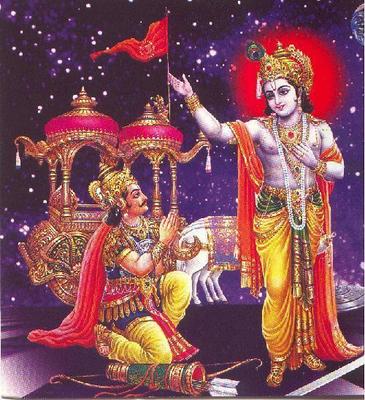
School of Yoga explains Srimad-bhagavad-gita, chapter 6, dhyana yoga (yoga of meditation).
What is dhyana yoga?
- Our dhyana yoga journey into Srimad-Bhagavad-Gita begin in chapter 1 with delusion and confusion. In chapter 2, the source, sustenance and motility of existence, Brahman is explained.
- Thereafter, in chapters 3, 4 and 5, Shri Krishna explains action (karma), knowledge of action and renunciation of action respectively.
- In this chapter, dhyana yoga, Shri Krishna closes a critical gap, a tool that cleans the student’s Self internally (atmashuddhye).
- Let us review components of any action?
- There are two types of action (karma) – we act without stimulus/ input or respond to incoming stimulus!
- When we act without stimulus, we are driven by an internal desire for an outcome. Our action is a manifestation of our sense of self-worth (asmita).
- Whether we respond or react to stimulus, in addition to manifestation of self-worth, we also seek to protect our sense of identity (purusha).
- Both, action and reaction are driven by fear (tamas) or desire (rajas) of loss of self-worth (asmita) and identity (purusha).
- Importantly, any activity (karma), by itself is inanimate. It gets texture by two factors – desire for outcome, which drives motivation to perform (sankalpa), expectation of result or fruits of action (karmaphala) which results in fear of outcome and duality (like-dislike, good-bad-right-wrong etc.) and the feeling of being the doer (ahankara).
- The action process…
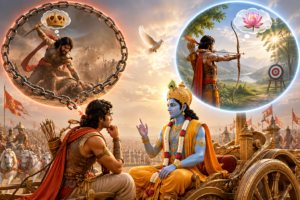
The quality of Karma depends on the engagement of the Self - There has to be someone who initiates action, owns it and performs it.
- This is the doer or (kartr).
- Next, the doer needs a reason (karana). Also, this is called causation, or reason for performing the action.
- The reason needs to transform into motivation or application of will (sankalpa) so that action (karma) may be initiated and completed.
- Finally, from effort comes result (karmaphala).
- Everything in action is about whether we control it or not. Ability to control action comes from free-will, but to what extent is free-will actually free? How can we increase the span of free will?
School of Yoga explains Srimad-bhagavad-gita, chapter 6, dhyana yoga (verse 1-3).
How can we act without stimulus? What are yajna and sankalpa?
- Firstly, all action (karma) arises from motivation (sankalpa).
- Next, once a cause is established, then effort (karma) has to be applied to achieve the result.
- Almost always, sanctioned actions also involve personal sacrifice or yajna. For example, a parent looking after his or her child has to sacrifice time, energy and resources. A student, to get good marks, must sacrifice time and effort to learn.
- However, it is important to remember that motivation or desire (iccha) will result in expectation of outcome (karmaphala). Parents begin to have expectations of a child, students who have studied hard expect good marks.
- As a result, self-worth (asmita) becomes attached to the outcome because once expectations get set, self-worth is dependent on success and good feedback. For instance, students get anxious before competitive exams and also before results are announced because of what it means to them.
- Importantly, quality of will (sankalpa) includes capability, resources and other factors which determine quality of action and outcome. For example, a person wanting to pass a competitive exam will need to have the ability or will for sustained effort, resources to buy or borrow study material and build an ability to write the exam etc.
- Additionally, self-worth (asmita) determines the quantum of agitation when action is performed. For example, when we are confident of what we are doing, there is minimal agitation. However, when we are afraid or unsure of our actions, or afraid of an adverse outcome, there is enormous stress, fear and agitation.
Thus, one can see that while free-will may motivate the beginning of any activity, as factors such as expectations (karmaphala), desire (kama), frustration with obstacles, personality issues and other factors kick-in, free-will becomes difficult to sustain and one often gets hijacked by the situation.
School of Yoga explains Srimad-bhagavad-gita, chapter 6, dhyana yoga.
How should we react to stimulus?
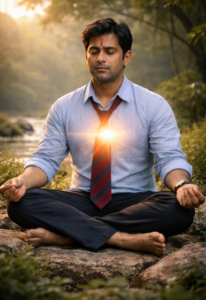
In dhyana yoga, reaction to stimulus has two parts; Primary response and secondary response.
- Primary response – When we receive stimulus, first, we assess the risk. This is done by the amygdala, a small organ which is part of the limbic system in the brain. Here, the amygdala, which is a storehouse of experiences uses prior conditioning (dharma) to trigger a fight or flight response. This reaction is mostly instinctive and has no free-will component in it because of the way the amygdala is designed and programmed. There is awareness (prajna) but the rational brain is mostly hijacked in any instinctive response.
- Secondary response – depending on the strength of the primary response, the cognitive and intellectual systems of our rational brain get activated. Here again, conditioning (dharma) determines the strength of free-will, but the elemental sense of self-worth (asmita) is able to assert itself and control the response.
Why is dharma actually conditioning from childhood?
Before examining our reaction to stimulus, let us review our system capability for response.
Like computers, we have hardware and software. The hardware is our DNA, health and age. These determine our ability to handle information, memory, speed of processing information and quality of our sensory apparatus. Culture, background, education and experience which form our operating system become the software.
The combination of hardware and software forms our conditioning or natural state, the envelope of existence in which we are most comfortable. This is dharma.
So, where does free-will come in? How can we control our actions and reactions? The fact is that like computers, our ability to act or react is mostly set by our dharma and the network we are connected to. This means that we are also impacted by the dharma of those we interact with and the environment we are in at the time.
So, dharma also includes dharma of the environment where decisions are made.
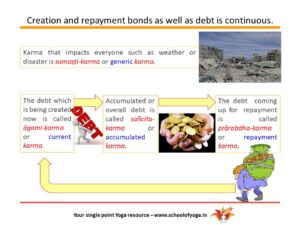
Dharma, to a large extent is governed by our prarabdha-karma (debt that has come up for repayment). Prarabdha-karma is that debt which has come up for repayment or it can also be one where we are the creditors, where others owe us. Either way, this reduces the scope for free-will.
Additionally, when we exert our will to control outcomes, we create karma, thus building debit and credit into our accounts which brings us back into the cycle of repayment.
For example, we are born to specific sets to parents. We go to specific schools in our environment even though there may be other options. We like and bond with specific class mates, some more that others. We like certain subjects and excel in specific sports. Our aptitude in computers, singing or painting come to us at birth. We take up certain professions, marry specific people and have children that are unique to us. This is on account of debt or prarabdha-karma.
The need to control outcomes and create karma can come from fear of impact on self-worth as well as conditioning (dharma), embedded desire arising from prārabdha-karma, also known as vāsanā, low self-worth (asmita), fear of failure, expectation loss, opinion of others, all of which can be clubbed under the feeling of being the doer (ahankara), and loss of awareness (prajna).
Karma and dharma impact all of us, that’s why it is universal (sanatana).
School of Yoga explains Srimad-bhagavad-gita, chapter 6, dhyana yoga (verse 4-10).
How does application of will (sankalpa) impact dhyana yoga?
- Topping everything is the realisation that we are our best friend or worst enemy. So, the only way to improve our abilities is by using our awareness (prajna) to improve our self-worth (asmita).
- While the awareness of individuality is will, the ability to exercise that will does not happen easily.
- Importantly, upon determining course of action, the degree of calmness and awareness that we retain (self-control) when acting determines the quality of activity and outcome.
- Additionally, if expectation or desire of outcome is removed, then will (sankalpa) reduces in value because the action is performed for itself and not personal gain. This means that the feeling of being the doer (ahankara) is removed.
- Also, when one removes expectation of outcome, fear is removed and self-worth (asmitā) remains unaffected/ undamaged.
- Importantly, when a person acts with reduced passion, this ensures that personalities are separated from the action. Consequently, everyone the self-worth of everyone in the transaction is likely to be protected from turbulence and the effort becomes peaceful and beneficial to everyone.
- Also, when ahankara (the feeling of being the doer) is removed from the action itself, there is more focus on perfection of effort and stability of outcome rather that personal gain in the effort.
- Consequently, one who aspires to sannyasa and to be a yogī should renounce all will (sankalpa) and perform action as duty, without seeking any fruits from his actions.
- However, the yogi must not sacrifice logic or method. This is because, without proper process or system adherence, outcome is bound to be sub-optimal. For example, when preparing for an exam, the right approach is to try and dissociate ourselves from the outcome. However, if the preparation is without proper effort or systematic and sustained study, then there can be no hope of success even if we were to try and dissociate ourselves from the outcome.
- Obviously, to increase the strength of will and reduce the impact of illusion (maya) is not easy and requires sustained effort. The good news is that once a person reaches this stage of perfection (siddhapurusha), then the person remains unaffected by any or all turbulence that he encounters and remains calm in any situation.
School of Yoga explains Srimad-bhagavad-gita, chapter 6, dhyana yoga (verse 11-17).
How can we increase strength of our will to improve dhyana yoga practice?

- Firstly, in order to rise in the practice of yoga, one should reduce material contact or reduce their impact on cognition (manas). The fact is, all stimuli come in through the senses. So, when the number of stimuli sources increase, our ability to pay sufficient attention to each point of stimulus reduces commensurately.
For example, if we are studying for an exam in front of the TV while the rest of the family are eating chocolate cake or chips, the ability to pay attention to studies will reduce dramatically.
- Secondly, to reduce attachment towards stimuli, view all entities as having a soul (atman) which is equal to our own (sama-drishti). When we do this, our ability to relate to the object without getting overwhelmed by its significance to us improves.
For example, when studying for an exam or preparing a project report, if we were to view the exam or project as a soul which is equal to our own, we stop giving it more weightage or less weightage that we ordinarily would have. While this does not reduce the importance of the exam, it brings equanimity to our transactions and allows balanced reactions.
- Thirdly, a key aspect of managing matters of the Soul (atman) is to recognise that we are “Our best friend or worst enemy”. Additionally, control of the Soul (atman) is about controlling what happens to the Soul when we are exposed to stimulus, good or bad. Consequently, when we decode the stimulus with full awareness (prajna), process the information without passion, personalities or assigned value (ahankara), focus on the outcome and remove fear, we begin to control the process as well as the outcome.
- As a result, the Soul begins to harmonise towards a natural state of peace. Of course, this requires practice, but when we do it consciously (control the citta or consciousness), then free-will and self-reliance increase and there is a deeper anchor in the state of peace.
- Lastly, how do we know that we are on the right track? When we are at peace or to use a colloquial term “feel cool or positive about everything”, then we know that we are in control.
School of Yoga explains Srimad-bhagavad-gita, chapter 6, dhyana yoga (verse 11-17).
How should one practice dhyana yoga (meditation)?
- Firstly, the practitioner should rely only on himself for all improvements, for each person is his own best friend or worst enemy.
- Secondly, the yogi should be steady and without agitation within. This happens when one views all creation equally, without assigning differential personal value (I want this, I hate this, I don’t like that person). Also, this includes animate and inanimate objects, friends and foes, relatives and saints.
- Additionally, this means that one should be calm and peaceful when experiencing opposites such as cold / heat, pleasure / pain or honour / dishonour.
- Undoubtedly, the most important requirement for a serious practitioner is finding a country or region (desha) which is well administered. This ensures that there are no disturbances and turbulences in the surroundings, there is law and order and as a result practice of meditation is undisturbed.
- An important self-control requirement is celebacy (brahmacaryam).
What is celebacy in yoga? Celebacy in yoga can be termed as control over seminal fluid discharge. Why? Seminal fluids have an ingredient called ojas which acts like a sheath over the nadi (channels through which prana flows). Depletion of ojas leads to musculo-skeletal weakness and stressed nerves which impedes concentration in meditation.
Also, practice of celebacy (brahmacaryam) is an exercise in self-control. Ideally, complete stoppage of sexual activity is advised, but if that it not possible, then it must be kept under control.
- Next, the yogi should sit in a clean place which is neither high nor low, over a bed of cloth and kusha. So, why is the seat important? Why should it be neither too high nor too low?
- When we sit too high or low, we never get the right perspective of our environment which results in a perceptual feeling of discomfort.
- When we sit in a place where we are unable to view our surroundings, we become insecure and uncomfortable,
- Then, the practitioner should control the sensory organs (indriyas) and cognitive apparatus (manas) by turning the consciousness (citta) After this, the yogi should try and hold his (manas) steady to a single point (ekagra) to purify the awareness of the Self (prajna).
- Lastly, the yogi should hold his body, head and neck in a balanced (sama) position and gazing at the tip of the nose (nasikagra).
- Additionally, he should avoid getting distracted by avoiding outside contact during the practice.
The transliteration and translation of Srimad-bhagavad-gita, chapter 6, dhyana yoga follows.
The Saṃskṛtaṃ words are in red italics.
(1-3) Śrī Kṛṣṇa said: Anyone that performs sanctioned action (karma) and is disengaged from the fruits of action (anāśritaḥ karmaphalaṃ kāryaṃ karma karoti yaḥ ।), he is a sannyāsin (ascetic) and yogī, not he that neither acts, not performs without a sacrificial fire (sa sannyāsī ca yogī ca na niragnirna cākriyaḥ ॥ 6-1॥). However, verily know that renunciation that they call yoga cannot be achieved by anyone without renunciation of saṅkalpa (yaṃ sannyāsamiti prāhuryogaṃ taṃ viddhi pāṇḍava । na hyasaṃnyastasaṅkalpo yogī bhavati kaścana ॥ 6-2॥). It is said that saints desirous of advancing must harmonise action with motivation (ārurukṣormuneryogaṃ karma kāraṇamucyate ।). In fact, it is said that even those who have achieved complete harmony are those who have brought calmness to their reason for action (yogārūḍhasya tasyaiva śamaḥ kāraṇamucyate ॥ 6-3॥).
(4-6) Also, it is said that when one has risen in yoga, then there is no clinging to sense-objects or actions and there is detachment from all drive of the will (yadā hi nendriyārtheṣu na karmasvanuṣajjate । sarvasaṅkalpasaṃnyāsī yogārūḍhastadocyate ॥ 6-4॥). So, elevate the Soul by the Soul itself do not allow the Soul to drop in performance (uddharedātmanātmānaṃ nātmānamavasādayet ।), for the Soul, in truth its only associate and the only adversary of the Soul is itself (ātmaiva hyātmano bandhurātmaiva ripurātmanaḥ ॥ 6-5॥). The Soul becomes a relative when Soul is conquered by the Soul (bandhurātmātmanastasya yenātmaivātmanā jitaḥ ।), however, the Soul of the unconquered Soul will be like an enemy until it is conquered by the Soul (anātmanastu śatrutve vartetātmaiva śatruvat ॥ 6-6॥).
(7-8) The self-controlled, tranquil, Supreme Soul is equipoised in cold/ heat, happiness or sadness as well as honour and dishonour (jitātmanaḥ praśāntasya paramātmā samāhitaḥ । śītoṣṇasukhaduḥkheṣu tathā mānāpamānayoḥ ॥ 6-7॥). It is said that the soul which is secure in the knowledge of the Self and surrounding, has attained unshakable victory over the senses, and harmonised itself, that yogī views everything as gold (jñānavijñānatṛptātmā kūṭastho vijitendriyaḥ । yukta ityucyate yogī samaloṣṭāśmakāñcanaḥ ॥ 6-8॥).
(9-10) One who is always in a state of undisturbed intellect with friends, allies, enemies, those that are sad, lawyers, the odious, relatives, mendicants or sinners always excels (suhṛnmitrāryudāsīnamadhyasthadveṣyabandhuṣu । sādhuṣvapi ca pāpeṣu samabuddhirviśiṣyate ॥ 6-9॥). Let the yogī, in solitude, maintain constant and steady Soul (yogī yuñjīta satatamātmānaṃ rahasi sthitaḥ ।) alone, with a Soul whose consciousness has no hope and free from greed (ekākī yatacittātmā nirāśīraparigrahaḥ ॥ 6-10॥).
(11-13) In a pure country, establish a firm seat that is neither very high nor very low, for the Self, of cloth, antelope skin, kusha grass, one over the other (śucau deśe pratiṣṭhāpya sthiramāsanamātmanaḥ । nātyucchritaṃ nātinīcaṃ cailājinakuśottaram ॥ 6-11॥). There, with a single pointed cognition, bring consciousness and senses under control, being seated in āsana, let him practitice yoga cognition for purification of the Soul (tatraikāgraṃ manaḥ kṛtvā yatacittendriyakriyaḥ । upaviśyāsane yuñjyādyogamātmaviśuddhaye ॥ 6-12॥). Then, holding body, head and neck exactly still, gaze at the tip of own nose and don’t look around (samaṃ kāyaśirogrīvaṃ dhārayannacalaṃ sthiraḥ । samprekṣya nāsikāgraṃ svaṃ diśaścānavalokayan ॥ 6-13॥).
(14-15) The fearless serene Soul that has taken the vows of celibacy, has stable cognition, with a consciousness that is united with me, as the final goal (praśāntātmā vigatabhīrbrahmacārivrate sthitaḥ । manaḥ saṃyamya maccitto yukta āsīta matparaḥ ॥ 6-14॥). Thus, the ever-balanced peaceful Soul of the yogī, with controlled cognition attains primordial absolute liberation at my abode (yuñjannevaṃ sadātmānaṃ yogī niyatamānasaḥ । śāntiṃ nirvāṇaparamāṃ matsaṃsthāmadhigacchati ॥ 6-15॥),
(16-17) The yogī is one that does not overeat, not, not eat at all he should not dream too much, nor should he be excessively engaged in activity (nātyaśnatastu yogo’sti na caikāntamanaśnataḥ । na cātisvapnaśīlasya jāgrato naiva cārjuna ॥ 6-16॥). He must keep sensible diet and entertainment, keep his consciousness in action, keep sensible balance between sleep and wakefulness, the yogī overcomes pain (yuktāhāravihārasya yuktaceṣṭasya karmasu । yuktasvapnāvabodhasya yogo bhavati duḥkhahā ॥ 6-17॥).

The complete text is available in my book, A Seeker’s Śrīmad-Bhagavadgītā. Buy your copy today – Notion Press home / Flipkart / Amazon / Amazon India / Amazon UK / Amazon US / Amazon Australia
Acknowledgement –
School of Yoga is profoundly grateful to Saṃskṛta scholars and academics Pijus Kanti Pal (pal.pijuskanti@gmail.com) and Dolon Chanpa Mondal for their support in Saṃskṛta transliteration and quality control.
Excellent explanation.
tHANKS FOR THE ENCOURAGEMENT. wE HAVE UPDATED THIS PAGE, PLEASE TAKE A LOOK