
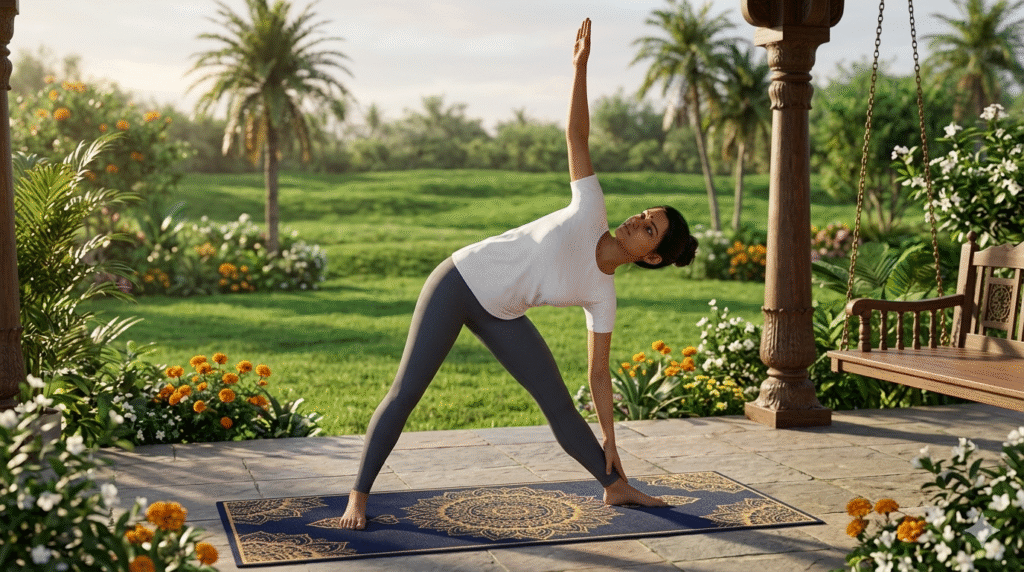
What is trikoṇāsana or triangle pose?
The trikoṇāsana (trikoṇ = triangle) is a basic stretching exercise. The body frame forms a triangular shape when performing this āsana.
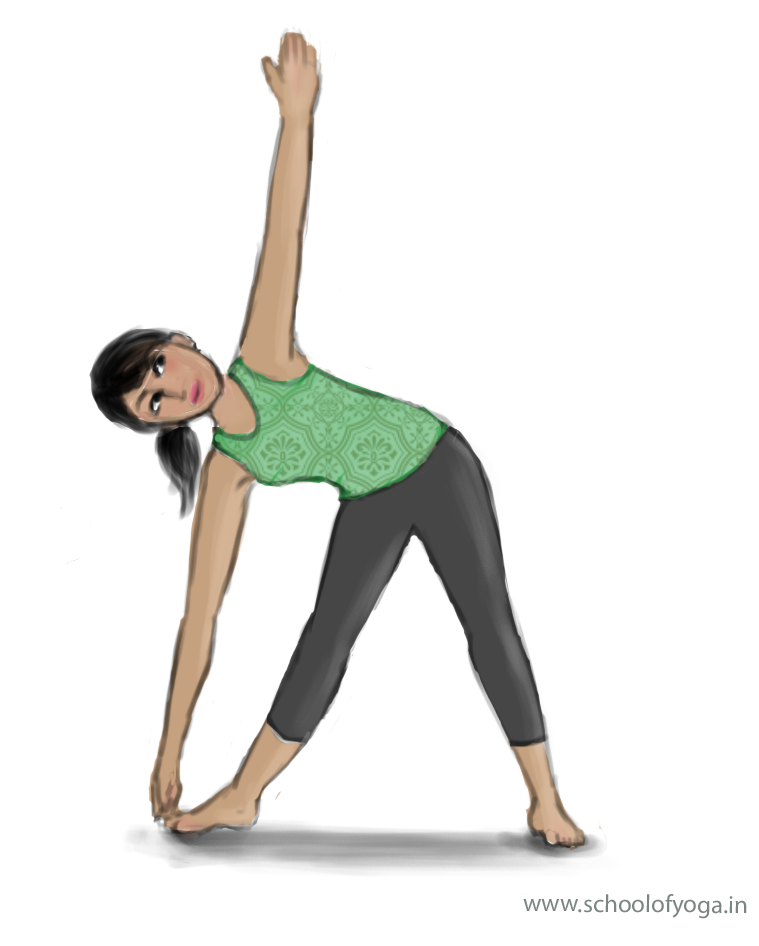
What is the technique to practice trikoṇāsana ?
- Sthithi (starting) position: Firstly, stand erect with both your legs spread to match the width of your shoulders.
- Keep both hands to the sides. Balance the body to achieve equilibrium.
- Beathe in and raise your hands to the level of your shoulders.
- Next, breathe out, and bend to one side so that your fingers touch the big toe of your foot. Try to bend only at the waist, while keeping your shoulders, knees, and elbows straight, so that the bending stretch is maximized.
- While bending, keep your face straight, but move your eyes sideways to gaze at the fingertips of the hand which is stretched upward. This recommended dṛṣṭi (gaze) is the angushtamadhye (middle of the thumb) gaze.
- Lastly, breathe in, and come back to the upright position.
- Bring your hands back to your sides.
- Follow the same steps to bend to the other side.
- Repeat twice or thrice.
What is the variation of trikoṇāsana ?
Parivrtta trikoṇāsana (crossed triangle pose)
- Instead of touching your hands to the foot on the same side (right hand touching right big toe and left hand touching left big toe), cross over and touch the big toe of the opposite foot (right hand touching left big toe and left hand touching right big toe).
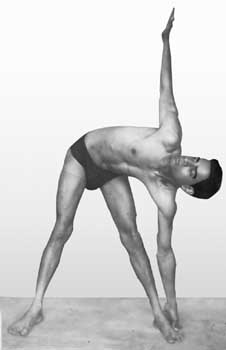
What are the benefits of practicing trikoṇāsana ?
- The action of bending results in the torso’s side muscles being alternately compressed and stretched. This strengthens the muscles and also removes fat from the sides.
- The bending action also increases the flexibility of the spine. Also, all the muscles of the spine get toned.
- The movement of the eyes increases peripheral vision and also strengthens the eye muscles.
What are the contraindications of trikoṇāsana ?
- People with back problems and circulatory disorders should not attempt this āsana without first consulting a physician.
- Those with lower back problems must perform this āsana only under the supervision of a physician.
- Do not perform this āsana during menstruation or pregnancy.
Some noteworthy points on trikoṇāsana :
Internal Links: Dharma (conditioning), Stress and Situational Awareness, Prana, Asana overview 1, Asana Overview 2, Asana Focus or gazing, Pranayama
External Links: Prana, Chakra, Pancha Tattva, Pancha Prana, Pancha Kosha, Nadi
- Firstly, the spacing of the legs is important. If the spacing of the legs is too narrow, the strain on the side abdominal muscles (oblique muscles) can lead to cramps. If the spacing is too wide, the strain on the inside of the thighs can be very high.
- This is a stretching exercise that opens up the groin, back, and the shoulders. It is a preparatory āsana.
- People with cardiac ailments should perform this exercise slowly because of the aerobic nature of the āsana.