
What is uḍḍīyana-bandha (abdominal hold)?
Uḍḍīyana is a bandha (hold) and not an āsana. Importantly, āsana is a pose that yields specific benefits by directing the flow of prāṇa to a particular part of the body, thereby energising it. However, bandha is a hold, obstructing the flow of prāṇa. As a result, the kundalini begins to move. In fact, though there are physiological benefits from these bandhas, most of the benefits are for ensuring higher yoga goals.
What does Hatha Yoga Pradeepika say on uḍḍīyana-bandha?
Ch2 v 55 uḍḍīyana-bandha: Yogis call it uḍḍīyana-bandha because when practiced, prāṇa flies through it to the suṣumṇā.
Ch2 v 56 Because the great bird (prāṇa) flies up continuously, it is called uḍḍīyana (ud = fly + di = up). The bandha is now explained.
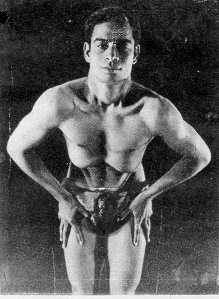
Ch2 v 57 The abdomen is drawn westwards so the navel moves up. Uḍḍīyana is like a lion for the elephant of death.
Ch2 v 58 One that practices uḍḍīyana after attaining familiarity as learned from a guru, even if old will become young.
Ch2 v 59 Draw back the abdomen above and below the navel with effort. After practice of 6 months, when one has mastered it, death is conquered.
Ch2 v 60 Of the bandhas, uḍḍīyana is most excellent. When it is perfected, mokṣa follows naturally.
How to practice the abdominal hold (learn the technique under supervision only)
- Starting (sthithi) position: Stand erect with legs slightly apart and hands to the side.
- Bend forward and place your hands on your thighs, some 6 inches below the hip joint.
- Vigorously breathe out and empty the lungs of air. This means breathe out till the diaphragm rises to its top most position in the thoracic cavity.
- When you feel your lungs are completely empty, suck the stomach inward vigorously towards the spine as far as possible.
- Hold for as long as is convenient.
- Breathe in slowly and release your stomach back to normal.
- Stand erect and bring both hands to the sides.
- Repeat once or twice.
- The recommended dṛṣṭi (gaze) is nābhigre (middle of the navel) for beginners and nāsikāgra (tip of the nose gaze) for spiritual levels of practice.
What are the benefits of uḍḍīyana-bandha practice?
- When the stomach is sucked inwards, the ascending, descending and transverse colon and intestines are pulled back and upwards towards the spine. This pulls the rectus and oblique abdominal muscles inwards.
- Also, it pushes the small intestines and other organs such as the spleen, pancreas, and stomach towards the spine. This energizes the complete abdominal viscera and tissues, holding them together in the abdominal cavity.
- Consequently, the peristalsis pushes the faecal matter in the large intestine towards the colon. As a result, this exercise addresses diseases related to acidity, piles, and constipation.
- It rejuvenates the rectus and oblique muscles of the abdomen and the inguinal ligament.
- Since the action of completely emptying the lungs and the push of the diaphragm inwards increases the stroke of the diaphragm, practice of uḍḍīyana helps increasing lung capacity and efficiency.
- Uḍḍīyana also energises and stimulates the cartilages of the spine, the sympathetic and parasympathetic nervous system.
- This exercise rejuvenates all major organs such as the pancreas, liver, kidneys etc.
- The primary benefit of this banda is to raise the kundalini, but this is for advanced practitioners and should be done under the supervision of a master (Guru).
What are the possible contraindications of uḍḍīyana-bandha practice?
- If you have any form of backache, do not attempt this bandha without adequate supervision and support.
- People with hernia, cardiac problems, lower back problems, and circulatory disorders should not attempt
this bandha without first consulting a physician. - Women should not practice this bandha during menstruation or pregnancy.
- Children, preteens and adolescents below 16 should avoid this bandha as it impacts development of the genitals.
Some noteworthy points on the abdominal hold:

Internal Links: Dharma (conditioning), Stress and Situational Awareness, Prāṇa, Asana overview, Asana practice, Asana Focus or gazing, Prāṇayama, Hatha Yoga Pradeepika
External Links: Prāṇa, Chakra, Pancha Tattva, Pancha Prāṇa, Pancha Kosha, Nadi,
- There are some variations to perform this bandha. The first method is where the practitioner performs the suction when bending forward in the standing position. Another method is to sit in padmāsana and perform uḍḍīyana. The last method is to combine uḍḍīyana-bandha with mūla-bandha and jālandhara-bandha.
- People with hernia, renal disease should avoid this exercise. Those with stomach ailments should increase pressure slowly.
- According to the Yoga Mīmāṃsā journal, pre-puberty practitioners should not perform this exercise.