
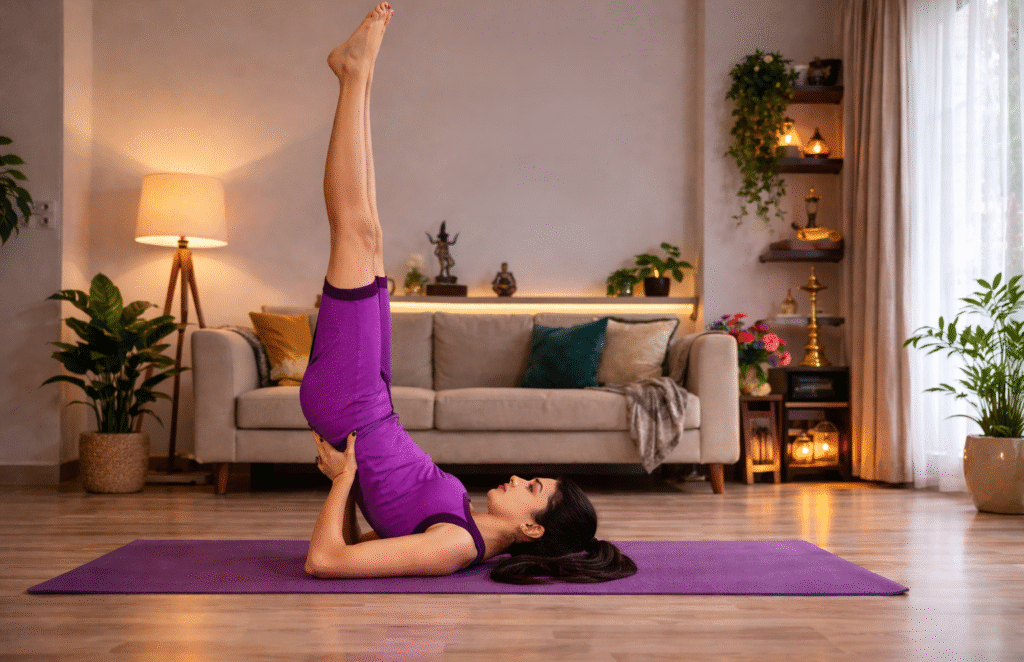
What is viparīta-karaṇī (inverted action pose)?
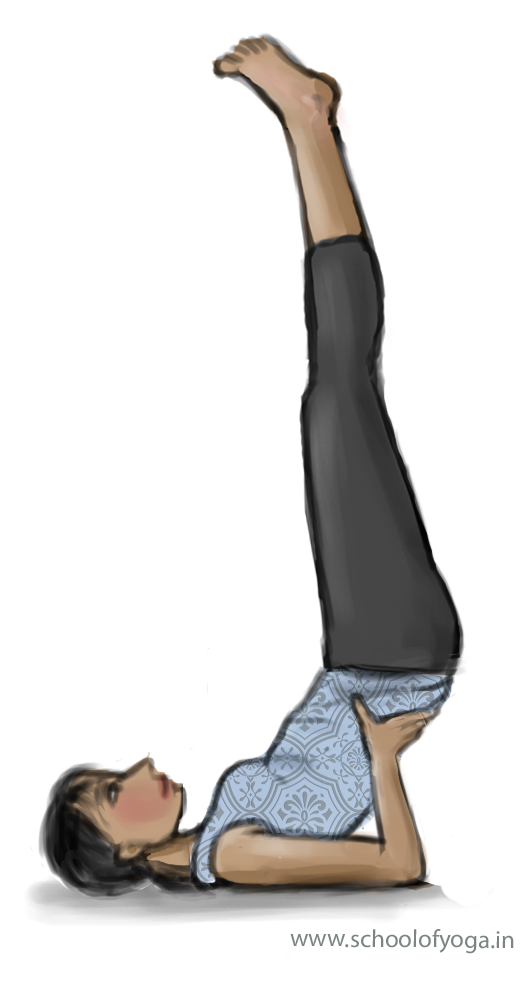
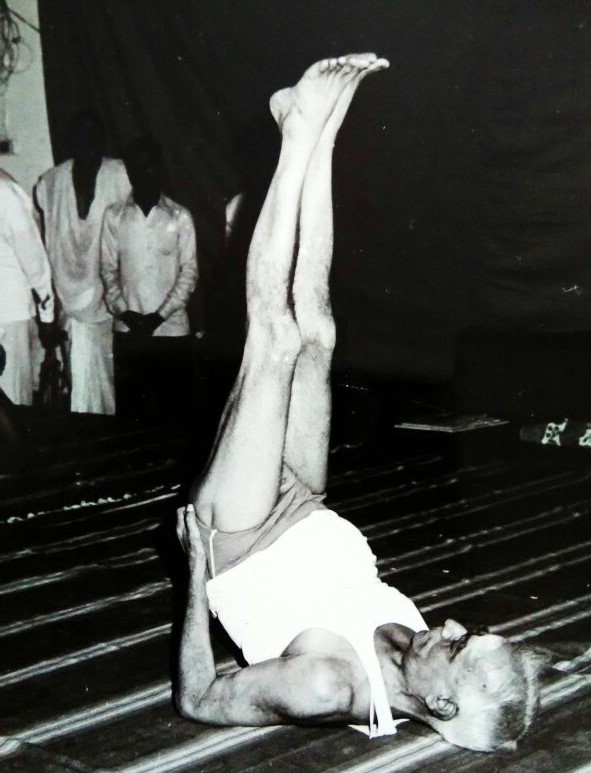
Viparīta-karaṇī is an āsana where the practitioner holds the legs and hips perpendicular to the torso, and balances the torso between 45 and 60 degrees off the ground.
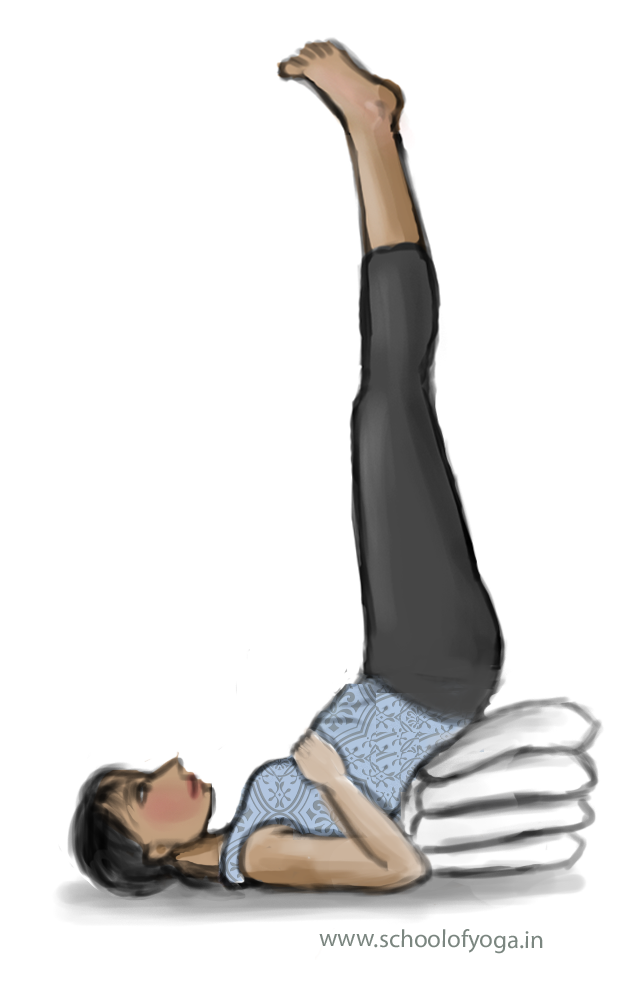
Since it is difficult to hold the hips in this position for extended periods, Yogacharya Sundaram devised a method to enable the practitioner to hold the pose for longer durations with less stress. This is called sundara-viparīta-karaṇī.
How should one practice sundara-viparīta-karaṇī? (Learn under supervision only)
- First, place 3-5 hard pillows on the mat in such a way that the pillows are at an incline of 60 degrees with respect to the floor.
- Then, sit at the far end of the pillows and slowly lower the torso over the incline on the opposite side so that the shoulders rest on the floor.
- Importantly, ensure that the torso is at 45 degrees to the floor.
- Now, fold the legs over the pillows towards the body and raise them straight into the air.
- Next, bring the legs towards the face, so that the legs and torso are about 90 degrees with each other.
- After this, place your hands at the sides of the pillows or across the chest.
- Finally, hold this position for 5 minutes, increasing up to 20 minutes. One can also split the practice into 2 periods of 3 to 10 minutes duration.
- Lastly, come back to the sthithi position in reverse order.
- The dṛṣṭi (gaze) recommended is pādayorāgre (toe of the foot gaze).
What are the sundara-viparīta-karaṇī variations?
Should hard pillows not be available, it is possible to perform sundara-viparīta-karaṇī by supporting the hip with the hands.
- Sthithi (starting) position: First, lie down on a blanket and keep your hands at the sides.
- Next, bend the knees over the torso to touch the forehead with the knees.
- Furthermore, supporting the hips with the hands just above the hip bones, lift the hips off the floor, such that the torso is at a 45-degree angle to the floor.
- Lastly, lift the legs straight up and align them such that they are at 90 degrees to the torso.
What are the benefits of practicing sundara-viparīta-karaṇī ?
- Firstly, this mudra ensures concentration of blood supply to the heart, lungs, liver, pancreas, kidneys, stomach and respiratory tract.
- Also, sundara-viparīta-karaṇī is good for all illnesses related to the torso and neck, including respiratory disorders, heart and digestive disorders.
- Additionally, this mudra builds resistance to all forms of allergies, colds and flu.
- The inverted action pose is excellent for treating digestive ailments, especially those related to the stomach, liver and bowels.
- Lastly, sundara-viparīta-karaṇī helps in stabilizing the female reproductive organs and alleviates menstrual discomfort and cramps.
What are the possible sundara-viparīta-karaṇī contraindications?
- First, if you have any form of backache, do not attempt this mudra without adequate supervision and support.
- Importantly, people with cardiac problems, lower back problems and circulatory disorders should not attempt this mudra without first consulting a physician.
- Also, people having arthritis or neck ailments such as cervical or lumbar spondylosis should not do the viparīta-karaṇī .
- Finally, people with hernia, etc., should avoid this mudra.
- Lastly, women should not practice this mudra during menstruation or pregnancy.
Hatha Yoga Pradeepika on viparīta-karaṇī :
Ch 3- v7 viparīta-karaṇī, vajroli and sakticalana; these are the 10 mudras which destroy old age and death.
Ch 3 – v77 viparīta-karaṇī: That nectar of the moon, which has divine qualities, gets digested by the Sun and induces ageing.
v 78 There is a divine technique by which the Sun’s face can be cheated. This should be learned under a Guru and not through theoretical study or discussions.
v 79 When the navel is above and the palate below, the Sun above and the moon below, then this is viparīta-karaṇī. This should be learned through the instructions of a Guru.
v 80 In the case of one who practices this daily, the gastric fires (jaṭharāgni) are increased, so one should eat sufficient food.
v 81 If one eats non-nutritious food, then the heat will quickly consume the practitioner. On the first day, stand on the head with feet up, for only a brief moment.
v 82 Increase the duration gradually every day. After 6 months, the wrinkles and grey hair disappear. He who practices it for a yāmā (3 hours) daily conquers death.
Some noteworthy points on sundara-viparīta-karaṇī :
Internal Links: Dharma (conditioning), Stress and Situational Awareness, Prana, Asana sequence, Asana schedule, Asana Focus or gazing, Pranayama, Hatha Yoga Pradeepika
External Links: Prana, Chakra, Pancha Tattva, Pancha Prana, Pancha Kosha, Nadi,
- Viparīta-karaṇī = viparīta = inverted + karaṇī = action in Sanskrit. The torso should be at a right angle to the legs, and the toes should form a hypotenuse with the head.
- This is one of the easiest and most effective āsanas for overall maintenance of health.
- Initially, practitioners will find difficulty in maintaining the position, but over time, this will stabilise.
- Also, it may be difficult to maintain the position for an extended period of time. So, one should initially split this effort into 3-5 minutes twice, with a rest interval of 2 minutes. Over time, one will be able to do this āsana in a single effort, with time taken up to 15 minutes.