

Introduction to Hindu Temples.
Hindu Temples have always driven the collective consciousness of the Sanathani people of Bharathavarsha! So, it is important to understand the true nature and science of temples, as well as their social impact and spiritual influence on the lives of millions of Hindus over the ages.
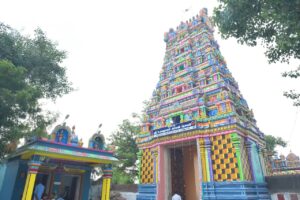
What is a temple?
A Hindu temple, devalayam, mandira or devasthana is a house, seat and body of divinity for Hindus. Importantly, it is designed to integrate humans and deities, through structures that to express the principles of Sanathana Dharma. Additionally, temple symbolisms and structures are rooted in Vedic as well as tantric traditions, often deployed in circles and squares. Moreover, temples incorporate all elements of the Hindu cosmos, lifestyle principles called called dharma, well as elements of Hindu concept of cyclic time and lifecycle.
Spiritual basis of Hindu Temples
The spiritual principles of Hindu temples are given in the Vedas and Upanishads, while their structural rules are prescribed in various ancient Sanskrit treatises on architecture. Some of these are Bruhat Samhita and Vastu Sastra. Additionally, the layout, motifs, building process, rituals, and geometric symbolisms reflect the philosophical values of various schools of Hinduism. Importantly, Bharat’s temples are not only spiritual destinations, but also civilisational anchors of arts, culture, as well as community celebrations. Furthermore, they have always acted as centers of economic activity.
Location of Temples
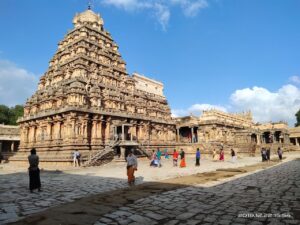
Hindu temples come in many styles, are situated in diverse locations, deploy various construction methods, represent a multitude of deities as well as local practices or sampradaya. However, all share the same core architectural principles, elements, symbolism and themes. They are designed to bring out the essence of dharma being a sort of unity in diversity. In fact, today’s temples reflect design and conceptual philosophies, arts, materials and designs that have evolved over two millennia.
Significance and meaning of the Hindu temple
The temple is the anchor of Bharat’s civilisation. It reflects a synthesis of arts, values of dharma, which is the way of life propounded by the Vedas. In fact, it is a link between man, deities, and the Universal Purusa in a sacred space. Also, temple are centers of Tirtha or pilgrimage, where location, ambience and design synergise to symbolically represent Hindu Dharma.
The underlying principle in a Hindu temple is built around the belief that all entities are one, everything is connected. The pilgrim is welcomed through 64-grid or 81-grid mathematically structured spaces, a network of art, pillars with carvings and statues that display and celebrate the four important and necessary principles of human existence or purushartha – the pursuit of artha, kama, dharma and moksha. At the centre of the temple, is hollow space with no decoration, representing Brahman, the Supreme Source, the One without form, which is present everywhere, connects everything, and is the essence of all creation. Typically, the deity sits in the center of this space or garbhagraha and represents the worshippers existence in the Universe.
The temple is meant to encourage reflection, facilitate internal purification, and trigger the process of inner realization within the devotee. The specific process is left to the devotee’s school of philosophy and practice. The primary deity of different Hindu temples varies to reflect this spiritual spectrum.
Conclusion:
Hindu temples are not just sacred spaces. In fact, their meaning and purpose extend beyond spiritual life to social rituals and daily life, having deep social and cultural significance. Also, temples often serve as location of community integration. Here, people celebrate festivals, practice arts through dance and music, even get married or commemorate marriages, birth of children and other significant life events.
This makes Temples, the anchor of Bharat’s ancient and hoary civilisation.