Bhagavad Gita dharma explains Sanatana Dharma
What is Sanatana Dharma?
No single text discusses or explains the many philosophies which fall under the umbrella of sanātana-dharma. The sanātana-dharma philosophy encompasses multiple schools of thought or shākhās, which are subdivided into sub-schools or pravara. Further, these get divided depending on interpretation, region, culture, practice, and, most importantly, guru.
This availability of multiple—and often conflicting—number of options in schools of thought can confuse a practitioner, resulting in some abandoning their search for the truth or looking for simpler solutions. However, these simpler systems generally have rigid rules for easy understanding and application, which constrict experimentation or personalization. Consequently, while the person becomes part of a system, full integration is not achieved. As a result of this compromise and loss of the perfect fit, the absolute Truth escapes the yogī.
What are the advantages of Sanatana Dharma’s open philosophical format?
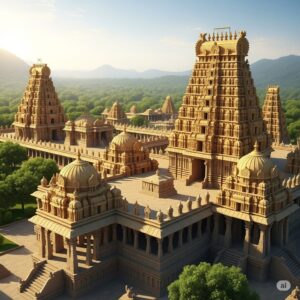
Dharma allows for three major adjustments:
- First, it allows one to change philosophical direction multiple
- Next, it allows one to rearrange the philosophical construct to suit one’s personality and aspirations. This means that it allows one to borrow from various philosophical streams without
- Eventually, this open format structure allows practitioners to adapt their spiritual path to changes brought about by age
The importance of Srimad-bhagavad-gita dharma
Śrīmad-bhagavad-gītā dharma should be viewed in the light of its importance to the overall philosophy of yoga (yogashastra):
- The ancient philosophical basis of yoga is that all existence is impermanent and a farce or illusion (maya).
- Illusion (maya) rises from Brahman, which is a cognitive state of infinite and imperishable equilibrium, peace, and null, or a state where there is no change.
- In fact, only the Brahman is permanent and absolute, everything else is impermanent or relative. Additionally, since it is permanent and absolute, Brahman is known as the state of absolute Truth (paramartha-sathya).
- Obviously, there can be only one absolute Truth; everything else is derived from it and known as illusion (maya) or derived Truth (samvritti-sathya).
- Everything in this illusionary state of relativity and impermanence (maya) has a natural state (svadharma). When anything is in its natural state (dharma), it is at a material, stable, harmonic, or thermodynamic equilibrium.
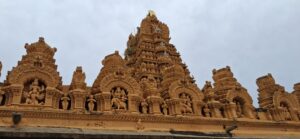
Bhagavad Gita dharma – The temples - Dharma applies to all entities, starting from an atom to all of existence.
- All forms of existence come as combinations of the primordial elements or panchabhutas (five primordial elements), comprising the earth (prithvi), water (ap), fire (agni), air (vayu), and space (akasha).
- Also, dharma includes all sentient or insentient entities, systems, processes, businesses, travel, and even Since this natural state of peace encompasses everything, it is called sanatana-dharma or universal natural state.
- In fact, everything in derived Truth/illusion (maya) is governed by sanatana-dharma.
- Importantly, by the very nature of maya, material equilibrium or dharma is continuously subjected to both sentient and insentient As a result, the equilibrium of dharma is constantly disturbed by change. This causes turbulence, confusion, or chaos, which is called adharma.
- Change creates an imbalance in everything impacted by it. Since any system that goes out of balance never returns to its original state of order or equilibrium (dharma), it can be deduced that dharma changes continuously; at the same time, there is a continuous increase in chaos or thermodynamic entropy, which is the measure of randomness in any system (adharma).
- The ancient seers (rishis) of Bhārat realized that while realization of Brahman was the main objective of existence, human and societal existence had to be structured so that chaos in daily living was minimized and individuals lived harmoniously in well-defined life-structures while gravitating naturally towards the Truth.
- Hence, they integrated this sanātana-dharma philosophy into the lifestyle of the individual and society so that each life-activity assisted the person in transcending māyā naturally and reaching perfection (Brahman). This is the ancient civilization (rashtra) of Bharat.
- This system is today called Hinduism.
- Interestingly, Hinduism cannot be called a religion in the traditional sense because it has no dogma. It is a life-cycle system that is influenced by philosophical schools (Shakha) as well as sub- schools (pravara), each of which follow broad-based practices, but these, too, have a very open structure and a lot of overlap with other philosophical schools in their construct and practices.
Bhagavad Gita dharma – Introduction to sanatana-dharma
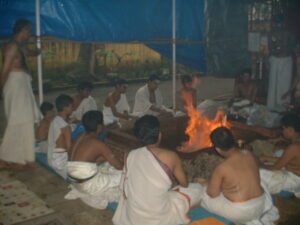
- The philosophical basis of Hinduism are the Vedas, which are considered to be apaurusheya, which can be translated as “not of a person”, meaning that they were composed by rishis or seers when in a state of complete merger with the Brahman.
- There are four Vedas (rig, yajur, sāma, atharva):
- The Vedas are followed by Vedanga (limb of the Vedas) which are six auxiliary disciplines that help in maintaining the purity of the Vedas. These are as follows:
- shiksha (phonetics or enunciation of Sanskrit)
- chandas (metering or how the verses should be chanted)
- vyakaranna (grammar or linguistic analysis)
- nirukta (explanation of certain words which are not generally used in everyday living)
- kalpa (passage of life or life event rites)
- jyotisha (astrology)
- The Vedas are followed by Vedanga (limb of the Vedas) which are six auxiliary disciplines that help in maintaining the purity of the Vedas. These are as follows:
- Vedanga are followed by Vedanta or upanishad, which elaborate upon the qualities of Brahman as well as the process of renunciation by simplifying the philosophy without diluting it, through explanations, comparison, storytelling (example – Kathopanidhad), and other
- Purana are the next level of simplification for easy understanding of the Brahman; these cover the stories of people who can be called role models— those who have transcended physical existence to realize the Truth.
- While the above texts cover the philosophical and intellectual aspects of Brahman, they are highly conceptual and difficult to implement in a secular Therefore, the rishis devised a life-cycle system for implementation of the above philosophy in society, and this evolved to become:
- Dharma-shastra, which covered every aspect of physical living. The intent was to condition the behavior of society and people, with constant focus on transcending māyā and living in peace, so that transcending physical existence to realize the Brahman became integrated into life and living.
- However, while the dharma-shastras applied to everyone, people had different socio-environmental requirements. So, these shastras were modified for local and regional adaptation, and these local nuances became known as sampradaya. For example, rice and fish are a staple of Bengal, and all religious and cultural events have both rice and However, sampradaya in Punjab is wheat-based, while in the South and East of India, celebrations are predominantly rice-based, and this exemplifies the elasticity of dharma.
Bhagavad Gita dharma – Sanatana-dharma philosophical system has some noteworthy features:
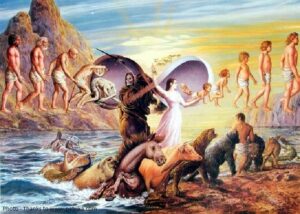
- First, it is personal because it allows molding of the philosophy to the person’s background, capability, and outlook. There is no wrong path; there is only the effort, learning, and transition. All that is required is sincerity, patience, and dedication of purpose and effort (shraddha).
- Second, since Brahman is an infinite, unchanging peace, by its very nature, it requires orientation towards internalizing peace, balance, and harmony among all entities, people, and Consequently, this makes Hinduism the most natural, organic, and scientific philosophy ever designed by mankind. By its nature, it adapts to external influence and is never in conflict with any thought or civilizational pressure. Finally, this philosophy is unique because it does not seek to establish political or social ascendency over anyone because its core principle is that all creation is equal.
- Thirdly, Hinduism is designed around the code that every creation, whether it is sentient (jiva) or insentient (jadam) has a soul that has the potential to transcend maya and eventually merge with the Brahman. This covers everything from a lowly atom to the solar system. Hence, it does not restrict transcendental development to man alone. In fact, since man is intellectually superior and the apex predator, it places an onerous leadership responsibility on man to ensure health and harmony of the complete ecosystem. These responsibilities are enshrined in the pancha-maha-yajna (five great sacrifices) and have been covered in subsequent chapters.
- Lastly, Hinduism is secular by design because it recognizes that there are many distinct paths to realize Brahman, and these paths need to be personalized to the natural capabilities of the seeker.
This is why Hinduism is not a religion but a “life-cycle system” or “way of life”.
The complete text is available in my book, A Seeker’s Śrīmad-Bhagavadgītā. Buy your copy today – Notion Press home / Flipkart / Amazon / Amazon India / Amazon UK / Amazon US / Amazon Australia