Hatha Yoga Pradeepika on nauli kriya (rectus isolation):
Before exploring the nauli kriya technique, let us understand what Hatha Yoga Pradeepika mentions about nauli kriya.
Ch 2 v 33: Sitting on the toes with heels above the ground, the belly should be vigorously moved from left to right, and right to left, as in vomiting. This is called nauli.
Ch 2 v 34: Nauli removes dyspepsia, increases digestion capability, produces happiness, and destroys all diseases and disorders of the dosha (humors).
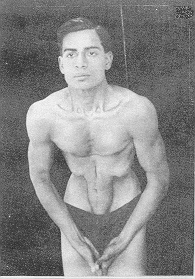
What is nauli kriya technique? (Learn under supervision only)
- Firstly, perform the uddiyana.
- Secondly, contract the rectus muscles in the abdomen and project the abdominal muscles forward in a thrusting movement. Use your hands to push the hip back, and generate a forward movement of the abdominal rectus with the back.
- As a result, the center of the abdomen will come out, and this is nauli kriya.
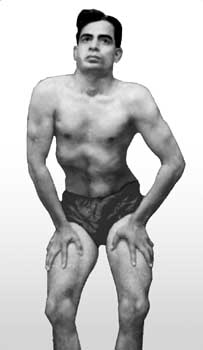
- Additionally, to isolate the right or left rectus, bend the knee of the isolating side a little more than the other knee. Follow this by pressing your hand on this bent knee, push the abdominus to the opposite side.
- Similarly, practice on the opposite side by bending the knee, pushing with the hand, and isolating the rectus on the opposite side.
- The rectus muscle on either side of the abdominus muscle can be completely isolated only when the opposite side is completely compressed.
- Now hold for 3 – 5 counts.
- Also, performing once is enough.
- The recommended drishti (gaze) is nabhigre (middle of the navel).
What are the variations or types of nauli kriya:
There are four variations of the rectus isolation technique as explained below:
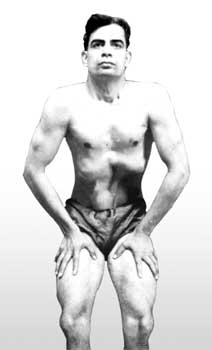
- madhyama-nauli (isolation of rectus abdominis) – this is the standard nauli.
- dakshina-nauli (isolation of the right rectus) – this is the ability to move the right rectus muscle into the abdomen while keeping the left constant.
- vama-nauli (isolation of left rectus) – here, this is the ability to move the left rectus muscle into the abdomen while keeping the right constant.
- nauli kriya (rotation of rectus abdominis) – this is the ability to rapidly alternate between the vama and the dakshina-nauli , i.e., alternate rapidly between the right rectus muscle and the left rectus muscle.
What are the benefits of practicing nauli kriya?
- Nauli kriya integrates all the benefits of uddiyana.
- The abdominal churning action in this exercise massages the liver, pancreas, stomach, and the intestines. Hence, it ensures complete evacuation of the bowels and restoration of health to the complete digestive, reproductive, and urinary system. It also cures all digestive ailments.
- Nauli kriya brings voluntary control to all abdominal muscles.
What are the contraindications of nauli kriya?
- One must perform this kriya on an empty stomach, preferably after evacuation of bowels.
- People with cardiac problems, lower back problems, and circulatory disorders should not attempt this kriya without first consulting a physician.
- People with hernia, etc., should avoid this kriya.
- Women should not practice nauli kriya during menstruation or pregnancy.
Some noteworthy points on nauli :
Internal Links: Dharma (conditioning), Stress and Situational Awareness, Prana, Asana overview 1, Asana Overview 2, Asana Focus or gazing, Pranayama, Hatha Yoga Pradeepika, Uddiyana
External Links: Prana, Chakra, Pancha Tattva, Pancha Prana, Pancha Kosha, Nadi.
- One must practice the uddiyana and nauli ONLY on an empty stomach.
- One must learn to practice the uddiyana and nauli only under the supervision of a Master.
- This is considered one of the shatkarmas (six actions) for preparing the body for advanced Hatha Yoga practice.
- People with hernia, renal disease, etc., should avoid this kriya. Those with stomach ailments should increase practice gradually and stop as soon as they sense any discomfort.