What is guna (attributes of cognition)?
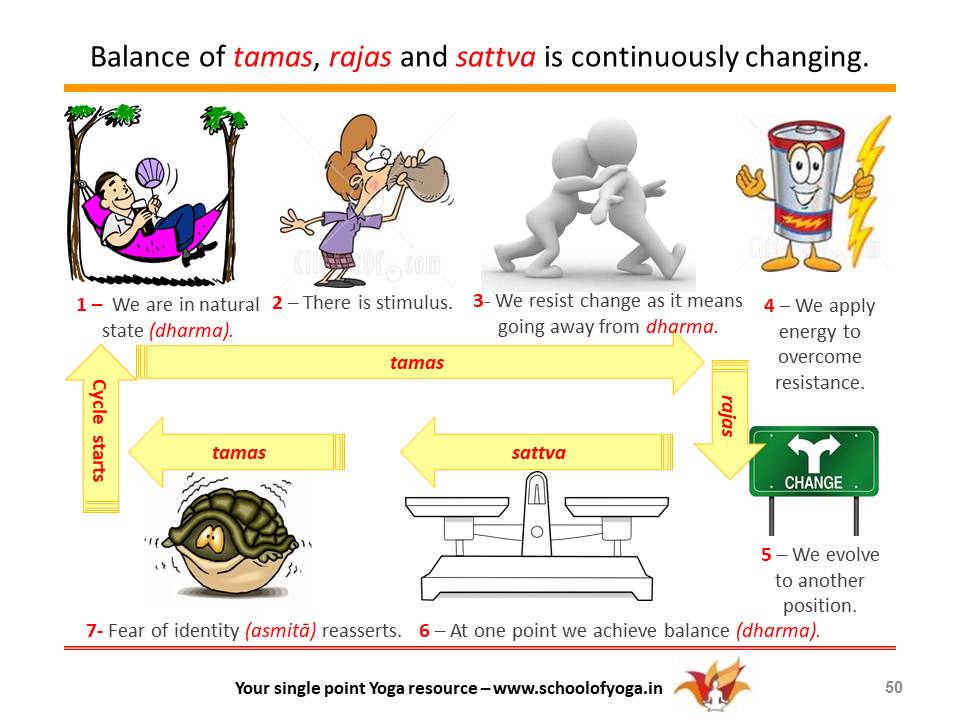
During any transaction, our awareness moves from confusion, to active effort and finally harmony. Our attributes are called guna in samskritam. These gunas or attributes are constantly changing in composition depending on the state of awareness of the Self with the subject.
What are the 3 types of gunas and the drivers of maya ?
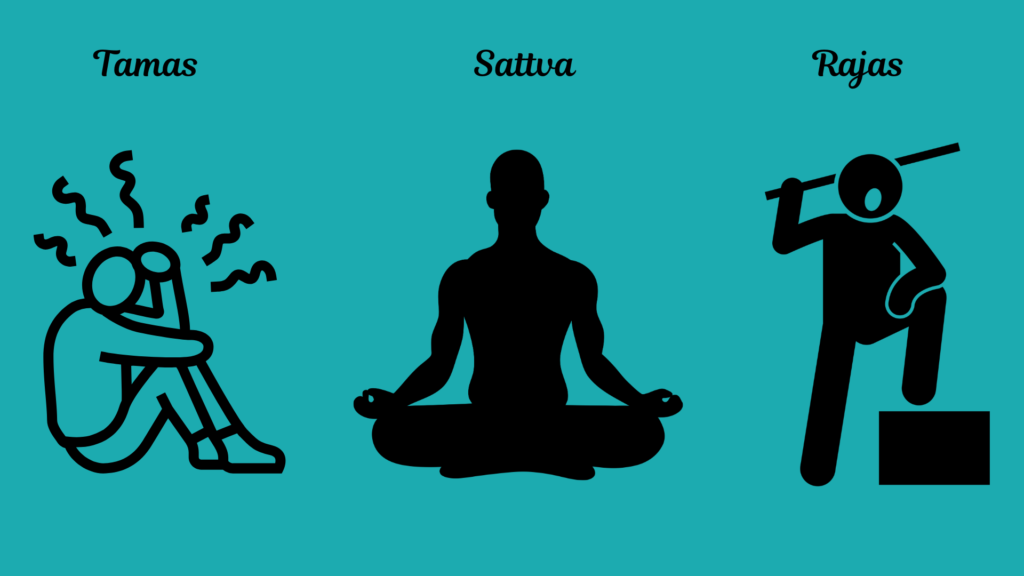
The 3 gunas or the components of attributes are tamas (inertia), rajas (passion) and sattva (harmony).
Tamas (inertia): This attribute is characterised by fear, laziness, indolence, confusion, delusion, etc., and is governed primarily by the physical/ static element of our Self. So, a person with predominance of this state generally is confused, lazy, indecisive, and will not do any work unless pushed or monitored.
Rajas (passion): This state governs nearly all forms of action, driven primarily by emotions. Also, this aspect drives our orientation towards results and desire for achievement. So, a person in this state would typically be result oriented, dominating, driving, aggressive, brooking no resistance, impatient, etc.
Sattva (harmony): This occurs when a person tries to balance result with resource, process, tries to balance task result with quality & relationships. This is driven by a need for balance. So, this person avoids confrontation unless absolutely required. When in a conflict situation, the person is calm and absorbs emotions. Also, this person avoids personal & and judgmental remarks.
How do the 3 gunas influence our mind – Anecdotes, experiences and situations to help understand guna or attributes:
Let us understand the three gunas with the help of the below example.
Example: A person is using an ATM (Automatic Teller Machine) for the first time. The bank has issued a new ATM card to the person.
Imagine the person’s state when he/she has to withdraw money from the ATM for the first time. Initially, there is confusion – “How am I going to do this?” or anxiety/ fear “What will happen if…?” This is tamas.
Then comes anger or irritation – “This is ridiculous! How do they expect me to operate this machine without training?” This is rajas. Then, there is effort… “let’s see what we can do”.
Finally, there is acceptance and ownership. Here, the person hacks around and finds a solution, either by doing it himself or by asking someone. Value is added and this is sattva.
Consequently, an awareness of the transaction in the person drives the outcome and consists of two parts. First, there is an awareness of the situation which is called vijnana. This transactional awareness results in increased understanding of the Self, an increase in asmita (I am this) and a feeling of being the doer (ahankara), and this is called jnana.
How does the transaction between two entities (Shiva) become maya (farce)?
Whenever we transact with anyone, we are constantly confronted by perception. We never see everything in its entirety, nor do others see us for what we actually are.
Broadly speaking, we can split our perceptions into:
- Our behaviour, which is called darshana (that which is shown).
- What others see, which can be called drishti (that which is seen)
- The seer is called drishtu(one who sees)
The transactional mechanics can be broken down as follows:
- Firstly, during the transaction, the manifesting Shiva can transmit its identity only to the level of its own awareness/ cognition, and this is never complete or in alignment with the situation.
- Similarly, the receiving Shiva can receive and analyse the incoming information only to the extent supported by its identity and its awareness of the situation.
- However, the reality is that each Shiva thinks that its own as well as the other’s manifestation is complete, and this leads to a difference in perception between the manifestation and feedback.
- The resulting relative difference between the perceptions of the sender and receiver as well as the way feedback is received and decoded is maya (illusion).
Additionally, it’s important to realise that various other parameters of decision-making framework are also continuously changing.
- Conditioning (dharma) of the sender and receiver is continuously changing.
- Dharma of others in the environment is continuously changing.
- Both, sender and receiver are getting inputs from multiple sources, which makes them distracted.
- Everyone’s self-worth (asmita) is continuously changing because the awareness is never completely engaged in the present.
- The environment or framework of the transaction is continuously changing.
Comment: Therefore, it is very important to understand how maya drives our existence. Our manifestation is the expression of our identity (asmita). However, the feedback we get may or may not be in congruence with how we perceive our Identity.
Consequently, when there is congruence between our manifestation and the feedback we receive, our sense of self-worth (asmita) expands and there is raga (attraction-karma). But, when it is dissonance between the feedback and our Identity, then our asmita contracts and dvesha (repulsion-karma) results.
What is the role of prajna (awareness) ?
From the above, we can realise that our ability to engage completely in any situation is dependent on our awareness in any situation.
Situational awareness (prajna) consists of two components:
- Awareness of the situation by the Self during the transaction (vijnana).
- Awareness of changes to the Self due to the transaction (jnana).
Points to ponder about guna :
Internal Tags: Conditioning or Dharma, Self Awareness or Asmita, Guna in Bhagavat- Geeta chapter 14
External Tags: Stress
- How do you recognise your value system or conditioning (dharma)?
- When you are stressed, how do you know?
- How do you react when you are confronted with change?
- What is your strategy for overcoming anxiety and fear of change?
- How do you cope with fear of consequence of your action?
- What are the factors which drive you to act?
- Do you experience passion and ambition? How do you handle them?
- When you are angry, what do you do?
- How do you recognise that your coping actions are not adequate?
- What would svatantra mean for your team, your company, your state or country.