What is virabhadrasana ?
Virabhadrasana, also known as the gracious warrior pose, is a very good asana for increasing strength, and it is also a graceful asana. It is a stretching exercise that cultivates balance and stability in posture.
What is the technique to practice virabhadrasana yoga pose ?
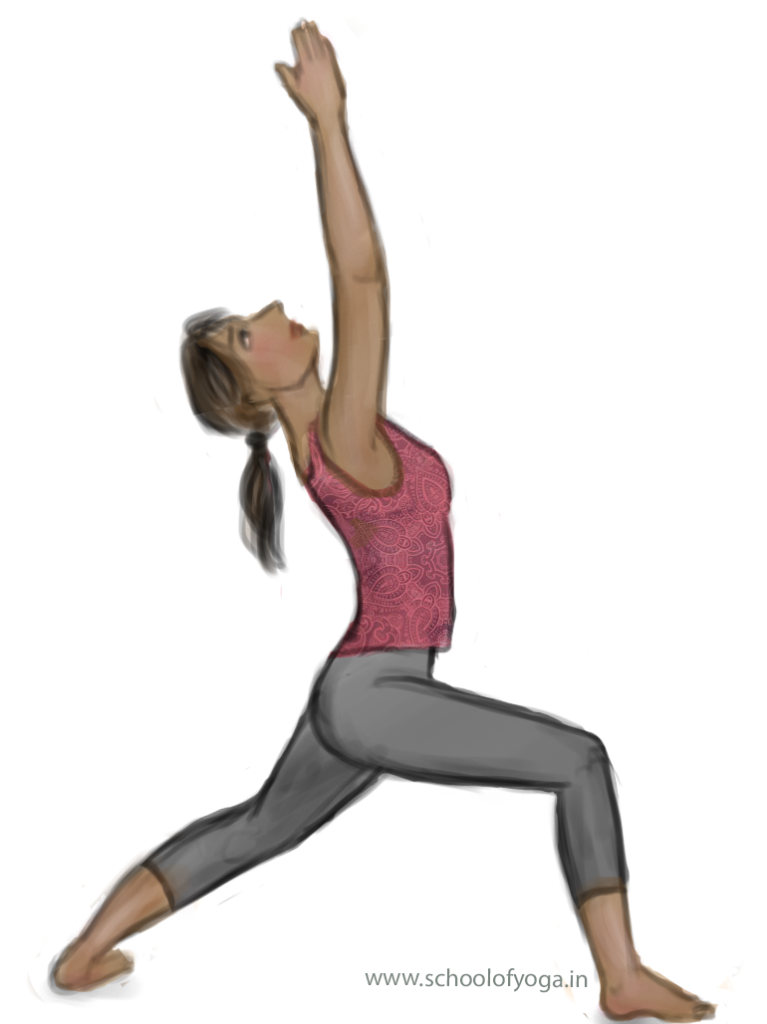
- Sthithi (starting position): Stand with your feet comfortably apart, around 1 meter or 3 feet. Keep your hands at your sides.
- Turn one foot on the heel such that the foot faces outward, while keeping the other foot grounded and steady.
- Slowly, fold the knee of the leg where the foot is turned outward. Sink the pelvis until the leg forms approximately a 90-degree angle at the knee.
- Keep the other leg stretched and straight at the knee.
- Next, take your hands above your head and join them in anjali mudra.
- With the hands in anjali mudra, breathe out and bend the torso forward in the direction of the bent knee, until your face touches the bent knee.
- Hold for 3 – 5 counts. At the end of the count, take in a shallow breath.
- Breathing out, also take the hands up, and slowly arch the back in the opposite direction as far as possible, without losing balance.
- The recommended drishti (gaze) or focus to be maintained is angushtamadhye (gazing into the nail in the thumb).
- Maintain this position for 3-5 slow counts.
- While breathing in, straighten your legs and come to the upright position.
- Straighten your feet parallel to each other.
- Bring your hands back to the sides.
- Bring your feet together and relax.
- Repeat on the other side.
What is the variation of virabhadrasana ?
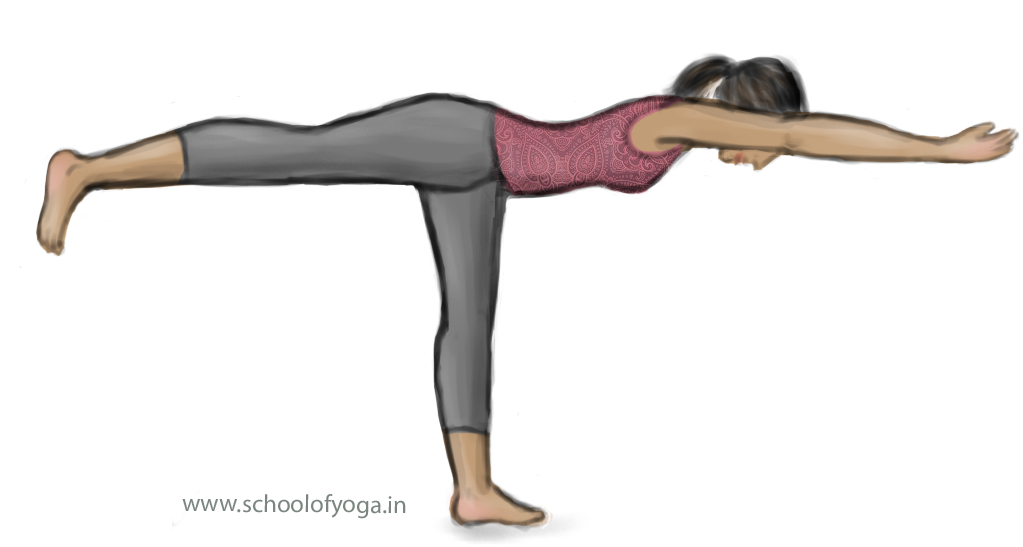
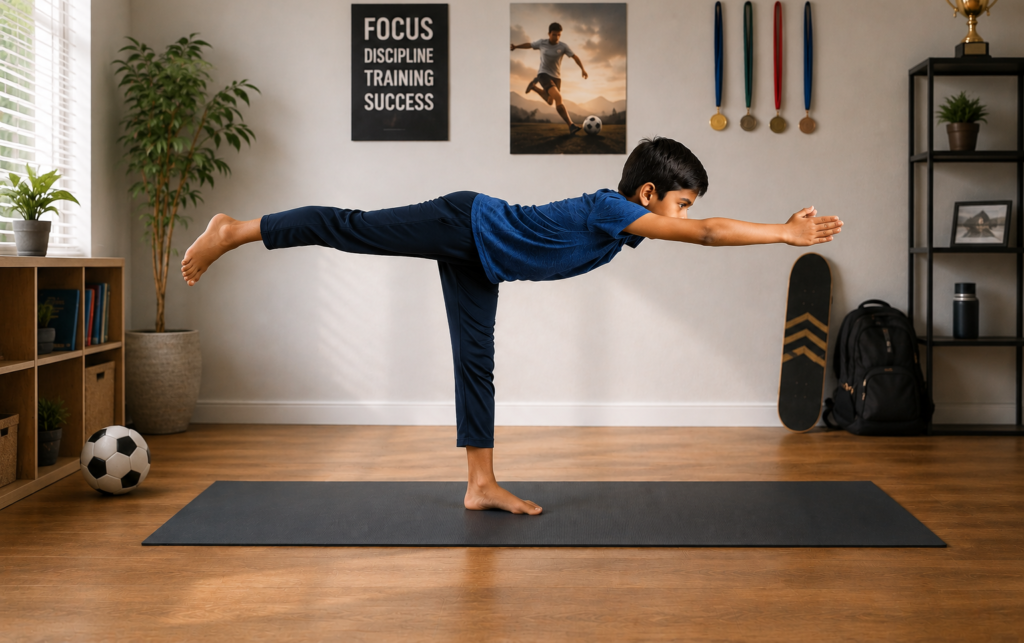
- Stand with both feet comfortably apart, slightly greater than 1 meter or 3 feet. Keep both hands on the sides.
- Then, turn one foot on the heel such that your foot faces outward. Keep the other foot stretched and steady.
- Breathe in.
- Then, take your hands above your head and join them in anjali mudra.
- Breathing out, turn the torso to the side of the foot that is turned outward.
- Bend the torso at the waist with the hands in anjali mudra, till the torso is parallel to the ground.
- Breathe in.
- While breathing out, balance your body on the foot that is turned outward, and slowly lift the other foot in the opposite direction, as far as you can manage. Hold the body still.
- Hold for 3-5 counts, and maintain shallow breathing.
- The recommended drishti (gaze) or focus to be maintained is urdhva drishti (gazing into space or the floor).
- Bring the leg back to the ground. Breathe in.
- Straighten the torso to an upright position. Let the hands fall back to the sides.
- Bring both feet to the straight-ahead position. Relax.
- Repeat on the other side.
What are the benefits of virabhadrasana pose?
- The act of sinking into the ground strengthens the sartorius muscles. The sartorius muscle is a long muscle that covers and acts upon both the hip and knee joints. At the hip joint, the sartorius, along with other major hip muscles, helps in flexing, holding, and supporting lateral movements of the thigh. At the knee joint, the sartorius helps to flex the leg sideways. This muscle is almost never exercised consciously, but virabhadrasana brings health to this muscle.
- This asana stretches all the muscles of the hips, back (especially the internal abdominal oblique and iliopsoas muscles), knee, calves, and ankles.
- The upper body stretching also strengthens the thoracic and cervical muscles, especially the trapezius and latissimus dorsi muscles.
- This asana assists in improving the functioning of all the organs in the lower abdomen – the digestive, reproductive, and the urinary tract organs.
- The stretching of the lower back strengthens the lower back muscles and also increases blood supply to the sympathetic and parasympathetic nerves.
What are the contraindications for virabhadrasana ?
- People with back problems and circulatory disorders should not attempt virabhadrasana without first consulting a physician.
- Practitioners with ear problems should not attempt the warrior pose without first consulting a physician.
- People with an arthritis problem must perform this asana only under the supervision of a physician.
- Do not perform this asana during menstruation or pregnancy.
Some noteworthy points on virabhadrasana :
Internal Links: Dharma (conditioning), Stress and Situational Awareness, Prana, Asana Overview 1, Asana Overview 2, Asana Focus or gazing, Pranayama
External Links: Prana, Chakra, Pancha Tattva, Pancha Prana, Pancha Kosha, Nadi, thesatoriconcept.com
- This is an advanced asana and when coupled with suryanamaskar, it can give very good aerobic benefits.
- This asana is great for increasing overall flexibility.