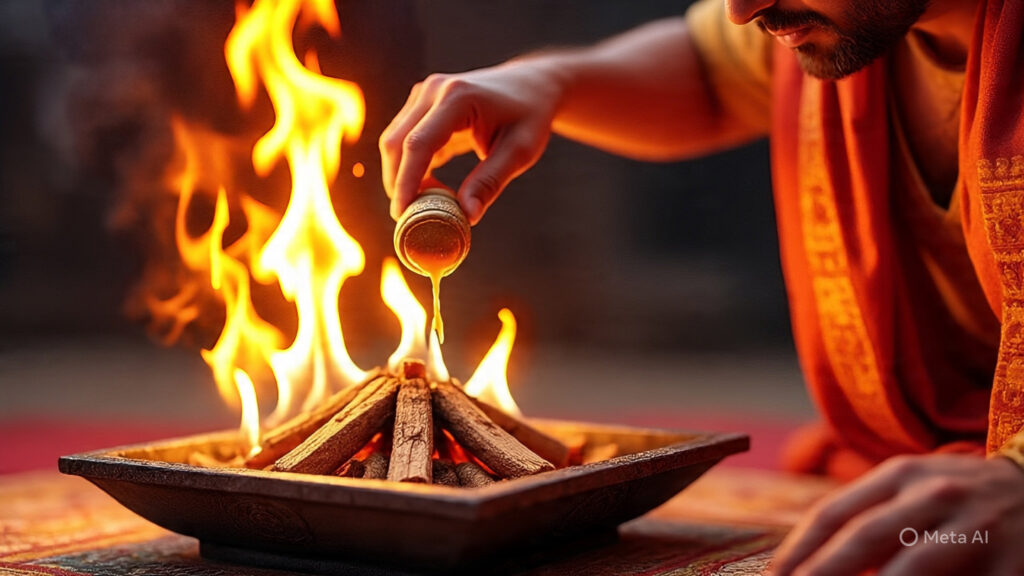
Acknowledgement – School of Yoga is deeply grateful to Dr. H.S. Ram Mohan for sharing his work on Agni, allowing us to make changes and to publish it on this site.
Agni puja : How is fire (Agni) relevant to Bharat ?
Agni (the presiding deity of fire-element) is a panchabhuta or primordial element.
Read about how Agni was personalised in Bharat (India) here.
Introduction: Firstly, since the advent of the period of Rigveda, the fire (Agni, which is a Samskrita cognate of the English word ‘ignite’) has been central to Bharat’s civilisation.
Let us look at the most important Agni mantra (invocation to fire) from the Rigveda :
ॐ अग्निमीळे पुरोहितं यज्ञस्य देवमृत्विजम् ।होतारं रत्नधातमम् ॥१॥
Om agni-mile-purohitam yajnasya devamhrtvijam l hotaram ratna datamam ll 1ll
Meaning: Hail Agni who is the Purohita (priest) of the yajna (sacrifice), as well as the source of hrtvij, (hrta means excellence), the supervising priest who guides the yajna, which is directed towards the devas (various deities), and is also the hotara (offering which is contained within the sacrifice), and in addition is also the bestower of wealth.
Second Reference – Here Sri Krsna describes himself in terms of excellence as Agni in Srimad Bhagavad Gita Chapter 10, verse 23 (वसूनां पावकश्चास्मि) – purifier (pavaka) among the Vasus (deities governing the material elements).
Additionally, in another verse from the Srimad Bhagavad Gita (chapter 9 verse 16), he says that he is embedded in every aspect of the sacrifice – enunciating that I am the purpose (aham kratu), I am sacrifice (aham yajnah), I am the oblation (svadhaham), I am medicine (aham aushadham), I am mantra (mantro’ham), I am also ghee (aham evajyam), I am fire (aham agni), I am that which is sacrificed or the offering (aham hutam).
So, it is evident that fire (Agni) has been considered a very important deity since time immemorial (going back before 4000 BCE) in Bharat’s civilisation.
Agni puja : How did Agni become so important?
Firstly, fire is one of the first primordial elements to be controlled by man, this occurred around 50-100 thousand years ago. Also, fire was used for many purposes, for heating, cooking and as protection from predators.
Subsequently, from Agni puja or the worship of fire evolved the house-fire (grhyagni).
Agni puja : What is the role of Agni in Bharat’s civilisation?
Clearly, Agni has been an important deity since the time of the Rigveda. Additionally, Agni has always been central to all Vedic rituals. In fact, in terms of importance, Agni was next only to Indra, the presiding deity of Vedic deities. This is due to the fact that Agni is the primary recipient of all sacrifices in Vedic rituals, and through him it is offered to other Gods. Hence, in this form, he is known by the name Vahni (carrier) and eulogized, because he acts as a vehicle between the worshipper and the chosen deity (deva).
Importantly, as the most potent and visible form of energy, useful but destructive at the same time, he was both feared and revered by the Vedic people. Additionally, almost every mandala or division of the Rigveda starts with a hymn to Agni. Furthermore, all hymns praise him abundantly, often describing him as the supreme God and Creator.
Agni puja : Agni in the pantheon of deities
Agni is the chosen Priest, Deity, minister of sacrifice, the hotar, who lavishes wealth and dispels the darkness. Also, Agni along with Indra, the Lord of the heavens and Surya, the Lord of the skies, constitute the first trinity of Hinduism (their places were latter assigned to Siva, Brahma and Vishnu respectively). He is the thunderbolt of Indra‘s weapon, the light of the Surya. In fact, in the later Vedic period he became one of the Ashtadikpalas as Lord of the southeast quarter.
However, in the Puranas, Agni is subordinated to other Gods. Additionally, over time, we see a clear decline in his popularity and significance, though not as much as Indra.
Agni puja : What are the various forms of Agni?
Agni is one of the primordial elements (panchabhuta) and emerges from the air element (vayu). Also, Agni ‘s halo is called agnimitra.
According to tradition, Agni has ten forms – of these the first five are his material or natural forms, and the next five are his ritual forms.
The five natural forms of Agni are:
- The Sun
- Ordinary fire
- Lightning
- The digestive fire (jatharagni comprising pachakagni (cooking fire), ranjakagni (that which initiates action), alochakagni (the heat in conversation), sadhakagni (the heat in practice)and bhrajakagni (the heat of the body/ aura)
- Destructive fire / forest fire (himsragni).
Additionally, the five ritual or derived forms of Agni are:
- Fire produced using sticks for the purpose of sacrificial rituals or agnimanthana
- Fire given to a student at the time of his initiation (upanayana) ceremony called samithagni
- The fire kept in the house for domestic rituals (grhyagni and agnihotra)
- The southern fire of the ancestors used in certain rituals (aupasanagni)
- The funeral fire used in the cremation rituals (dahanagni).
Agni puja : The sacred rituals of fire worship
Agni as sapta-jihva
Furthermore, Mundaka Upanishad (2.4) mentioned the seven tongues of Agni (sapta-jihva) as kali (black), karali (terrific), manojava (as fast as cognition), sulohita (red), sudhamravarna (purple), sphulingini (spark emitting) and vishvaruci / vishvarupa (universal nature/ form).
Additionally, Agni operates in two states – Jataveda and Kravyadagnia. Jataveda means knowledge/wisdom/understanding (veda) of all existence (jata). Kravyadagni (क्रव्यादाग्नि, “The funeral fire”) is one of the five forms of Agni ’s ritual fire. In this form, fire is lit on the funeral pyre and into which the body is offered as the final oblation.
Finally, Agni is recognised as the closest Vedic equivalence for the omnipotence of the Brahman, the friend of Man, the mediator, the sacred and sacrificial fire, and at the same time the fire that is in the sun, in burning things, and in the heart of Man, everywhere the same, and yet everywhere different, having varied and even almost contrary effects.
Agni puja : Agni as a deity
Furthermore, Agni is associated with the consonant ra and carries significance akin to the Egyptian Sun-God. This is known as a sound of the seers/rishis as the seers are said to be channels/pathways towards the Supreme.
Importantly, two paths of moving upwards towards one’s deity (ra-fire) or bringing the deity down to oneself (la-earth) as governed by the rishis are defined. The sound ra, signifying the upward movement of communication by the fire (Agni) is commonly added to the mystic seed/bija mantras, i.e. hrim, srim and krim are common uses of the same, and represent this upward movement.
Agni puja : Agni in the week
Firstly, the Sanskrit word for weekday is vara. Also, the word vara is short for the word vasara. Vasa means to stay, abide, dwell in, whilst ra is a reference to Agni, the God of fire. Hence, the word vasara implies an abode for the God of fire. Similarly, a weekday/ vara is a resting place for the Agni, and all the functions of the weekdays arise from this principle.
Agni puja mantra : Connection between Agni and tapas (austerity)
Agni Mantras are often used in the practice of austerity (tapas). Among the mantras for Agni puja, there are some simple ones such as om agnaye namah or om jatavedase namah.
But a more popular Agni puja mantra in the traditions of Jyotish is the chaitanya/consciousness mantra, meant to bring superior awareness and consciousness to the individual. This Agni mantra is also called the navarna mantra as it is nine syllables in length: om hum ram chaitanyayai namah.
Agni puja : Agni Gayatri mantra – a powerful mantra to worship fire
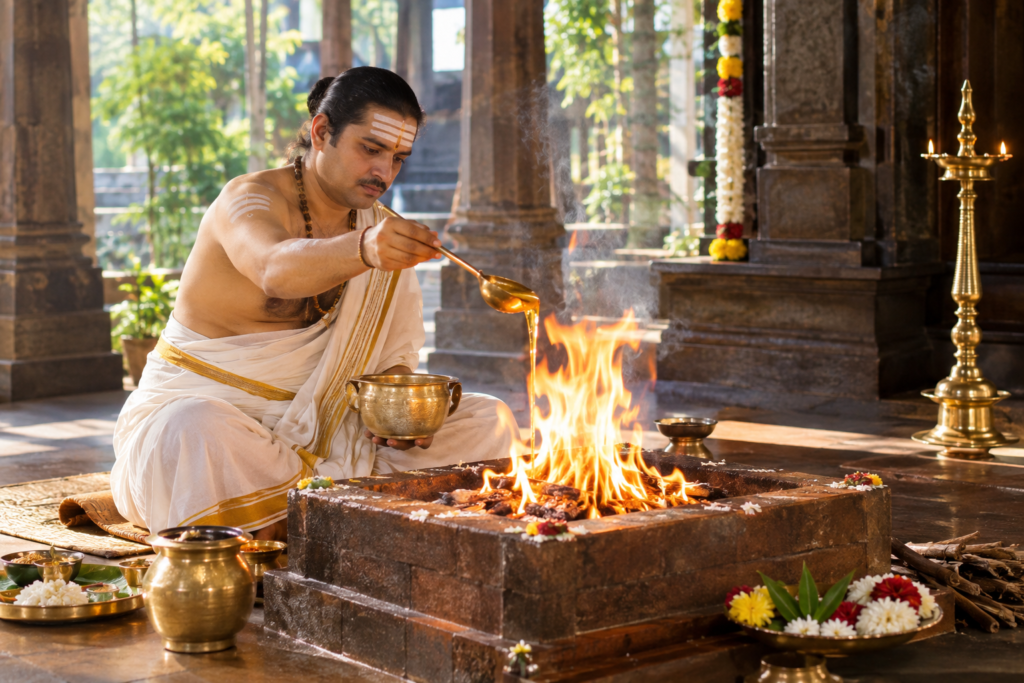
The Agni Gayatri mantra is powerful chant for Agni puja, to invoke the divine energy of Agni and it is chanted as Om Mahajwalay Vidmahe Agni Madhyaya Dhimahi |Tanno Agnih Prachodayat ||
Meaning : Om, Let me meditate on the great flame, Oh, God of fire, grant me with higher intellect, Oh, let the radiant God of Fire illuminate my mind.
- Om Mahajwalay Vidmahe Agni Devaya Dhimahi |Tanno Agnih Prachodayat ||
- Om Vaiswanaraya Vidmahe, Laleelaya Dhimahe| Tanno Agnih Prachodayath ||
- Om Sapthajihvaya Vidmahe, Agni Devaya Dhimahi |Tanno Agnih Prachodayat ||