School of Yoga explains Srimad-bhagavad-gita, chapter 9, on Hindu Cosmology.
What is Hindu Cosmology?
Hindu cosmology starts with the concept of the Brahman. We have seen that Brahman is infinite and changeless cognitive state of nothingness, which is the state of peace.
How does Hindu cosmology explain Purusha and Prakriti
- Brah
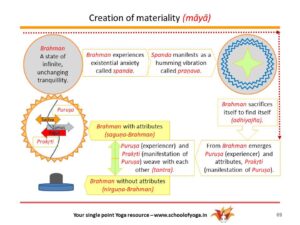 man experiences an existential crisis and sacrifices itself. As a result, we get primordial sacrifice (adiyajna). Shri Krishna says that he is this state of adiyajna.
 - At this point, from Brahman emerge puruṣa (primordial Identity or Self or adhidevata) and prakriti (primordial manifestation or energy of purusha).
- Purusha is the static element of Brahman and the experiencer.
- Next, from prakriti, the dynamic element, emerges guna (attributes) – tamas (delusion or lethargy), rajas (passion) and sattva (balance).
- Subsequently, prakriti and puruṣa weave (tantra) with each other to create primordial karma (action).
- Importantly, all motility comes from Brahman.
- Additionally, when prakrti and purusha weave and there is creation of materiality, this is called (saguna–brahman). This is also called maya (illusion).
- However, there are other conditions when the weave of purusha and prakriti is not perfect;
- Firstly, prakrti may not manifest in response to purusha. For example – often, we do not react to every experience, especially when we are unsure or afraid of the outcome, such as when we are confronted by a bully or fear our safety, jobs etc. At such times, we often just experience great fear, but let the moment go.
- Second, even when prakriti manifests, there may be no feedback, in which case purusha experiences only itself. For example – assume that you are walking in a corridor and you meet and greet a friend. If the friend does not return the greeting, purusha has an experience of loss of self-worth, but prakriti does not participate in the transaction.
- This is called (nirguna–brahman) where purusha exists but prakriti is not engaged. For example – we suddenly may have a craving for potato chips but be unable to act on the craving.
Hindu Cosmology – What are adibhutas or panchabhutas?
First, transformation from unmanifested (nirguna–brahman) to manifested (saguna-brahman) occurs due to yajna (sacrifice). From saguna–brahman emerge the cardinal elements (panchabhuta), comrising earth (prithvi), water (ap), fire (agni), air (vayu) and ether (akasha) as a mix of the guna, tamas (indolence/ delusion), rajas (passion, energy) and sattv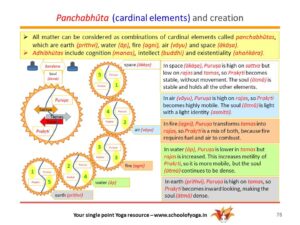 a (balance).
For instance, when we drive, there is a mix of earth (prithvi or car) + water (ap or fuel) + fire (agni or combustion) and air (vayu or movement, coefficient of drag or resistance).
- Firstly, if we give or take materially, it is solid or prithi (earth).
- Next, when we exchange liquids, it is water (ap).
- Also, fire (agni) is transformation agent that occurs in all effort. Importantly, fire is the only medium that changes the state of anything. For example – fire (agni) transforms ore to metal. Also, when it is removed as latent-heat from an ingredient, it freezes the ingredient. Since it is a predominantly transformative element, fire is considered to be the most important amongst all the primordial/ cardinal elements (panchabhuta). This is also the reason why fire is central to sacrifice (yajna) in sanatana-dharma and thermodynamics is central to science.
- When we move, there is air (vayu).
- Lastly, our speech is communication or ether (akasha)
What is the sacrifice (yajna) in Hindu Cosmology?
- Ability to overcome inhibition or fear to get a job done is sacrifice of asmita (self-esteem).
- Investing in resources such as car, fuel, coordination etc. is sacrifice of resources such as time, money and effort.
- Willingness to change in light of newer information sacrifice of asmita.
School of Yoga explains Hindu Cosmology in Srimad-bhagavad-gita, chapter 9, rajavidya-rajaguhya-yoga.
Hindu Cosmology basis of the Universe and Yoga.
Let us now look at the concept of matter and energy. Scientists have come up with a theoretical model that the universe consists of ~68% dark energy (an expanding energy that fills the space which is getting created in the Universe), ~27% dark matter (there are spaces in the Universe where there is no matter), ~5% normal matter.
No one is sure how space is getting created, how distances between galaxies are increasing, why there are empty spaces and what is matter.
Does Yoga have an answer to Hindu Cosmology paradigms?
Let us look at the problem from the concept of Brahman, which is a cognitive state of null. This means that Brahman is a combination of Physics and Psychology. It is not a Philosophy. It is state of existence, the bedrock of creation.
From Brahman emerges purusha and prakriti to create the Universe or hiranyagarbha (golden egg), likely though the Big-Bang. The identity of this entity is called Vishnu. It’s important to remember that Vishnu is the identity and hiranyagarbha is the manifestation. One can conclude that Vishnu energises hiranyagarbha but does not participate in it.
Also, we know that matter is composited of five primordial elements (panchabhuta), comprising earth (prithvi), water (ap), fire (agni), air (vayu) and ether (akasha), which occur from the weave of purusha and prakriti, as a combination of guna.
All matter has a quanta unit, this comes as the weave of śiva is called śakti that create everything. This weave is called tantra, their union is called yoga and one quanta weave of śiva and śakti is called prāṇa (motility).
What this means is that while Physics/ Science posits that the building block of matter is a waveform which then combine/ recombine to form the Universe, actually, the waveform (Shakti) is an expression of Shiva.
Physics is unable to prove the existence of Brahman or a Universal identity (Vishu) because of what it is, a consciousness. But this concept of Brahman answers every question of existence that science cannot.
School of Yoga explains Hindu Cosmology in Srimad-bhagavad-gita, chapter 9, rajavidya-rajaguhya-yoga
Definition of Brahman – Brahman can be defined as an infinite state of unchanging equilibrium or peace.
- So, Brahman is a state of “Zero Entropy” and “Zero Enthalpy” (there is no heat content or disorder, because there is no pressure, volume or temperature, hence it is not a thermodynamic system).
- It is important to recognise that pressure, volume and temperature are all functions of fire (agni).
- Hence, Brahman is both, a state of null as well as infinite state of unchanging thermodynamic equilibrium.
Hindu Cosmology on the creation of the Universe: All creation comes from the Brahman: The consciousness (citta) of Brahman, in a state of infinite thermally inactive equilibrium, becomes aware of itself (prajna) and experiences existential anxiety and a desire to know itself.
- Consequently, this anxiety manifests as a vibration called spandana (atemporal vibration or pulse).
- Next, from this vibration (spandana) emerges a macrostate called purusha (primordial identity or experiencer) that weaves with prakriti (manifestation of that identity) to create matter. Simultaneously, at a quanta level, the building block of purusha and prakriti is shiva (quanta identity) and shakti (quanta manifestation) emerge.
- Purusha and prakriti weave with each other to create an entity called the atman.
- At a super-macro-thermodynamic system level, this is called the Universe or hiranyagarbha (golden-egg) with its atman as Vishu.
- This state is also valid in any visible, normal entity or standard thermodynamic closed system like a bird, animal, human, earth, solar system, universe, car, computer, table, chair etc., anything that has a natural state (dharma).
Hindu Cosmology – How does quanta yoga work? How is it different from science?
- Shiva manifests from Brahman without attributes as nirguna–brahman.
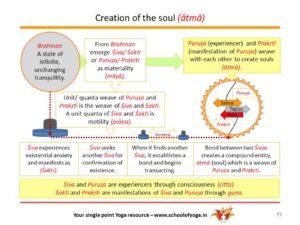
- Obviously, since this is an Identity only, it does not enable Brahman to confirm its existence because there is no change in state or thermodynamic equilibrium.
- So, Shakti manifests from Shiva and this weave (tantra) with Shiva is called saguna–brahman because attributes (guna) emerge from Shakti.
- Also, the quanta unit of the combination of Shiva and Shakti is a unit of motility called prana.
- From Shiva emerges consciousness (citta) and from Shakti emerges attribute (guna).
- Shiva is the static aspect and Shakti is the dynamic aspect of their weave. Shiva’s identity experience through its consciousness (citta) and manifests as Sakti.
- Shiva and Shakti are inseparable and weave with each other continuously. Without Shiva (identity), there can be no Shakti (manifestation) and without Shakti (manifestation), there can be no Shiva (identity). This is encapsulated is Ādi Śankara’s soundaryalahiri, stanza 1.
- However, this weave yields no outcome because there is no confirmation of identity of Brahman’s manifestation.
- Confirmation is activated when another Shiva-Shakti entity emerges from Brahman and the two entities confirm each other’s existence.
- Whenever there is lack of confirmation of its identity, Shiva experiences a drop in identity, resulting is the consciousness (citta) turning inward, which draws Shakti inward also.
- The impact of the consciousness (citta) turning inward results in Shiva becoming lethargic, which is inertia, mass or tamas.
- The weave of Shiva with Shakti creates a quanta movement which is called karma (action) and is what we call work in thermodynamics. Energy is created.
- Shakti’s movement inward creates an electromagnetic force moving inward, which results in prana, a unit of Shiva-Shakti generating gravity.
Hindu Cosmology – What happens when Shiva finds another Shiva?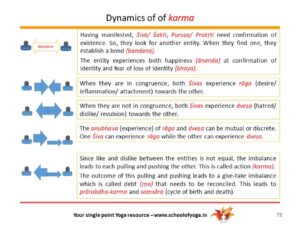
- First, how does Shiva look for another Shiva? If Shiva does not find another Shiva, it immediately experiences inertia or fear of loss of identity. So, it manifests and starts seeking another Shiva.
- Shiva’s consciousness (citta) emerges on the manifestation of Shakti in the form of an electromagnetic pulse. This electromagnetic pulse could be light that has a consciousness (citta) constantly seeking another Shiva.
- This makes light or any waveform such as an electromagnetic pulse a karma generated by the weave of Shiva with Shakti.
- Importantly, the outcome of the weave of Shiva and Shakti is dependent on consciousness (citta), because consciousness is the communication medium between Shiva and Shakti and determines Shakti’s attribute (guna).
- Hence, consciousness (citta) determines how identity/ matter (Shiva) will combine/ transact/ experience other Shivas.
Hindu Cosmology – Creation of matter and energy.
- When two Shiva’s connect, they immediately form a bond (bandana) with one another, the two quanta Shiva combining to form a complex identity called Purusha.
- This complex independent identity (Purusha) weaves its own unique manifestation (Prakriti), and this is separate from its constituent quanta Shiva or Shakti.
- The unit of Purusha and Prakriti is called atman (Soul). Purusha then begins to seek with its consciousness (citta) and bond with other Purusha in the same manner as explained with Shiva above.
- Consequently, this results in creation of matter and energy, each entity having a Soul (atman), which is a unit of Purusha (matter) and Prakriti (energy).
- When matter (Purusha’s) consciousness (citta) turns inwards or becomes negative, energy (Shakti) manifests as inertia, tamas or matter.
- Next, when citta emerges from Purusha, energy (Shakti) becomes positive, and outward flowing expansive, passionate, is called rajas or energy.
- Finally, when Purusha and Prakriti find a balance, it is called sattva or natural state/ harmony. The relationship between Purusha and Prakriti is matter-energy balance and their quanta unit is prana.
- However, the relationship between various Purusha is very unstable because there is continuous bonding with other Purusha resulting in equilibrium being disturbed. Consequently, the cycle of guna (attribute), tamas, rajas and sattva are perennial, with each getting ascendancy briefly, depending on the state of puruṣa’s citta.
- The least stable of all three guna is sattva, because thermodynamic balance or ideal state in entropy is not only difficult to achieve, but also difficult to retain.
Hindu Cosmology – Dynamics of the bond (bandhana).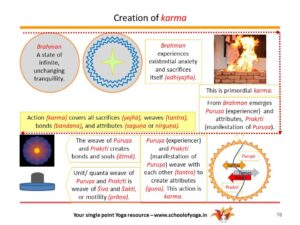
- Within any bond, the two Shiva have identities of different intensities but neither will leave the bond unless they can find another Shiva because they fear loss of identity and the bond is the only confirmation they have of their own existence.
- As a result, the Shiva that is more stable is less dependent than the Shiva that is insecure.
- This results in inequality of give-take and binding energy within the bond which results in an unequal give-take relationship / transaction between the two Shiva.
- Since the give-take within the relationship is unequal, one gives or takes more, thermodynamic work is generated out of the relative movement between the two Shiva-s.
- This results in release/ absorption of energy and creation of debt (rinn) because one Shiva would have given more (exothermic) than and the other Shiva would have taken more (endothermic).
- It’s important to realise that the release or absorption of energy (Shakti) will result in a manifestation and generation of another identity (Shiva).
- This generation of new Shiva (identities) creates unbonded identities (entropy), result in expansion and makes the thermodynamic cycle perennial .
- So, karma is a thermodynamic transaction between Shiva-s that results in the production of more Shiva-s and since the process is self-sustaining, continuous and infinite, it is called sada-shiva (perpetual Shiva).
- This is why the universe is continuously expanding.
- This debit/ credit is stored in Shiva and it has to be reconciled with the other Shiva. When this debt or credit is not reconciled, Shiva experiences distress or tamas and turns inwards into dark matter.
- The above process which has been explained for quanta Shiva is valid for Purusha also.
- The only change in the case of Purusha is that since Purusha is a complex structure of other Purusha-s, with their foundation in quants Shiva-s, the relative movement (thermodynamic work or karma) within a macro entity can be very complex, consisting of many sub-entities and quanta.
Hindu Cosmology – School of Yoga explains Srimad-bhagavad-gita, chapter 9, rajavidya-rajaguhya-yoga
Normal matter: Importantly, for normal matter, which is the manifested aspect of Brahman (saguna-brahman), any weave of Purusha and Prakriti that results in creation, maintenance and dissolution of panchabhuta-s or lower order of creation / primordial elements with the existence of a Soul (atman) is normal matter.
Dark matter: When Shiva or Purusha’s debt (endo-exo thermodynamic balance) is not getting reconciled, then the consciousness (citta) becomes inward looking and incapable of manifestation and the prana or atman experiences severe tamas or inertia, that is dark matter.
Importantly, when Shiva has low identity, hence low motility, Shakti also will have low/ no motility (it can move without direction but cannot create) because motility requires Shiva to form a bond with another Shiva and establish its identity. This cannot occur if Shiva is in existential crisis.
Inertia, gravity and yoga: When Purusha or Shiva is in tamas, Shakti ~ zero. Consequently, this results in consciousness (citta) moving into Purusha or Shiva which generates an inward electromagnetic force which is the source of gravitational force.
Dark energy: When Shiva emerges from Brahman, it experiences fear of loss of identity. So, it manifests as Shakti and its consciousness (citta) reaches out to confirm its existence. This is an electromagnetic pulse that is experiencing extreme fear of loss of identity.
Consequently, Shakti’s intensity is much higher than Shiva which is ~ zero. This is dark energy in Physics. However, since Shakti exists without a strong anchor of Shiva, its velocity is solely dependent on the speed of Shiva’s consciousness (citta).
Why does light bend: Light is high on energy (Shakti) and low on identity (Shiva). So, in order to affirm its identity, Shiva needs to establish a bond with another Shiva. Consequently, Shakti needs to manifest and find another Shiva. As a result, Shakti, in the form of light forms a natural affinity towards any type of identity (Shiva). So, then consciousness (citta) finds another Shiva, Shakti, driven by Shiva’scitta bends towards any Shiva. This is called gravitational lensing.
This is also the reason why objects light up when light strikes them. There is natural affinity of citta to another Shiva for the establishment of a bond and confirmation of identity of its own Shiva. So, when Shakti finds another Shiva, a bond is created between the two Shiva-s and both increase in manifestation, this lights the entity, after which karma occurs and there is material creation.
This material creation is always a mix of Shiva and Shakti in the quanta form growing into Purusha and Prakriti in the universal form. The five primordial materials of earth, water, fire, air and space get created by the mix of tamas(Shiva>Shakti),rajas (Shakti>Shiva) and sattva (Shiva=Shakti). For instance, earth is predominantly tamas or Shiva/Purusha>Shakti/Prakriti.
Hindu Cosmology – Interchangeability of light and matter.
- Importantly, the balance between Shiva and Shakti is never constant, it changes according to the bond that Shiva has with another Shiva.
- So, first Shiva experiences deep sense of loss of Identity which is tamas, this makes Shakti move because Shiva-s consciousness (citta) tries to find other Shiva which is compatible. Finally, Shiva forms a bond with another Shiva and creates normal matter, which is sattva.
- However, the bond is temporary and dependent on each Shiva’s sense of identity-insecurity, hence the bond breaks whenever there is interference from another Shiva, leading to a repeat of tamas/rajas/sattva cycle.
- As a result, Shiva (identity) may start as normal matter, transform into dark matter (nirguna–brahman) or become a weak identity and become dark energy within Purusha. Also, this state can keep changing.
- Finally, this means that light and matter are interchangeable because they co-exist in the same unit, prana which is the quanta motility unit of the yoking of a Shiva with a Shakti.
- Lastly, the material entity which is created by the integration of the weave of Shiva and Shakti in the quanta form growing into Purusha and Prakriti in the universal form is called hari-hara. This comprises half body of Shiva integrated with an opposite half of Vishnu in sanatana-dharma.