What is prana or motility in yoga?
Prana is a unit of motility. It is also known as the life force or chi/ qi in East Asia. Prana is a sentience, but it cannot be seen, however, it can be sensed and provides the existential drive to all creation.
Prana is an important concept, but it is also slightly difficult to understand. In Yoga, prana moves as an airstream (vayu), through channels (nadi) and vortices (cakras), and these currents of motility (prana) drive the body. Since they are subtle, they cannot be measured and are experiential.
How does prana move?
Prana moves in a flow or vayu. There are five such movements or vayus of prana.
- Prana-vayu – Prana-vayu refers to all incoming motility flow, including breath.
- Apana-vayu – This is the outward flow of prana. It manifests as all forms of excretion, including defecation, urination, menstruation etc.
- Vyana-vayu – is the aura of prana that exudes from the body and allows us to project ourselves into the environment. It also manifests as a warmth that emanates from the body as part of the vaisvanaragni (heat of the body).
- Udana-vayu – This refers to an upward flowing prana from the chest, driven by exhalation, and covers speech as well as all forms of facial mannerisms. Udana-vayu is also the prana that takes life away at death.
- Samana-vayu – Samana-vayu is the circulatory force centering around the abdomen. It covers the circulation of food as well as blood. Samana-vayu is also a part of the vaisvanaragni (heat of the body). It is driven by the heat of digestion, called jataragni.
How can one cognise prana?
Prajna (situational awareness) is cognition of prana in the body, that is ksetra (kshetra). This awareness (prajna) of the body is called awareness of the region or ksetrajna (kshetrajna). The body (ksetra) is considered to be made up of five sheaths or kosa (kosha) these are;
- Annamayakosa – sheath made by food.
- Pranamayakosa – sheath of prana.
- Manomayakosa – sheath of cognition.
- Vijnanamayakosa – sheath of awareness of the system.
- Anandamayakosa – sheath of bliss coming from merger.
We can also split awareness (prajna) of a body (ksetrajna) into three levels.
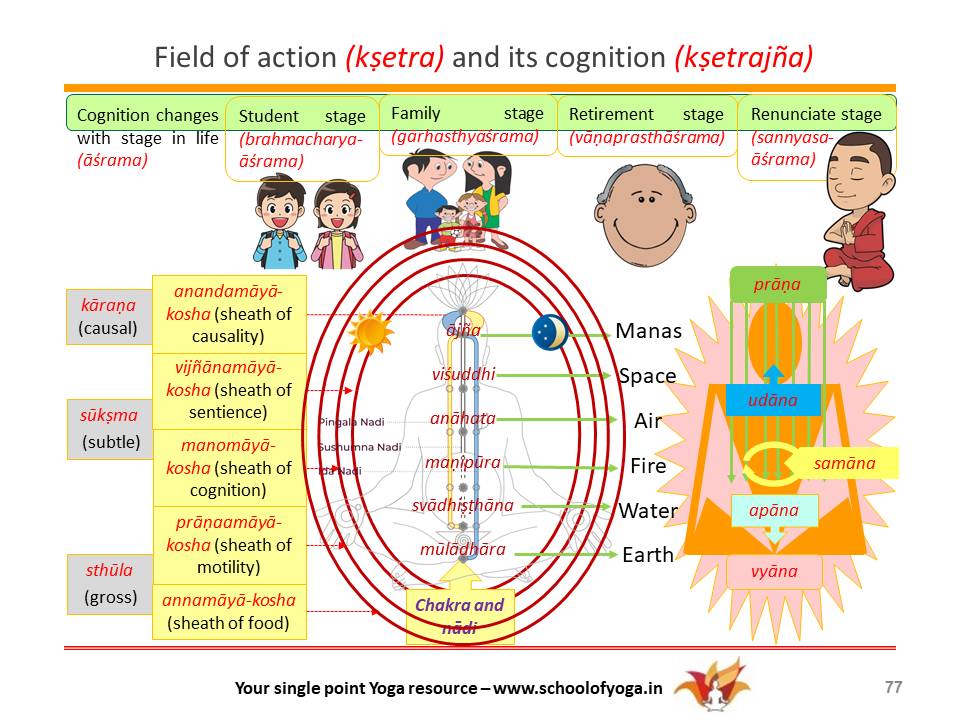
- Gross (sthula) – This covers all aspects that can be cognized by the senses (indriya), cognitive apparatus (manas) and intellect (buddhi).
For example: There are five cardinal elements or panchabhutas that constitute the world and all material. These are – earth (prithvi), water (ap or jal), fire (agni), air (vayu) and space (akasha).
Our sensory system recognizes and senses all of these elements, and decodes them into what they represent, by the cognitive and logical apparatus. So, when we shop for vegetables, we look at the gross aspects of the vegetable – its colour, texture and feel – to ascertain its health through our sensory apparatus. This is the decoding process by our cognitive and logical apparatus.
Within our bodies, this translates to the sheath made by food (annamayakosa) and sheath of prana (pranamayakosa). This is sthula-sarira, or cognition of the gross body, which covers awareness of the material aspect of the human body driven by diet (annamayakosa) and motility (pranamayakosa).
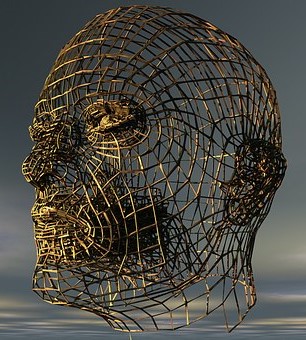
- Subtle (suksma) – The awareness of gross elements is driven by an underlying principle, which is the consciousness (citta).
For example – The body is a complex mechanism. Health is primarily determined by a condition known as homeostasis. So, if your vitals such as blood pressure, temperature, weight, etc., are within a certain range, it implies that you are healthy. But, how does the body maintain everything within homeostasis? That subtle element that controls physical manifestation of normalcy, is the subtle body (suksma-sarira).
This comprises two elements. First is the cognition of sensory stimulus within the body and this is called sheath of cognition (manomayakosa). The second is the awareness of our environment and our own linkages to various external entities that drive our sense of identity (vijnanamayakosa).
For instance, when you read this sentence, the primary information you see, is derived through its physical attributes (sthula-sarira), of alphabets and words that are transmitted through a device. However, your experience of the underlying principles (suksma-sarira) comes from the quality of your awareness as you decipher the information (manomayakosa) relating to the subject and it’s application in the real world (vijnanamayakosa).
- Causal (karana) – this is the state from which all materiality (maya) is caused, the reason materiality exists.
The source and sustaining aspect of existentiality are called Brahman. Also, it is the launch point of experience, and when the yogi merges with it, the movement of consciousness stops (cittavrtti-nirodhah), and the yogi experiences infinite and changeless bliss. This is the sheath of joy (anandamayakosa) in yoga.
For example – we know that Archimedes was bobbing physically (sthula) in a bathtub in a state of null (Brahman) watching the waters sloshing over the tub and his body bobbing. Suddenly, an inspiration occurred (anandamayakosa), and he cracked the problem of buoyancy (suksma). The same applies to Newton sitting under a tree watching the apple fall down or August Kekule imagining the Benzene ring to be a snake chasing its own tail or Watson to discover the ATGC (adenine-thyamine-guanine-cystocine) model of DNA. This is the causal state (karana-sarira).
Cakras – vortices of prana
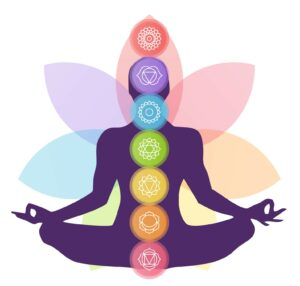
Yoga and other forms of Oriental healing advocate that the rate of energy flow through these centres, affects the behaviour of the person. As a matter of fact, ancient Oriental texts on this subject from India, China, Korea, and Japan, speak of multiple energy vortices (cakra), but all agree that there are six major vortices in the human body that control all major organs.
- Base cakra (muladhara): (mul= base + adhar = foundation or source)
The first of the energy vortices aligns itself with the perineum, a flat region above the coccyx and between the anus and genitals. This centre affects the physiological aspects of the individual, that is, the overall energy levels, feeling of safety and health.
- Self-evolution cakra (svadhisthana): (sva = self + adhisthana = evolved place)
This energy vortex corresponds to the sacral region around the genital area. It affects sexuality, social and communications skills of the individual. Control of this centre results in strong response control and also helps in emotional stability.
- Stomach cakra (manipura): (manipura = navel)
The stomach cakra, placed around the navel, corresponds to the lumbar area of the spine. This is a centre that controls situational as well as management skills.
- Heart cakra (anahata): (ana= not + ahata = touched)
Placed at the centre of the chest, this responds to the thoracic region on the spine. This is also the centre of emotional energy. So, a balanced centre is essential for emotional stability.
- Throat cakra (visuddhi): (visuddhi = extraordinarily pure)
This energy vortex, placed around the Adam’s apple, corresponds to the cervical region in the spine. The thyroid, parathyroid, and also the lymphatic systems, which control metabolic activity, reside here. Since metabolism is the ability of the body to convert food into usable energy and re-building of tissue, seamless energy flow here is critical.
This is also the area which controls breathing and food intake, so any disruption in our stress levels will immediately impact the quality of our breathing and digestion.
- Forehead cakra (ajna): (ajna = that which commands)
The forehead cakra is between the eyebrows in front of the cranium. It controls the functioning of the other energy vortices. It energizes the amygdala, pituitary and endocrine glands etc., and controls both, primary and secondary responses. Consequently, this energy vortex acts as the primary input point for the “fight or flight” stimulus.
The concept of cakra system of Yoga has highly evolved and is popular in therapy practices. Another important aspect is that Yoga recognizes that each of these vortices may be activated, depleted, or congested to varying degrees and that this is an actively changing parameter. This makes the Yoga system subtle and sophisticated.
How can you sense prana?
- One can sense prana as mild pressures over the surface of the entity, though they flow along various intersection points on all objects, known as vortices (cakras). Cakras exist at various points In the human body. However, the main cakras exist along the spine, intersecting three major ‘channels of prana ‘ (nadis).
- The asana practice begins to streamline the prana sheaths (kosas) and vortices (cakras). As a result, prana flow is smooth and not depleted or congested. Consequently, there is rejuvenation of the organs and body. Finally, with the smooth prana flow, stress levels drop, discrimination (vivekam) and dispassion (vairagyam) increase.
Internal Links: Dharma (conditioning), Stress and Situational Awareness. Karma
External Links: Chakra, Pancha Tattva, Pancha Prana, Pancha Kosha, Nadi.
Points to ponder
- Have you experienced changes to your energy levels in times of stress?
- When you are driving any vehicle and wish to cut across traffic, where is the stress most felt most in your body? (It should be along the lower back). Consequently, do you become aware of the energy flow and points of congestion or depletion?
- How does catching a cold affect the energy level and flow?