
What is ardha halāsana (semi-plow pose)?
Ardha halāsana is an āsana where the person lifts the legs to 90 degrees using the abdominal and back muscles, to increase the strength and functioning of the lower back and also the abdomen.
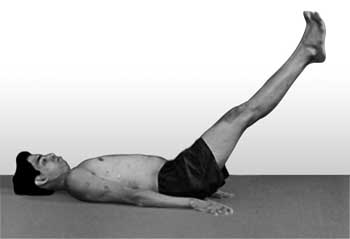
An intermediate position of ardha halāsana, where the legs are raised to 45 degrees, is called uttana-pādāsana.
What is uttana-pādāsana technique?

- Sthithi (starting) position: Lie on the back. Ensure that feet are kept together at the thighs, knees, ankles and feet. Breathe in.
- Next, breathing out, keep legs straight and then lift them up to 45 degrees.
- Hold in place for a few seconds (start with 3 counts and increase to 6).
- Breathing in, slowly bring your legs back to the ground.
- Now, breathe normally. Repeat 3 to 10 times.
- The dṛṣṭi (gaze) recommended is pādayorāgre (toe of the foot gaze).
What is the semi-plow pose technique?
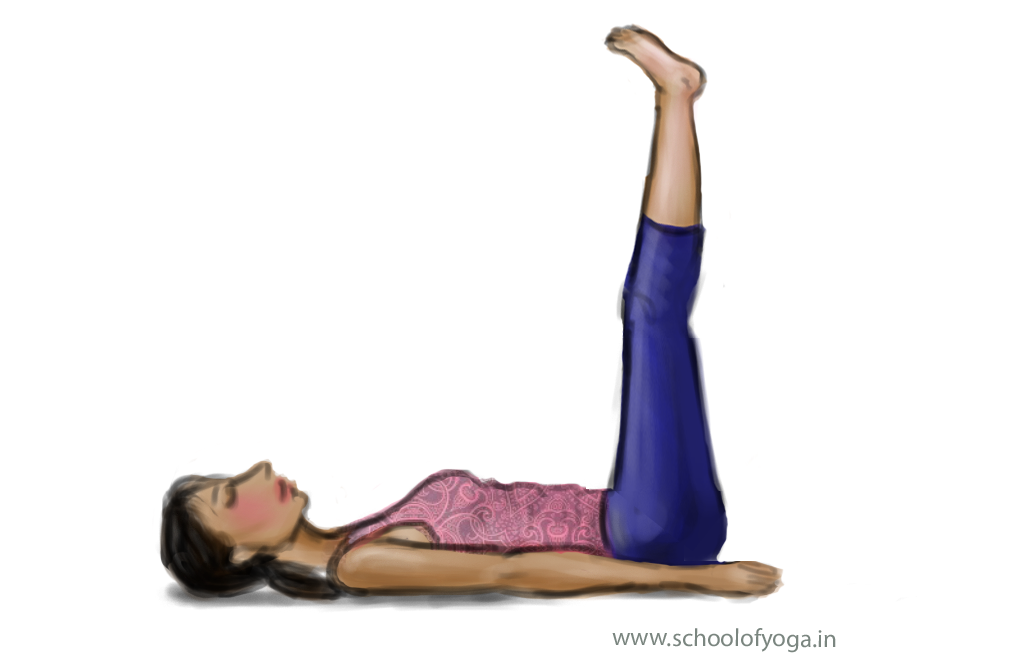
- Perform the uttana-pādāsana, however, raise your legs to 90 degrees instead of 45 degrees.
- Moreover, note that there is no need to hold the legs in position for longer than 1-2 seconds, as that is enough to reach equilibrium.
- Repeat 3 to 10 times.
What are the benefits of practicing ardha halāsana ?

- First, the spinal nerves, nerve roots, and also the sympathetic nerves get toned up. The sacral and lumbar regions are strengthened, and also become become supple and elastic.
- Second, the action of stretching and pulling tones and strengthens the abdominal and lower back muscles.
- In addition to exercising the muscles of the back and abdomen, the action of holding the legs straight and stable, creates intra-abdominal pressure. This results in strengthening of abdominal muscles, and reduction of adipose fat.
- Importantly, the leg lifting action pulls the buttocks together, thus toning up the rectal muscles and sphincter.
- This exercise is good for constipation, obesity and diabetes, besides other abdominal concerns. Additionally, it is very good for maintaining the strength of various muscles in the lower back.
- Importantly, this āsana assists in relieving menstrual disorders.
- Additionally, this āsana prevents hernia.
- During the breathing process, when exhalation occurs, the abdominal walls push the digestive viscera down, setting up peristalsis. Hence, it is a very good āsana for treating constipation and other ailments of the lower digestive tract.
- Finally, performing both uttana-pādāsana and ardha halāsana slowly, brings other benefits such as increased intra-abdominal pressure inducing peristalsis, reduction in adipose tissue and tightening the symmetry of the abdominal viscera.
What are the contraindications for ardha halāsana ?
- If you have any form of back ache, ask a partner to provide passive support at the ankle. However, if the discomfort increases, please stop. Eventually with practice, strength in the back will increase.
- People with cardiac problems, lower back problems and circulatory disorders should perform this exercise very slowly and stop in case of discomfort or pain.
- Those with lumbar (lower back) problems and hernia should avoid this exercise.
- Undoubtedly, this āsana should not be practiced during menstruation or pregnancy.
Some noteworthy points on ardha halāsana :
Internal Links: Dharma (conditioning), Stress and Situational Awareness, Prana, Asana sequence, Asana schedule, Asana Focus or gazing, Pranayama, Hatha Yoga Pradeepika
External Links: Prana, Chakra, Pancha Tattva, Pancha Prana, Pancha Kosha, Nadi,
Keep the knees and ankles together. This ensures symmetry in the movement of the legs and ensures a balanced pressure on the lower back muscles (left and right of the spine).
Keep your knees straight and rigid, to ensure that when raising them, there is pressure on the lower abdominal muscles, inside thigh (gracilis and adductor longus), knee muscles, especially quadriceps and hamstring muscles.
Also, to lose weight around the abdomen, perform the exercise rapidly without allowing the legs to touch the ground. Repeat 6 to 10 times.