Yoga for immunity: The urgent need to combat pollution
Pollution covers all the primordial elements (panchabhuta) – earth, water, fire, air, and space.
In Earth, these manifest as sludge, plastic waste, desertification, landfills, carcinogenic dumping, etc. However, the impact of this is not directly felt by us.
Next, the pollution in water is more direct, as the toxicity in the water directly affects critical organs like the kidneys.
Following this, the impact of fire is also direct and visible as climate change, hotter summers and altered monsoons. To compensate, we use air conditioners, which add to heat pollution.
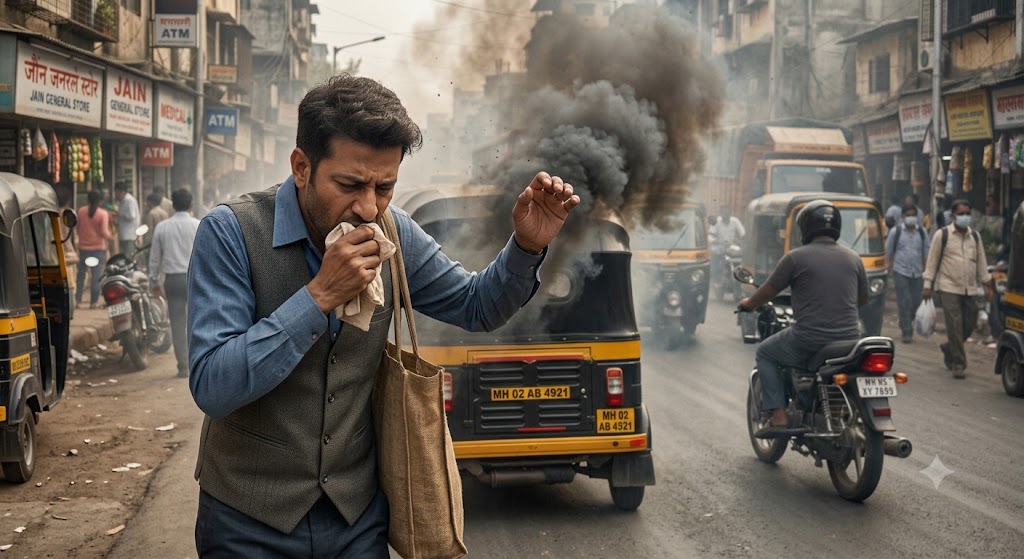
Next, the impact of air pollution is also felt directly. In fact, every one of Bharat’s 1.4 billion people is exposed to this pollution.
Lastly, we have space pollution, which manifests as sound, in the form of noise.
Choosing yoga for immunity: Can yoga help us alleviate the impact of pollution?
The question is what can we do to reduce the impact of pollution? Clearly, the current state of pollution in Bharat makes it difficult for anyone to avoid. So, each of us will be exposed to it in some form or the other. Since the scale of the problem is high, let us narrow the focus to what is in our control.
Yoga can definitely help us cope with the impact of pollution on the body. Practicing yoga for immunity can increase the body’s resistance to pollution. There are certain yoga asanas that ensure special emphasis on the upper respiratory tract, which is impacted by both, water and air quality.
However, yoga alone cannot completely combat the harmful effects of pollution. We need to prepare our body to reap maximum benefits of yoga. Thus, along with learning how to practice yoga for immunity, it is important to maintain discipline in lifestyle factors.
Lifestyle:

In this area, we will focus on simple lifestyle factors and habits that we can control, to improve our immunity levels and overall health:
- Diet – Eat natural. Bharat has been blessed with natural foods. So, avoid processed foods, fried food and sweets. For example, eat whole wheat and avoid refined flour or maida, as it becomes a mash that sticks to the wall of the intestine and reduces digestion capability.
- Weight control – Importantly, the best way to health is to stay within the weight range for our height. This element of yama, called mitahara is critical for good health.
- Sleep – Often, we don’t realize that the conversion of what we eat into work, called metabolism, comprises two parts, anabolism and catabolism. Importantly, this process of rebuilding the body, called catabolism, occurs during sleep. So, when we deny the body sleep, it gets stressed and this results in lower immunity.
- Noise and clutter – Too much social media results in noise, and a lack of routine results in clutter. As a result, there is stress in the cognitive spaces as well as pressure on the sense of self-worth (asmita). Reduce access and control your time spent on social media and adopt a disciplined and regular routine. Being boring is good!!!
Yoga for immunity: Recommended yoga poses and breathing techniques
Asanas:
Now let us look at some simple daily exercise routines that can boost immunity.
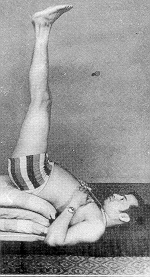
- Sundara Viparita karani – It is often called a lazy person’s asana, but viparita karani has enormous capability to boost immunity. In this asana, the practitioner rests the hips on a pile of pillows, with both legs raised, while keeping the torso at 45 degrees to the floor, and resting the body on the shoulders as shown in the picture.
As a result, blood and lymph flow in an unstressed manner to the kidneys, lungs, heart, shoulders and throat.
This rejuvenates these organs and improves immunity. - Sarvangasana – As the name suggests, this asana is meant to rejuvenate the entire body. Importantly, how does this happen? In sarvangasana, the practitioner lifts the body vertically, while balancing the torso on the shoulders in a neck-lock.
Why is this asana relevant? In the neck-lock, the carotid artery is pinched. This floods the neck area and the brain stem with oxygen-rich blood – especially in the thyroid, parathyroid, and larynx, as well as the aforementioned brain stem. The thyroid and parathyroid ductless endocrine organs are directly responsible for immunity. Additionally, the brain stem controls breathing, sleep, and other motor functions. When these organs get rejuvenated, the resistance to disease increases. - Matsyasana – When one performs viparita karani and sarvangasana, the cervical region is bent forward. However, this has to be normalized. Hence this asana should be practiced after the above mentioned asanas.
Pranayama:
Breathing is critical to life. Additionally, there are two types of pranayama that can increase resistance to disease.
- Nadi shuddhi – Why has this type of pranayama been chosen? Pranayama is the science of regulating the flow of motility (prana) in the body so that the motility channels or nadi operate at maximum efficiency and improve health. Nadi shuddhi achieves the balancing of the nadi, especially the important Sun (ida) and Moon (pingala) nadi. Additionally, when laminar breathing is practiced with holding (kumbhaka), there is reduced stress and equalization of the left and right brain functions. This results in deeper than normal homeostasis, which increases our resistance to infection as well as pollution.
- Bhastrika – This may seem an odd choice, especially when chosen over bhramari. The reason is that bhastrika is an evacuation procedure which increases the volumetric efficiency of the lungs. Since sarvangasana is already practiced, bhastrika adds more value over bhramari.
Mouna (silence):
The last yoga practice that will add enormous value to internal resistance is the practice of silence or mouna. One needs to follow the below rules when practicing silence (mouna).
- Speak only when you can make an impact on the outcome. This makes mouna more restrictive than the proverb “speak only when spoken to”.
- Practice internal silence. When the brain creates images, do not engage with it, instead practice silence.
When silence is practiced, there is deep homeostasis (psychosomatic equilibrium) which calms the HPA system, reduces cortisol and adrenalin in the bloodstream, and increases resistance to diseases.
Some noteworthy points on practicing yoga for immunity:
How long should this practice take?
- Viparita karani – 10 minutes
- Sarvangasana and matsyasana – 6 minutes
- Nadi shuddhi – 10 minutes
- Bhastrika – 3 minutes
Total – 29 minutes to a healthy body.
Is warm up not required?
No, if you have not eaten solid food for 3 hours and not consumed any liquid for 30 minutes before the practice, you start with viparita karani, no warm up is required.