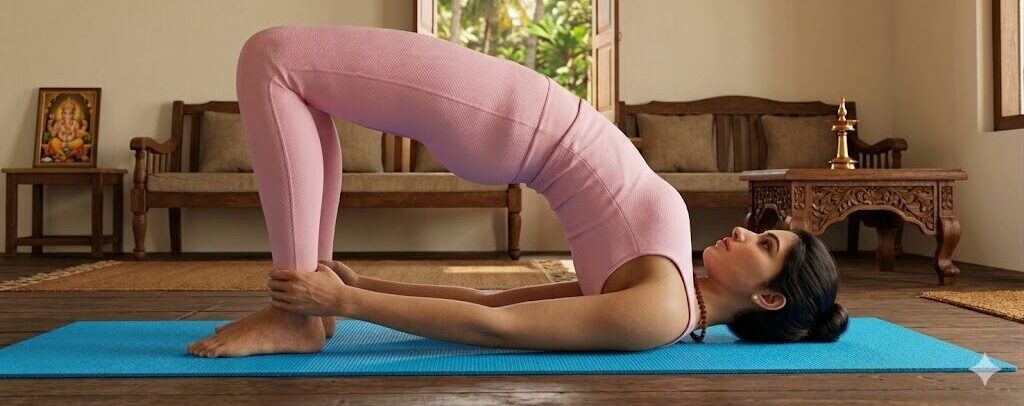
What is setubandhasana (bridge-building pose or bridge pose)?
The setubandhasana (setu = bridge and bandha = lock) is an exercise that involves lifting the hips and arching the back, thus forming a bridge-like shape with your body.
How to do setubandhasana yoga pose ?
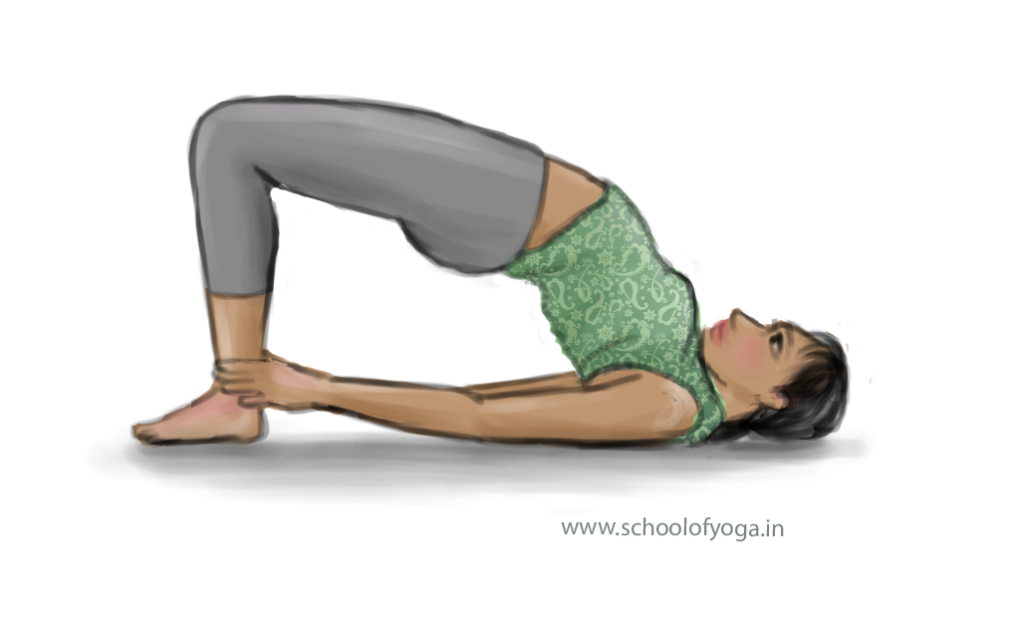
- Sthithi (starting) position: First, lie down on your back. Keep both hands at your sides.
- Next, keeping your legs together, fold them backwards at the knees and bring your feet close to your buttocks.
- Try to hold your ankles with your hands.
- Using the thighs, lower back and shoulders, lever upwards to reverse-stretch the torso without losing grip of the hands on the ankles.
- Importantly, keep the back in even tension.
- Maintain urdhva-drishti or gazing at the ceiling or sky.
- Hold for 10 to 30 counts while maintaining shallow breathing.
- Slowly, release the pressure on the back, straighten up, and bring both your hands to the sides.
- Breathe deeply.
- Performing this asana once is enough.
What are the benefits of setubandhasana ?
- This exercise is excellent for toning the muscles of the lumbar and thoracic areas – that is, the lower and middle back, shoulders, and upper and lower thigh muscles.
- This asana is also excellent for preventing lower back pain, as it tones and strengthens all the muscles in the lumbar region.
- It improves and tones both the sympathetic as well as the parasympathetic nerves.
- This asana helps in stabilising menstrual issues.
What are the contraindications for the bridge pose?
- People with back problems should attempt setubandhasana only after consulting a physician.
- People with lower back problems must perform this asana only under the supervision of a physician.
- Women should not perform this asana during menstruation or pregnancy.
Some noteworthy points on practicing the bridge pose:
Internal Links: Dharma (conditioning), Stress and Situational Awareness, Prana, Asana overview 1, Asana Overview 2, Asana Focus or gazing, Pranayama,
External Links: Prana, Chakra, Pancha Tattva, Pancha Prana, Pancha Kosha, Nadi,
- People with cardiac ailments should do this exercise slowly, because of the aerobic nature of the asana.