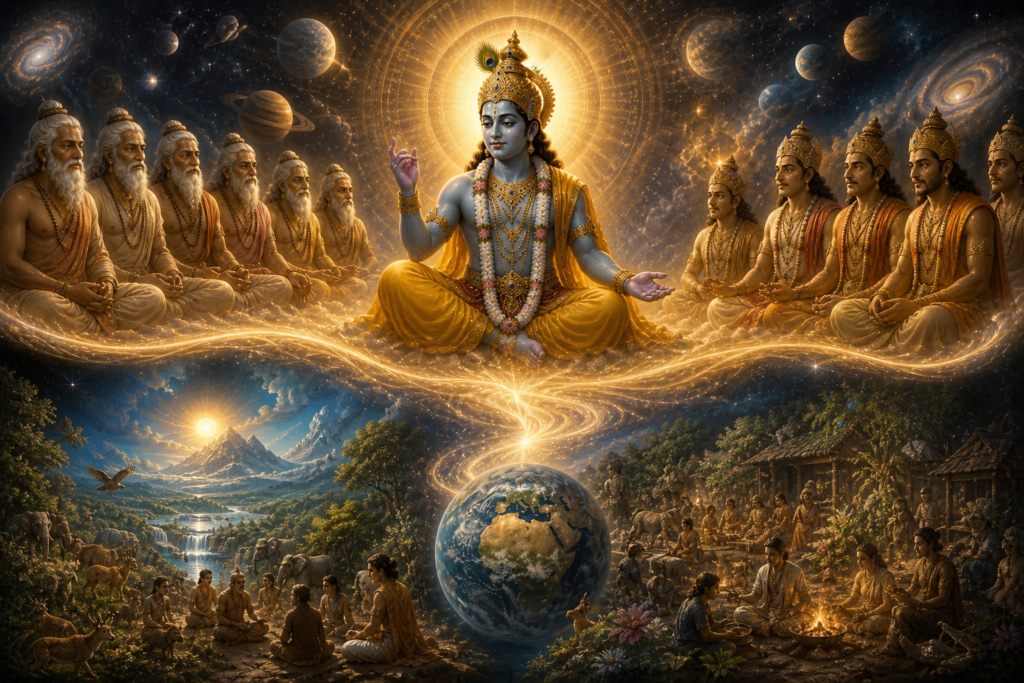
School of Yoga explains Srimad-bhagavad-gita, chapter 11, Hindu Universe.
The sankhya of mahat (the conceptual base of creation of the Hindu Universe).
How was the Hindu Universe formed?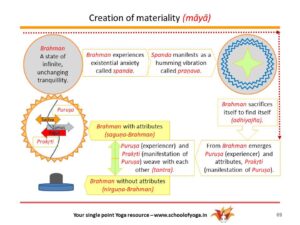
- Everything comes from the Source/ Truth/ Origin or Brahman. This is a state of eternal, infinite, unchanging peace.
- The Brahman experiences existential anxiety (do I exist?) and desires self-expression (I want to see myself).
- Brahman sacrifices itself to create itself. This is primordial sacrifice adiyajna (Shri Krishna).
- From Brahman, nirguna-brahman (Brahman without attributes) and saguna-brahman (Brahman with attributes / Ishvara or the observer and the supreme Soul or Paramatma) emerge.
- Saguna-brahman or Paramatma is the weave of purusa (primordial Identity, Self or experiencer) and prakrti (primordial manifestation or energy). Ishvara is an amsham (part) of Brahman which connect the entity to the Brahman and is completely inert. It is a consciousness and has no attributes.
- Prakriti and purusha weave with each other to create primordial karma (action).
- From karma (action), guna (attributes) emerges. Gunas are an outcome of the weave of purusha and prakriti.
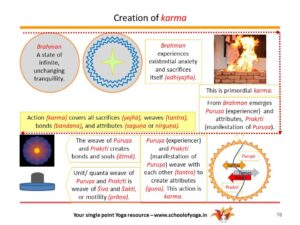 When purusha (experiencer) is ascendant over prakriti (manifestation), it is called tamas (delusion). Similarly, when prakriti is ascendant over purusha, the attribute is called rajas (passion or flow) and finally, when purusha and prakriti are in balance, this is called sattva (harmony or balance).
- Purusha and prakriti continue weaving to create hiranyagarbha (golden egg) or brahmanda (Brahma’s egg or Cosmos) the universe that houses all
- Since karma creates transactions and bonds, these result in creation of multiple identities/ souls (atma) of varying complexities. The primordial Identity, which is the identity of hiranyagarbha is called Viṣṇu. Viṣṇu is the repository of maya (farce).
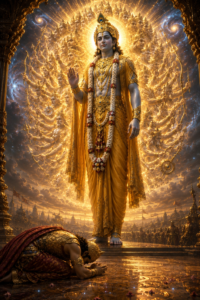
What Arjuna saw was hiranyagarbha. Since, Shri Krishna is adiyajna, this would have been natural and easy. Therefore, the details that Arjuna saw are no surprise, because this is what one would see in brahmanda or hiranyagarbha (golden egg or Cosmos).
School of Yoga explains Srimad-bhagavad-gita, chapter 11, Hindu Universe.
Architecture of the Hindu Universe (brahmanda or hiranyagarbha).
It would be appropriate to detail the various worlds / realms that are supposed to exist in the Hindu Universe system (brahmanda or hiranyagarbha) (reference – https://www.ganeshaspeaks.com/predictions/astrology/14-lokas-of-existence-in-hindu-mythology/) and (http://ancientvoice.wikidot.com/article:the-fourteen-worlds). This also forms part of the brahmanda-purana, vishnu-purana and bhagavad-puran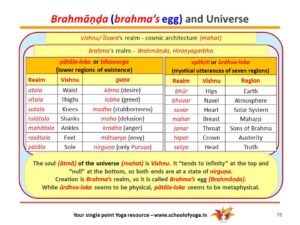 a (2.5).
There are 14 regions of existence or loka of the Hindu Universe, according to nilamata-purana.
Seven are considered vyahritis or urdhvaloka (mystical utterances of the seven regions) and remaining seven are considered patalaloka (lower regions).
The seven vyahritis (mystical regions) of the Hindu Universe are,
- Satya-loka (Region of Truth) – This is the region of Truth, where there is no death.
- Tapah-loka (Region of austerity) – This is the region which comes out of austerity. This region is inhabited by Vaibharaajas and cannot be consumed by fire.
- Jana-loka (jana means people) – This is considered to be the region inhibited by the sons of Brahma such as Sanandana.
- Mahar-loka (region of the maharishis) – This is a region beyond dhruva and the region of the maharishis. This may also mean the Milky Way.
- Suvar-loka (Vishu-purana) – region beyond bhuvar-loka, considered to be beyond the Sun up until dhruva (Pole star) which is supposed to be ruled by Indra and his devas. This may include the entire Solar system. It has 9 orbits (mandala) called dhruva-mandala, shani-mandala (Saturn), brhaspati-mandala (Jupiter), angaraka-mandala (Mars), shukra-mandala (Venus), budha-mandala (Mercury), nakshatra-mandala (Constellation), candra-mandala (Moon), surya-mandala (Sun).
- Bhuvar-loka (region of energy) – This is also known as (dyu-loka or jyotir-loka), this is the region of existence where energy predominates and there is no matter (this may also be equated with the region where earth’s magnetic field exists). Vishnu-purana 7 says that it is the space between Earth and the Sun, where siddhas move.
- Bhur-loka (region of existence) – This is plane of existence of all humans as we know it. It consists of a central land mass (jambudvipa) surrounded by six other land masses called Plaksha, Sālmala, Kusha, Kraunca, Saka, and Pushkara. This area consists of mountains, oceans, rivers etc.
Patalaloka or bila-svarga (lower regions of existence) of the Hindu Universe comprises.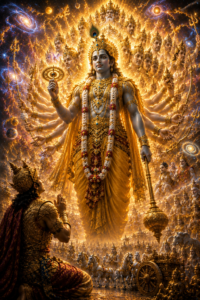
- Atala-loka – Region ruled by Bala, who with his mystical powers has created 3 types of women in a yawn; svairini – self-willed, who like to marry men from their own group, kamini – lustful, who marry men from any group and panchashalis, who keep changing partners.
- Vitala-loka – Region ruled by hara-bhava, where gold called hataka is created
- Sutala-loka – Region created by Vishwakarman, ruled by Bali Chakravarti.
- Talatala-loka – Region ruled by maya, a demon-architect skilled in sorcery, who created the magical city of Tripura.
- Mahatala-loka – Region of the nagas (many hooded serpents), sons of kadru (called krodhavasha), Kuhaka, Takshaka, Kaliya and Sushena along with their families.
- Rasatala-loka – Region at the sole of the feet of Viṣṇu where danavas and daityas reside.
- Patala-loka – Region of Vasuki, who is the snake that adorns Shiva.
School of Yoga explains Srimad-bhagavad-gita, chapter 11, Hindu Universe.
Comments on brahmanda or hiranyagarbha of Hindu Universe.
The etymology of the two Sanskrit words Vishnu and Brahma in the Hindu Universe can be decoded as follows:
- Vishnu (Vis) means that which expands, thus corresponding to an expanding universe or increasing entropy in any system.
- Brahma (Bṛh) means anything that is big or expanded, anda means egg. This corresponds to Brahmanda or Brahma’s-egg.
Decoding the various realms (loka) of the Hindu Universe.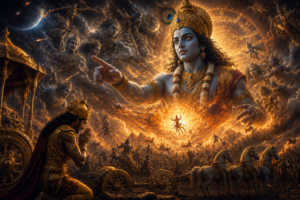
It is clear that the description contains two aspects, a material aspect of the Universe intertwined with a metaphysical aspect of Yoga. While the seven constituents of urdhva-loka are obviously related to the physical and metaphysical Universe in their gross and subtle aspects, patala-loka seems to be more of a reflection of the realm inside ourselves. This can be seen from the allusion to the Shad-ripu (six poisons) that are clearly indicated in the representation of the regions.
The alignment of the patala-lokas to the cakras on the spinal column is an assumption and not substantiated by evidence.
Going from first principles that everything is a weave of purusha (experiencer or primordial Identity) with prakriti (manifestation of Identity), we can close out the first (satya-loka), last (patala-loka) and middle realms (bhur-loka or Earth) of the Hindu Universe as follows,
- Satya-loka is the realm of Truth and equivalent to Brahman, so it is a state of nirguna-brahman, where purusha experiences itself, but does not manifest. It is a state of Truth, infinite peace or pure consciousness where manifestation (prakriti) is in nirguna.
- Patala-loka is at the opposite end of the spectrum. Vasuki is a serpent that is in a state of material rest or pure purusha or null, which means prakriti is in nirguna state here also. This is also a state of nirguna-brahman or pure infinite peace or zero-state-purusha.
- Bhur-loka or Earth is where purusha and prakriti are playing out maya in all its states of consciousness and attributes (guna).
- Importantly, the movement into the urdhva-lokas seems to be one of mix of electromagnetic as well as metaphysical realms, while the patala-loka seems to be intrinsic to the Self.
- In terms of creation, all inhabitants of brahmanda are progeny of brahma, whether they inhabit urdhva-loka or patala-loka, other than the maharishis (seers) who inhibit mahar-loka whose origin seems to be indeterminate, so one has to assume that they come directly from the brahma.
Let us look at the pair or regions on opposite sides of the Earth (bhur-loka) in the Hindu Universe.
Since bhur-loka is the seventh region, there will be one more on the patala-loka side.
-
Bhuvar-loka and atala-loka of the Hindu Universe.
- In bhuvar-loka, which is the Earth’s atmosphere, there is only space. So, purusha experiences reduced consciousness because there is no material transaction. Prakriti manifests predominantly as rajoguna, as magnetic energy where consciousness of purusha is still fixed by its relationship with the Earth. Meanwhile, prakriti has begun shedding tamoguna and is manifesting as rajoguna.
- Similarly, in atala-loka, Identity (purusha) experiences contraction because it is transacting with fewer souls (jiva), while prakriti has become more tamasika.
- This slide of prakriti to tamas can be derived from the allegorical vision that Bala yawns to create three types of women. Yawning is indicative of purusha experiencing lethargy. Also, allusion to sexual preference of women is indicative of restless boredom (tamas) of prakriti and sexual desires (kama) in purusha.
-
Suvar-loka and vitala-loka of the Hindu Universe.
- Suvar-loka is clearly the Solar system. Why is this important?
- Earth has a magnetic field; all creatures on Earth exhibit some form of electrical conductivity.
- Similarly, each of the other planets in the Solar system also have magnetic fields.
- Additionally, planets affect each other’s magnetic fields depending on their orbits, size and inter-planet distance with respect to each other. For example, we know that the Moon influences tides on Earth depending on whether it is waxing or waning. We also know that the Human body comprises 75% water. Imagine the impact a waxing or waning Moon on the Human body due to change in flow of electrolytes. If the Moon can influence us and our reactions, then what about other planets? Does it not stand to reason that large entities such as Sun, Saturn and Jupiter will impact Human state of experience in some form? This is suvar-loka, where experience is created.
- Vitala-loka is where gold is created.
- Gold is prized because it is one of the most stable metals. It does not decay or tarnish and it is classified as a diamagnetic material (one that is not magnetic).
- So, while purusha in suvar-loka experiences increased sattvaguna and reduced rajoguna, in vitala-loka, purusha experiences wealth and greed (lobha), a tamoguna of prakriti.
-
The pairing of mahar-loka and sutala-loka in the Hindu Universe is almost prophetic.
- Mahar-loka is the place where maharishis or Great Seer’s reside. What is the role of these maharishis?
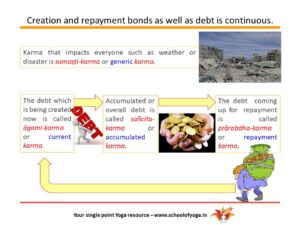
- Let us look at the first principles of action (karma). There are four types of karma,
- agami-karma (karma that which is currently getting created),
- prarabdha-karma (karma that has come up for reconciliation),
- sancita-karma (overall karma available with any entity),
- samasti-karma (karma that affects all creation on account of a macro event such as earthquake, eclipse, cyclone, monsoon, epidemic etc.).
- How is sancita-karma transferred to prarabdha-karma? Obviously, the number of entities that a person interacts with in life are too many for easy reconciliation. Hence, resolution of debt between entities needs to be orchestrated. This is done by entities that have requisite control over prana (creative force) called maharishis at mahar-loka who also manage samasti-karma (macro-action which overrides all individual action).
- Once, the reconciliation parameters of karma are fixed, these are then coded into the movement of the planets in the suvar-loka so that the magnetic and gravitational forces influence decision making on bhu-loka as existence.
- On the patala-loka side, sutala-loka is created by Vishwakarma, a celestial architect and ruled by Bali Chakravarti, a Regent who was just and virtuous. Hence, on the face of it, its position in nether-world does not make sense.
- However, let us look at the transformation of Bali Chakravarti. He conducted a sacrifice (yajna), which was officiated by Śukrācārya (the Guru of asuras and member of mahar-loka because he is the governing principle of Planet Venus). Śukrācārya recognised Vishnu in vamana form and warned Bali, but Bali ignored the warning and ended up sacrificing himself to Vishnu.
- The realm of sutala-loka is one where purusha experiences stubbornness and pride (mada), even to the extent of not being able to cognise the advice of one’s well-wishers. This is a tamoguna of prakriti.
-
Jana-loka and talatala-loka of the Hindu Universe.
- Jana-loka is inhabited by the sons of Brahma (prajapati) and a natural progression of mahar-loka. For the maharishis to rearrange prarabdha-karma and samasti-karma, there must be a higher architectural hierarchy where control of mahar-loka is exerted.
For example, a computer needs a motherboard (jana-loka) on which an operating system (mahar-loka) is loaded so that programmes can be run (bhuvar-loka) for specific situations (bhur-loka).
-
- Jana-loka is a hierarchically the highest level in terms of creation management.
- At the opposite end, talatala-loka is a city created by sorcery.
- Talatala-loka was created by mayasura, a brilliant architect to protect the city of Tripura from destruction.
- The city consisted of three fortresses, all mobile but connected such that they come into confluence only on a particular day.
- On the day of confluence, the city was destroyed by Shiva (tamoguna) using Vāsuki (who lives in patala-loka) as the missile.
- Talatala-loka is the realm where purusha experiences moha (delusion), a tamoguna of prakriti.
-
Tapah-loka and mahatala-loka in the Hindu Universe.
- Tapah is austerity. Austerity comes from sacrifice (yajna).
- Primordial sacrifice (adiyajna) is Shri Krishna. This is the realm from where purusha and prakriti emerge to start creation. It is the starting point of saguṇa-brahman, paramātmā, īśvara, Viṣṇu and Śrī Kṛṣṇa
- On the other side, mahatala is the realm of krodhavasa (power of anger), daughter of Daksha, wife of Kāshyapa and mother of asuras.
- It is inhabited by nagas, who are known for their short temper. This is the realm where purusha experiences anger (krodha), which is a tamoguna of prakriti.
-
Rasatala-loka of the Hindu Universe.
- This is the region where daityas and danavas reside and located at the sole of Vishnu, thus representing the other end of Brahmanda or hiranyagarbha.
- Rasatala means “region of essence”. The root of all shad-ripu (six treacherous qualities) is identification of the Self with the environment. The problems start with comparison of oneself with others which results in envy (matsaryam) which is the root of all other afflictions.
- Interestingly, all the inhabitants in talatala-loka, starting from atala-loka until rasatala-loka, are descendants of Daksha, who was also created by Brahma. So, rasatala-loka represents the other end of jana-loka.
- Talatala-loka – This is the region inhabited by Vasuki who adorns Shiva, and his sister Manasa (cognition). Here purusha is in Shiva or nirguna state, the state of null or pure
Srimad-bhagavad-purana on evolution of the Hindu Universe cosmic architecture (mahat).
- Śrīmad-bhāgavad-purāṇa (2.5.21 onwards) – The evolution of knowledge is minutely explained. It starts with Vishnu creating the universe for its own pleasure (this can also be interpreted as experience of a loss of Identity which made Vishnu manifest to seek confirmation of Identity), the onset of time, karma and svabhava.
- Verse 23-24 – Creation of mahat (concept of cosmic architecture) is achieved by application of attributes (guna). This results in creation of matter (tamas), wisdom or balance (sattva) and work or effort or energy (kriya). There is formation of ahankara (sense of doer-ship), which is another representation of attributes. This occurs in the form of vaikharika (that which is modulated or harmonic) which is a sattvika outcome, taijasa (effulgent or manifesting power and drive) which is rajasika and tamasika (lethargic or delusional) which is manifestation of tamas.
- Verse 25 onwards – ahankara is the origin of the five primordial elements (earth, water, fire, air and ether). Sound also emanates from ahankara and provides evidence of existence to the subject (seer) and object (seen). For example – when someone exclaims “the light has turned green, it signifies a change in state. This is through use of sound (shabda). From ether comes air (whose svabhava or character is sound, vitality, energy, zeal and strength). From air comes fire, with characteristics of quality of colour, sound and touch. From fire came water with added character of taste in addition to sound, touch and colour. From water emerged earth with added character of smell.
- Verse 30 onwards – From the mix of the above elements emerged cognition and the 10 kinetic and cognitive senses. But all this creation just kept growing without any motility in the form of an egg (hiranyagarbha). But, once Brahman gave it life, purusha burst forth from hiranyagarbha and emerged, with seven higher regions above the waist and seven regions below the waist.
- Verse 37 – Brahmins represent the mouth, kshtriyas represent the arms, vaishyas represent the thighs and shudras, the feet. This seems to conform to the traditional occupation of brahmanas being teachers and priests requiring the mouth, kshtriyas being warriors requiring strong arms, vaishyas being business people requiring to travel and shudras being workers represented by the feet.
- Waist upwards – bhuvar-loka is the navel, suvar-loka is the heart, mahar-loka is the breast, jana-loka is the neck, tapo-loka is the crown and satya-loka is the head.
- Earth (bhu-loka) is not specified, but the region between the navel and thigh is the hips. This region houses the genitals and this the pelvic area is the crossover from motivation to movement, thus all the three attributes get located here. Deep and subtle allegory are embedded in these verses.
- Going downwards- atala-loka is the waist, vitala-loka is the thighs, sutala-loka is the knees, talatala-loka is the shanks, mahatala-loka is the ankles, rasatala-loka is the feet and patala-loka is the sole.
School of Yoga explains Srimad-bhagavad-gita, chapter 11, Hindu Universe.
The Soul (atman) and rebirth in the Hindu Universe.
It’s only natural that one should wonder what happens to the Soul (atman) after death. Some aspects that need to be considered are,
- In sanatana-dharma, there is no death. The Soul (atman), moves out of the body once its prarabdha-karma has been exhausted.
- The Soul (atman) remains unchanged through each of these births and the embodiment of the Soul (atman) that has in experiencing this life is called jiva.
- When the person dies, the jiva does not die, but continues experiencing (purusha) and adding karma (action) due to its experiencing of duality (like-dislike, attraction-repulsion, good-bad etc.).
- Physically, respiration stops, the person dies and the jiva leaves the body with prana (motility). The body is disposed and reverts to its primordial elements. The prana in this situation is the udana-vayu (upward flowing motility).
- The jiva in this form is called preta (that which has gone to the other world). At this time, the jiva is disoriented after having lost the body that it was used to and having experienced the brutality of death.
- Para-loka-vidya espouses that the jiva does not wait for reconciliation, but moves to another body immediately. This contradicts the principle espoused by Shri Krishna in Chapter 8, 9 and other chapters, where he says that a person gets what he or she sows, which means that the process of rebirth is a clearly mapped reconciliation process.
- Let us look at the following quote from Chandogya-upanishad – “Having become cloud he rains down. Then he is born as rice, corn, herbs, tree, sesamum and beans. From them the escape is beset with most difficulties. For, whoever the person may be who eats the food and begets offspring, he henceforth becomes like unto them.” (Chāndogya-upaniṣad: 10.5).
- How can reconciliation happen if the jiva moves immediately to another body after expiration? There is simply no opportunity for all the players with whom one has debts (rinn), to be available for prarabdha-karma to be reconciled.
- Another contradiction is the prevalence of other realms (lokas) such as abode of Yama (yama-loka), abode of the ancestors (pitru-loka), brahma-loka, candra-loka in the various puranas such as Naradiya-purana etc. How can these realms exist outside of Vishnu since Shri Krishna says that everything is embedded in the Brahmanḍa. Again, this confusion needs to be resolved.
- Obviously, there is a great deal of confusion and reconciliation required. However, it is entirely possible that the ancient texts are using different terminologies to describe creation and re-creation. Also, it is possible that since the journey of Souls (atman) is a subtle one, one needs greater perception of the subtle aspects of prana to decipher the Truth.